
Tendering in business is a formal procurement process where a buyer invites competing suppliers to submit documented bids, evaluated against predefined criteria. It is the mechanism buyers use when they need to prove fairness, drive competition, and select the supplier who delivers the best overall outcome — not just the lowest price. The Chartered Institute of Procurement & Supply (CIPS) is explicit on this: modern procurement seeks the "most advantageous" tender, where capability, compliance, and service levels commonly outweigh headline cost.
Three elements define every tender:
- Competition: Multiple suppliers bid on identical terms, preventing favoritism.
- Transparency: Evaluation criteria and weightings (often a 60/40 or 70/30 quality-to-price split) are disclosed upfront, per NSW Government evaluation guidance.
- Best-fit selection: The winning bid satisfies the buyer's full requirement — quality, risk, and delivery — not just cost.
For Australian businesses preparing to bid, understanding the tendering definition is step one. Knowing how to win is where coaching makes the difference.
Table of Contents
- When does tendering make sense for your procurement?
- What are the four main types of tendering methods?
- How does the tendering process work? Seven stages explained
- What documents does a compliant Australian bid require?
- How are bids evaluated and scored?
- Should you bid? A practical bid/no-bid decision framework
- Common mistakes that cause bids to fail in Australia
- Tender readiness checklist: 30, 60, and 90 days out
- How business coaching improves your tender win rate
- Key Takeaways
- The part most businesses get wrong about tendering
- Championbusinesscoaching gets Australian businesses tender-ready
- Useful sources for Australian businesses
When does tendering make sense for your procurement?
Tendering suits situations where the stakes are high enough to justify the process overhead. Public sector contracts, large capital projects, supplier panel arrangements, and high-value or high-risk purchases are the natural home for formal tenders. Australian government agencies are often legally required to tender above certain thresholds, and probity obligations make open competition non-negotiable in those contexts.
Not every purchase warrants a tender, though. Small, time-critical buys, existing long-term supplier relationships with proven performance, and specialist engagements where only one or two credible suppliers exist are all cases where a negotiated approach is faster and cheaper for both parties. A construction firm replacing a broken pump on a live site does not run a tender. A local council procuring a three-year facilities management contract does.
The practical test: if the contract value, risk profile, or public accountability requirement is significant, tender. If speed and relationship continuity matter more than competitive pricing, negotiate directly.
What are the four main types of tendering methods?
Four primary types cover most procurement situations Australian businesses encounter.
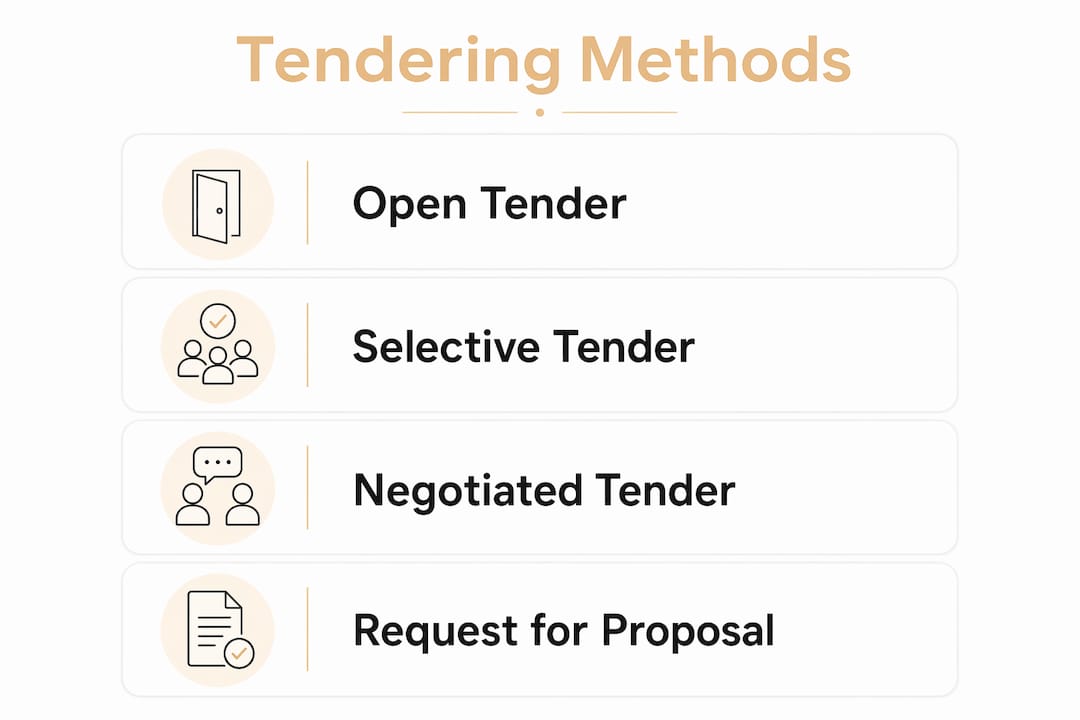
Open tender is publicly advertised — any supplier can respond. Government agencies use it most often because it maximizes competition and satisfies probity requirements. Expect high submission volumes and rigorous evaluation panels.
Selective tender limits the field to prequalified or invited suppliers. Buyers use it when they already know the capable market and want to reduce evaluation workload. For suppliers, receiving an invitation is itself a signal of standing.

Negotiated tender skips competitive advertising entirely. The buyer approaches one or two suppliers directly — typically for specialist work, urgent needs, or where an incumbent has unique knowledge. Two-stage tendering is a variant common in construction: stage one involves early contractor involvement and design collaboration; stage two locks in a final price once scope is defined.
Requests for Proposal (RFPs) shift the focus from price to solution. RFPs ask suppliers to propose methodologies, not just quote a number — standard practice for IT, consulting, and complex service procurements. If your business sells expertise rather than widgets, you will encounter RFPs regularly.
How does the tendering process work? Seven stages explained
The business tendering process follows a consistent seven-stage structure regardless of sector.
- Needs assessment and preparation. The buyer defines scope, budget, and evaluation criteria. Suppliers use this window to monitor tender portals (AusTender, ProcurePoint, local government sites) and qualify opportunities before committing resources.
- Invitation and advertising. The buyer publishes a tender notice with associated documents: the Invitation to Tender (ITT), specifications, and evaluation methodology. Bid periods for government contracts typically run several weeks, often around one to two months.
- Submission and bidding. Suppliers prepare and lodge responses by the stated deadline. Late submissions are almost universally rejected without exception.
- Bid clarification. Buyers may issue clarification questions (RFIs) to all bidders or request specific information from shortlisted suppliers. Responses become part of the formal record.
- Evaluation. A panel scores submissions against weighted criteria. Price, technical capability, methodology, experience, and delivery are the standard dimensions.
- Selection and contract award. The buyer notifies the preferred supplier and, in public procurement, publishes a contract award notice. Unsuccessful bidders can request a debrief.
- Contract management. Performance is measured against the agreed SLAs and KPIs. Strong contract management protects both parties and builds the track record needed for future bids.
What documents does a compliant Australian bid require?
| Document | Purpose | Common Buyer Check |
|---|---|---|
| Invitation to Tender (ITT) | Sets scope, criteria, and rules | Read in full before drafting |
| Formal proposal / response | Your substantive bid | Mapped to each criterion |
| Selection Questionnaire (SQ) | Eligibility and compliance gate | Insurance, financials, referees |
| Insurance certificates | Public liability, PI, workers' comp | Current, correct coverage levels |
| Financial statements | Demonstrates financial viability | Audited or accountant-certified |
| Referee contacts | Verifies past performance claims | Contactable, briefed, relevant |
| Methodology and resourcing plan | Shows how you will deliver | Specific, not generic |
Selection Questionnaires are the gatekeepers. Suppliers who cannot produce compliant insurance certificates, audited accounts, and verifiable referees on demand are eliminated before a single evaluator reads their proposal.
Pro Tip: Build a pre-verified "bid-ready folder" containing current insurance certificates, your last two years of financial statements, three referee contacts with signed consent, and your standard capability statement. Update it quarterly. When a tender drops with a four-week window, you will spend that time writing — not chasing paperwork.
How are bids evaluated and scored?
Evaluation panels convert evidence into scores using a weighted matrix. A typical structure looks like this:
| Criterion | Weight | Score Bands |
|---|---|---|
| Price / commercial | 30–40% | Scored against lowest compliant bid |
| Technical capability | 25–30% | Evidence mapped to specification |
| Methodology | 20–25% | Clarity, feasibility, innovation |
| Relevant experience | 15% | Recency, scale, similarity |
| Delivery / risk management | 5% | Mitigation plans, contingencies |
The "most advantageous" tender concept means a supplier quoting 15% above the cheapest bid can still win if their technical and methodology scores are strong enough. CIPS guidance reinforces this: capability and SLAs commonly outweigh headline price in well-run procurement. Buyers who select purely on cost tend to pay for it later in variations, delays, and poor service delivery.
Should you bid? A practical bid/no-bid decision framework
Walking away from a poor-fit tender can be as valuable as winning the right one. Bid resources are finite; spending them on a low-probability opportunity means missing a high-fit one.
Run this checklist before committing:
- Strategic fit: Does this contract align with your target market, service capability, and growth direction?
- Win probability: Have you worked with this buyer before? Do you have relevant, verifiable experience at this scale?
- Margin potential: After bid costs, delivery costs, and risk contingency, does the contract generate acceptable margin?
- Capacity: Can you resource the bid AND deliver the contract without compromising existing clients?
- Incumbent risk: Is there a strong incumbent? If yes, what is your genuine point of difference?
Score each factor 1–5. A total below 15 out of 25 is a strong signal to pass. Pursuing marginal bids burns time, erodes team morale, and produces thin win rates. Focusing on high-fit opportunities — where your experience, relationships, and capability genuinely match the buyer's need — is where strategic bid decisions pay off financially.
Common mistakes that cause bids to fail in Australia
Australia-specific compliance risks compound this. Probity requirements in public procurement mean any perception of unfair advantage, undisclosed conflicts of interest, or inconsistent pricing between sections can disqualify an otherwise strong bid. Missing a mandatory criterion — even a minor one — is typically grounds for automatic rejection.
Practical mitigation steps: read the ITT twice before writing a word, create a compliance checklist from the mandatory criteria, verify all referee contacts before submission, and have someone outside the bid team review the final response for internal consistency.
Tender readiness checklist: 30, 60, and 90 days out
- Day 1–30: Audit your evidence library. Identify gaps in case studies, certifications, financial documents, and insurance. Brief your referees. Assign a bid coordinator role.
- Day 31–60: Draft and refine your capability statement. Build a pricing model that reflects true delivery costs plus margin, aligned to the likely evaluation weighting (if quality is weighted at 70%, under-investing in your technical response to save on price is a losing strategy). For small businesses preparing to tender, this is also the stage to decide whether to engage a bid writer or coach.
- Day 61–90: Monitor relevant portals daily. When a target tender drops, run the bid/no-bid checklist immediately. If you proceed, storyboard your response to each criterion before writing a single sentence — storyboarding evidence to evaluation criteria is where most winning tenders are shaped. Allow at least three days for internal review and one day for final compliance checks before submission.
Resourcing reality: a compliant response to a mid-sized government tender typically requires 40–80 hours of skilled effort. Budget for that, or budget for a coach or bid writer to close the gap.
How business coaching improves your tender win rate
Coaching interventions that move the needle on tender success are specific, not generic. A bid/no-bid facilitation session with a coach typically takes two hours and produces a scored decision framework the team can reuse. Storyboard-based response planning maps your strongest evidence to each evaluation criterion before drafting begins — the approach Tenderplus Consulting identifies as the primary driver of coherent, high-scoring submissions.
Pricing support is another high-value intervention. Many businesses either undercut to win (eroding margin) or overprice out of caution (losing on commercial score). A coach with financial modeling capability helps you price to the evaluation weighting, not to gut feel.
Championbusinesscoaching works with Australian businesses across service-based sectors and trades to build the operational foundations that make tenders winnable: documented processes, verifiable outcomes, and a clear value proposition. The 90-day coaching guarantee means you see measurable progress or the session is free — a meaningful commitment when you are investing in bid capability ahead of a major contract opportunity. Championbusinesscoaching holds a 5-star rating on Google.
Key Takeaways
Tendering in business is a formal, criteria-driven process where preparation quality and evidence mapping determine outcomes far more than price alone.
| Point | Details |
|---|---|
| Tendering definition | A formal procurement process where buyers invite competing suppliers to bid against predefined criteria. |
| Evaluation priorities | Quality-to-price splits of 60/40 or 70/30 are common; the most advantageous bid wins, not the cheapest. |
| Bid/no-bid discipline | Score each opportunity against strategic fit, margin, capacity, and win probability before committing resources. |
| Readiness timeline | A 30/60/90-day preparation cycle covering evidence, pricing, and storyboarding gives compliant, competitive submissions. |
| Coaching support | Championbusinesscoaching offers bid/no-bid facilitation, storyboard planning, and pricing support backed by a 90-day guarantee. |
The part most businesses get wrong about tendering
Most articles on tendering focus on the writing. The writing is the last 20% of the work. What actually separates winning bids from losing ones is the planning that happens before anyone opens a document.
Businesses that treat tendering as a writing exercise consistently produce generic responses. They describe what they do rather than proving they can do it for this buyer, at this scale, with this level of risk. Evaluators notice immediately. The score reflects it.
The discipline of storyboarding — sitting down with your team and mapping your strongest, most verifiable evidence to each evaluation criterion before drafting — forces you to confront the gaps. Sometimes you discover you do not have a relevant case study at the required scale. Better to know that in week one of a four-week bid window than in the final 48 hours.
The other underrated skill is the bid/no-bid decision. Businesses that win consistently are selective. They protect their bid resources for opportunities where their experience, relationships, and capability genuinely match what the buyer needs. Chasing every tender that looks interesting is a fast path to a low win rate and an exhausted team.
Championbusinesscoaching gets Australian businesses tender-ready
Winning tenders requires more than good writing. It requires documented processes, verifiable outcomes, a pricing model that holds up under scrutiny, and the discipline to walk away from the wrong opportunities. That is exactly what Championbusinesscoaching builds with clients across Australia.

Whether you are preparing your first government bid or rebuilding your approach after a string of losses, Championbusinesscoaching's coaching plans cover bid/no-bid facilitation, storyboard-based response planning, pricing support, and submission quality review. The 90-day coaching guarantee means results are the standard, not the exception. Rated 5 stars on Google by Australian business owners who have been through the process.
Book a consultation and find out where your tender readiness stands before the next opportunity lands.
Useful sources for Australian businesses
- CIPS — Tender Process and Evaluation Guidance: The global procurement standard-setter's guidance on evaluation methodology, most advantageous tender principles, and scoring best practice.
- NSW Government — Evaluation Criteria Guidance: Practical buyer-side guidance on how criteria and weightings are set in Australian public procurement.
- AusTender: The Australian Government's central tender portal — the primary source for Commonwealth contract opportunities and published award notices.
- SA Government Industry Advocate — Bid/No-Bid Analysis: A practical framework for assessing whether to pursue a tender, developed specifically for Australian SMEs.
- Thornton & Lowe — Selection Questionnaire Completion Guide: Step-by-step guidance on completing SQs, including the compliance and financial evidence buyers require.
- Tenderplus Consulting — Storyboarding for Tender Planning: An Australia-based resource explaining how to map evidence to evaluation criteria before drafting begins.