Pick the goal first, pick one focused agenda format, run two or three targeted activities, and lock in a 30-day follow-up. That combination, more than any clever icebreaker, is what produces measurable change. Tuckman's stages of team development tell you which activities fit your team's current state, a tool like the Team Canvas gives you a baseline to measure against, and a 30/90-day review cadence turns a good afternoon into an actual shift in how the team operates.
TL;DR:
- Focus on a single, clear goal and follow it with two targeted activities to maximize measurable change within 30 days.
- Use pre-work and scheduled follow-ups, including a 30-day check, to ensure commitments are tracked and accountability is maintained.
- Remote and hybrid teams require structured roles, shared visual tools, and written instructions to facilitate engagement and inclusivity.
- Short, focused workshops with follow-up outproduce longer sessions that lack follow-through, emphasizing the importance of concrete commitments.
- External facilitation is recommended for difficult topics, especially when the manager is not neutral or when specific techniques are needed to ensure results.
Table of Contents
- Quick Pick: Matching Formats to Common Workshop Goals
- Ready-to-Run Activities Grouped by Purpose and Timebox
- Building Your Agenda: Three Copyable Templates
- Facilitation Best Practices and the Mistakes That Sink a Session
- Running the Same Ideas With Remote and Hybrid Teams
- Measuring What Changed: Diagnostics and the Follow-Up Cadence
- How Champion Business Coaching Runs Outcome-Focused Team Workshops
- A Facilitator's Honest Take on What Actually Works
- Get Guaranteed Follow-Through With Championbusinesscoaching
- Templates and Tools Worth Bookmarking
- Sources
Quick Pick: Matching Formats to Common Workshop Goals
Most managers waste planning time browsing giant activity lists before they've even named the goal. Flip that order. Name the outcome you need, then let the format follow.
Here's a fast lookup for the five goals that come up most often:
- Onboarding a new team or new members: Half-day format, 6 to 10 people, built around a "roles and expectations" mapping activity. Send a one-question pre-work prompt: "What's one thing you wish someone had told you in your first week here?"
- Realigning after a reorg or strategy shift: 90-minute session, any group size, anchored by a values-to-behaviors translation exercise. Pre-work: a five-minute pulse survey on where people feel unclear.
- Solving a specific, stuck problem: 60-minute sprint, 4 to 8 people (bigger groups slow decision-making), using a structured prioritization activity. Pre-work: each person submits one root cause in writing before the room.
- Rebuilding morale or connection after a hard stretch: 60 to 90 minutes, whole team, mixing a trust exercise with an energizer. No heavy pre-work here. Forcing reflection before people feel safe backfires.
- Kicking off a new project or quarter: Full-day or half-day offsite, whole team, combining vision-setting with concrete task assignment. Pre-work: a shared doc where people list open questions in advance.
The common thread across all five: the workshop itself is only half the job. High-performing teams build trust through consistent, repeated practices, not a single big event, which is exactly why the follow-up step below matters as much as the session you're planning right now.
Pro Tip: If you're not sure which goal is real, ask your team directly with a two-question pre-work form before you book a room. What people actually say they need is usually narrower than what you assumed.
Ready-to-Run Activities Grouped by Purpose and Timebox
This is the working catalog. Each activity below lists the goal, the time it needs, what to bring, and how to run it, plus a note on adapting it when half your team is remote.
1. Two Truths and a Lie, Reframed
Goal: Icebreaker that surfaces something real, not just trivia. Timebox: 5 to 10 minutes. Materials: none.
Ask each person to share two true things and one false thing about a recent work challenge, not their personal life ("I once shipped a bug that took down the site for four hours" hits differently than "I once climbed a mountain"). The group guesses the lie. This works because strong, specific prompts do more to equalize voice than a generic "introduce yourself" round. Virtual adaptation: Use the chat for guesses so quieter voices participate without interrupting.
2. The One-Word Check-In
Goal: Quick emotional temperature check. Timebox: 5 minutes. Materials: none.
Go around and ask each person for one word describing how they're arriving today, no explanation required unless they want to add one. Skip judgment entirely. This isn't about fixing moods in the moment. It's about making the room's actual state visible before you ask people to do harder work. Virtual adaptation: Drop words into a shared chat simultaneously rather than one at a time, so no one anchors on the first answer.
3. Rose, Thorn, Bud
Goal: Structured check-in that surfaces wins, friction, and opportunities. Timebox: 10 to 15 minutes. Materials: sticky notes or a shared digital board.
Each person names one win (rose), one struggle (thorn), and one thing they're hopeful about (bud) from the past week or sprint. Capture themes on a board as people talk. Virtual adaptation: Use three columns on a shared board like Miro or Google Jamboard; have people type simultaneously, then read out loud in clusters rather than one by one, which keeps a 12-person remote group from taking 40 minutes.
4. 1-2-4-All
Goal: Problem-solving and prioritization with full participation. Timebox: 20 to 30 minutes. Materials: timer, sticky notes or a shared doc.
This is a Liberating Structures format: each person thinks alone for two minutes, pairs up for four minutes, groups of four for six minutes, then the whole room for eight minutes of shared-out. It's built specifically so quieter voices contribute and parallel small groups produce usable output instead of the loudest three people dominating a 12-person room. Virtual adaptation: Use breakout rooms for the pairs and quads, and assign one person per breakout to type notes into a shared doc so nothing gets lost when rooms close.
5. Troika Consulting
Goal: Peer problem-solving for a specific, real issue someone is stuck on. Timebox: 30 to 45 minutes for a group of 9 (trios rotating). Materials: timer.
Groups of three. One person presents a real problem for five minutes, the other two ask clarifying questions, then give advice for ten minutes while the presenter just listens and takes notes, no defending or explaining. Rotate roles. Virtual adaptation: Works cleanly in breakout rooms of three; assign a timekeeper role in each trio since you can't monitor all rooms at once.
6. Impact/Effort Prioritization Grid
Goal: Decide what to actually do next when everyone has opinions. Timebox: 30 to 40 minutes. Materials: whiteboard or shared board with a four-quadrant grid.
List every idea on sticky notes, then have the group place each one on a grid: high impact/low effort in one corner, low impact/high effort in the opposite. Attack the high-impact, low-effort quadrant first. Virtual adaptation: A shared Miro board with drag-and-drop stickies works better here than a verbal discussion. Give people five silent minutes to place notes before anyone talks, so the loudest opinion doesn't set the grid before others weigh in.
7. Values-to-Behaviors Translation
Goal: Vision and values alignment that produces something concrete. Timebox: 45 to 60 minutes. Materials: printed or digital list of stated company/team values.
Take your team's stated values ("collaboration," "ownership") and ask small groups to translate each one into three specific behaviors they'd actually notice in a coworker. Vague values like "we value collaboration" mean nothing until someone writes "responds to Slack questions within two hours" underneath them. This is the exact mechanism behind converting abstract values into behavioral agreements with named owners, which is what separates a workshop that changes behavior from one that just felt nice. Virtual adaptation: Assign each value to a separate breakout room, then reconvene and have each group present their translated behaviors to the full team.
8. The Team Canvas
Goal: Full alignment session covering purpose, goals, roles, and working agreements. Timebox: 60 to 90 minutes. Materials: printed Team Canvas template or digital board.
Walk the team through a structured canvas covering shared purpose, individual strengths, goals, values, rules of engagement, and needs. It's slower than a single activity but produces a document you actually keep and revisit. Virtual adaptation: Pre-fill the canvas template on a shared board before the call and have people add sticky notes live rather than trying to draw it from scratch on a video call.
9. Trust Fall, Rebuilt for Adults
Goal: Trust-building without the cheesy physical version. Timebox: 30 to 45 minutes. Materials: none, maybe a talking object.
Skip the literal trust fall. Instead, ask each person to share one time they needed help at work and were afraid to ask for it. Then ask the group: what would make it easier to ask next time? This surfaces real barriers to trust instead of manufacturing a fake vulnerability moment. Virtual adaptation: This one actually works better remote for shy groups, since there's less eye contact pressure. Keep video on, but let people look at their notes while talking.
10. The Appreciation Round
Goal: Closer that ends on connection instead of a checklist. Timebox: 10 to 15 minutes. Materials: none.
Each person names one specific thing a colleague did recently that they appreciated. Specific beats generic ("you covered my shift Tuesday when my kid was sick" lands harder than "you're a great teammate"). Virtual adaptation: Type appreciations into the chat simultaneously at the end so everyone gets a screenshot to keep.
Mini-Activities for Under 10 Minutes
When you only have a sliver of meeting time, these still count as real workshop moments. Short, focused five-minute activities paired with clear deliverables can be just as effective as longer sessions when the group is small and the ask is specific.
- The 60-Second Standup Plus One: Each person gives their normal status update, plus one thing blocking them. Five minutes, any group size.
- Would You Rather, Work Edition: "Would you rather have zero meetings or zero email for a month?" Silly, but it gets quiet people talking fast. Five minutes.
- Name One Thing to Stop Doing: Round-robin, one sentence each. Surprisingly effective at surfacing process friction. Eight minutes.
Pro Tip: Never run more than three activities in a single session. Teams don't remember volume, they remember whether the room felt honest and whether anything changed afterward.
Building Your Agenda: Three Copyable Templates
A workshop without a written agenda drifts, and drift is what kills the follow-up step everyone skips. Effective sessions follow a clear arc: open with safety and context, explore the real tensions or ideas, then close with named owners and deadlines. Skip the close and the whole session evaporates by Thursday.
Here are three ready structures, scaled by time available.
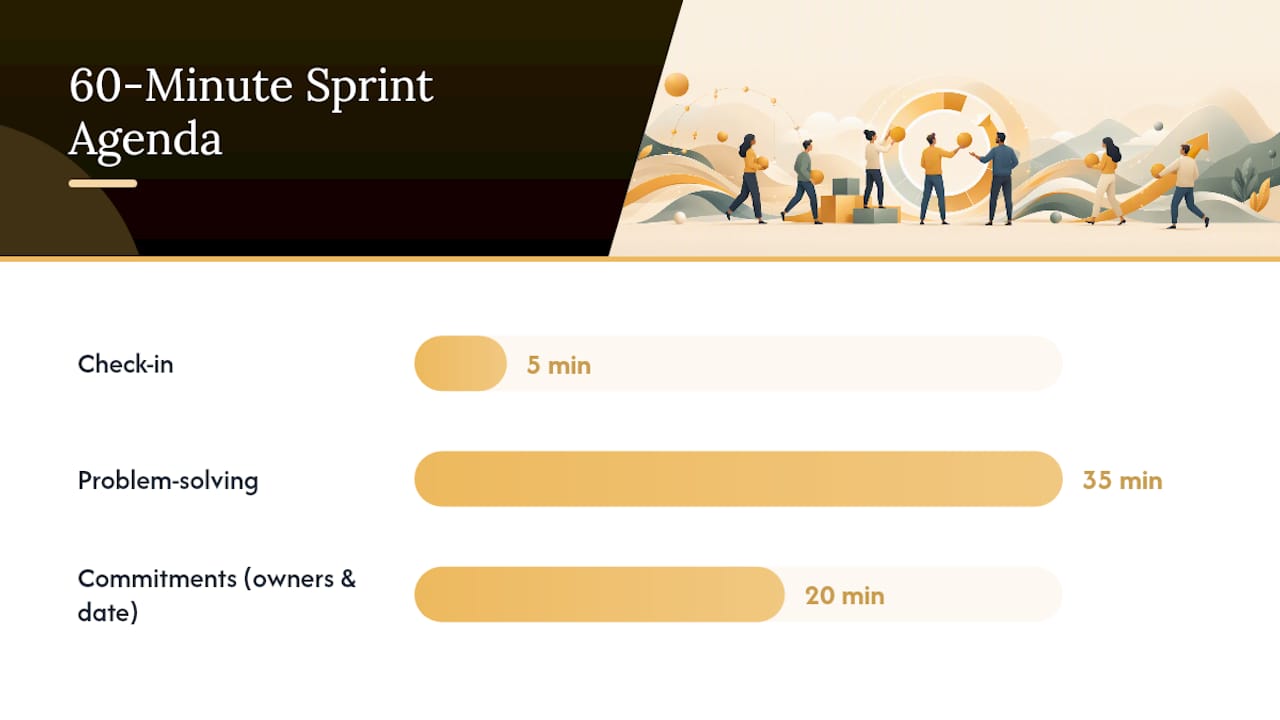
The 60-Minute Sprint works for a single stuck decision. Open with a five-minute check-in, spend 35 minutes on one problem-solving activity like Troika Consulting or the Impact/Effort Grid, then spend the last 20 minutes converting the output into one written commitment with a named owner and a date.
The Half-Day Session (roughly 3 to 4 hours) suits alignment or onboarding goals. Start with a diagnostic, either a Team Canvas walkthrough or a pulse-survey debrief, move into 90 minutes of working activities like the Values-to-Behaviors translation, then close with 45 minutes of synthesis where the group writes down what changes starting Monday.
The Full-Day Offsite is for quarterly kickoffs or major resets. The energy flow matters more here than in shorter formats. Open heavy (vision-setting, hard conversations) in the morning when energy is highest, use lighter connection activities right after lunch when everyone's sluggish, and close the day with concrete task assignment rather than another reflective exercise. A structure like WorkshopBank's parallel breakout model is a useful reference for running several topic-specific breakouts at once inside a longer offsite.
| Time Block | Purpose | Facilitator Role |
|---|---|---|
| First 15–20 min | Check-in and framing the day's goal | Sets tone, states the one outcome the day must produce |
| Mid-morning (60–90 min) | Core working activity (problem-solving or alignment) | Runs the activity, keeps time, stays out of the content |
| Post-lunch (30–45 min) | Energizer or connection activity | Lightens the room, no notetaking needed |
| Final 45–60 min | Synthesis and commitments | Captures owners and dates on a visible document |
In every template, one person facilitates and a different person captures commitments in writing. Asking the facilitator to also take notes is how good discussions turn into agreements nobody remembers making.
Facilitation Best Practices and the Mistakes That Sink a Session
The opening five minutes decide whether people actually engage or just perform engagement. A real check-in question, not "how's everyone doing," creates enough psychological safety that the harder conversation later in the session actually lands. Setting one ground rule out loud, something like "we critique ideas, not people," costs you thirty seconds and saves you from the one meeting where feedback turns personal.
Debriefing well is a skill most managers skip entirely, jumping straight from an activity to "great, moving on." Instead, ask three questions after any substantive activity: What did we notice? What does that tell us? What are we going to do differently because of it? Write the third answer down with a name and a date attached. That third question is the one that separates a workshop from a nice afternoon.
Three pitfalls show up constantly, and each has a specific fix.
- Vague commitments ("we'll communicate better") produce zero change. Fix: force every commitment into the format "[Name] will [specific action] by [date]."
- Pacing that runs long on discussion and short on synthesis leaves no time for the close. Fix: set a visible timer for the discussion portion and protect the last 20% of the agenda no matter what.
- No scheduled follow-up means the workshop's energy dies within a week. Fix: book the 30-day review meeting before anyone leaves the room, not after.
If a session is heading toward real conflict rather than productive friction, that's a different skill set than standard facilitation. Structured coaching support for difficult workplace conversations can help a manager prepare for that moment instead of winging it.
Pro Tip: Assign someone other than yourself to watch the clock. Facilitators who also timekeep almost always let discussion run over, because they're too invested in the conversation to cut it off.
Running the Same Ideas With Remote and Hybrid Teams
Every activity above works remotely with the right setup, but hybrid sessions need more structure than fully in-person ones, not less, because half the room's non-verbal cues disappear the moment someone's on a screen.
Before the session, confirm your tech stack covers three things: a shared visual board (Miro, Mural, or even a shared Google Doc), a reliable breakout room feature, and a visible shared timer everyone can see. Assign three roles beyond the main facilitator: a tech monitor who handles breakout assignments and screen-share hiccups, a timekeeper, and a "remote voice" watcher whose only job is noticing when someone on screen has been quiet for too long and inviting them in directly.
A few inclusion rules keep hybrid sessions from tilting toward whoever's in the physical room:
- Never let in-room side conversations happen while remote participants wait silently; mute the room or address it out loud.
- Rotate who speaks first between remote and in-person participants each time you switch activities.
- Put every instruction in writing on the shared screen, not just spoken aloud, since audio quality varies more than people admit.
- For any activity longer than 15 minutes, use breakout rooms rather than one long call, even if some breakout members are sitting in the same physical room.
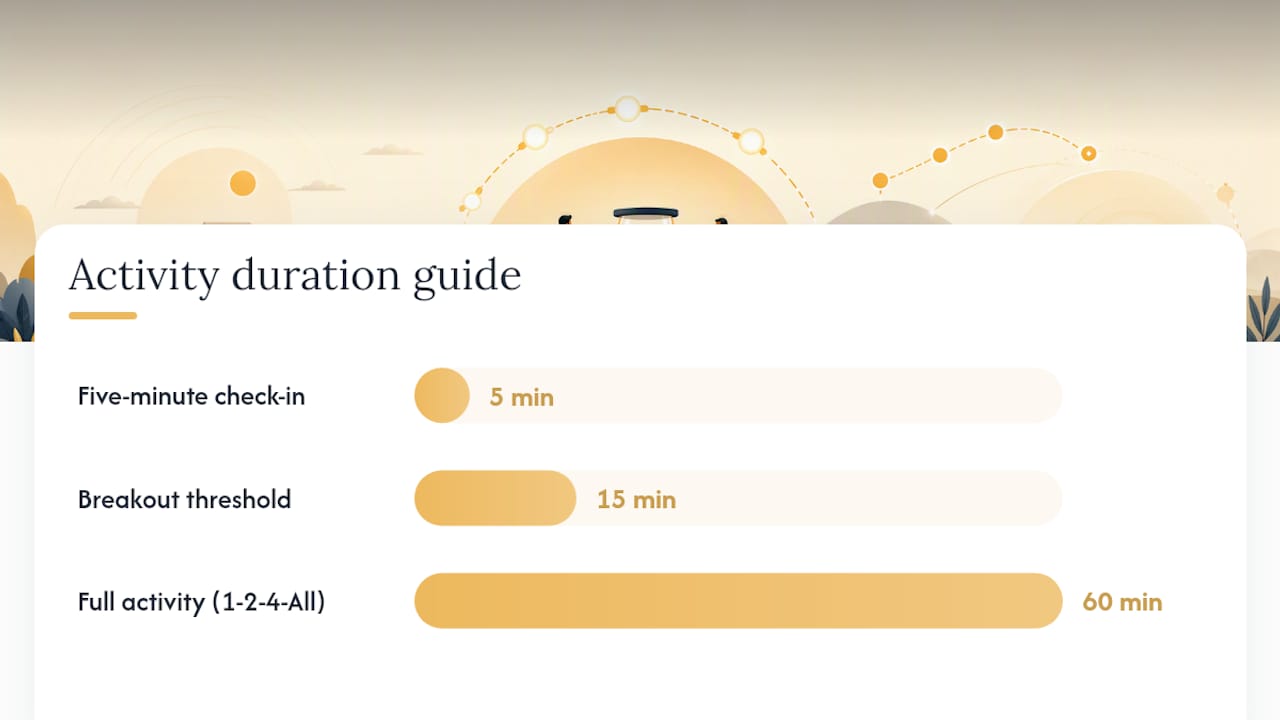
For a five-minute check-in, drop the one-word answers into a shared chat instead of going around verbally, which keeps a 20-person hybrid call from eating 20 minutes on hellos alone. For a full 60-minute activity like 1-2-4-All, the pair and small-group stages translate directly into breakout rooms. Just assign one notetaker per breakout so the shared document fills in even when you can't personally monitor every room.
Measuring What Changed: Diagnostics and the Follow-Up Cadence
A workshop with no baseline is a workshop you can't prove worked. Run a short pre-workshop diagnostic, either a Team Canvas exercise or a three-to-five question pulse survey, before you even set the agenda. Short pre-work dramatically improves how relevant and focused the actual session turns out to be, because you're solving a problem people already named instead of guessing at one.
Coming out of the session, pick two or three measurable commitments, not twelve. Vague goals don't survive contact with a normal workweek. Then schedule two follow-ups on the calendar before anyone leaves the room: a 30-day check to see if commitments actually happened, and a 90-day review to see if behavior actually shifted, not just whether the task got done once.
Sample pulse questions for the 30-day check:
- Did the specific commitment from the workshop actually happen? Yes, partially, or no.
- What got in the way, if anything did?
- Has anything changed day-to-day because of the workshop, even something small?
Report outcomes back to the whole team, not just leadership. This is the step that gets skipped most often, and it's the reason the same complaints resurface every six months. Diagnostics like Atlassian's Team Health Monitor can standardize this measurement so you're comparing the same metrics workshop over workshop instead of reinventing the survey every time.
How Champion Business Coaching Runs Outcome-Focused Team Workshops
Team workshops build around the principle that a session only counts if something measurably changes afterward. Coaching engagements pair a facilitated workshop with a structured follow-up cadence, sometimes backed by a coaching guarantee promising results within a set window or the coaching session is free. Coaching slots can be kept limited by design to ensure sessions stay small and specific rather than generic.
Teams get more out of hiring an outside facilitator when the topic involves real tension (a reorg, a leadership transition, unresolved conflict between departments) or when the manager running the session is also a stakeholder in the outcome and can't stay neutral. Internal facilitation works fine for routine check-ins and low-stakes alignment sessions.
A quick readiness checklist before deciding whether to hire external help:
- Is the topic something the manager can be neutral about, or are they too close to it?
- Does the team need a specific facilitation technique (like AI-assisted planning tools) that nobody internally has run before?
- Has an internal attempt at this exact topic already stalled once?
If two or more of those apply, bringing in a facilitator, rather than running it internally, tends to produce a cleaner outcome.
A Facilitator's Honest Take on What Actually Works
The counterintuitive finding buried in most of the research on this topic: shorter workshops with guaranteed follow-up consistently beat long, ambitious offsites with no follow-up plan. A 60-minute session with a scheduled 30-day check-in changes more behavior than an all-day retreat that ends with everyone feeling good and nothing written down. Length feels productive. Follow-through is what's actually productive.
Most managers over-invest in the activity and under-invest in the close. That's backwards. The activity generates the raw material. The close, the specific commitment with a name and date attached, is what turns that material into change.
Before your next session, run this five-step check:
- Name one goal, not three.
- Pick a pre-work question that surfaces the real issue.
- Choose two activities max.
- Write the debrief questions before the session, not during it.
- Book the 30-day follow-up before anyone leaves the room.
— Duncan
Get Guaranteed Follow-Through With Championbusinesscoaching
Running a workshop is the easy part. Making sure the commitments made in that room actually survive the next quarter is where most managers get stuck, and it's exactly the gap Championbusinesscoaching is built to close. Instead of a one-off session that fades within weeks, coaching engagements include structured follow-up built into the plan itself, backed by a 90-day guarantee: if the agreed outcomes aren't showing up, the coaching session is free.
Championbusinesscoaching keeps its coaching slots limited on purpose, so every engagement gets real attention instead of being just one client among hundreds. That model suits teams who've tried the DIY workshop route once already and watched the momentum die within a month. If you're planning a session around a strategy shift, a hiring push, or a stuck operational problem, a structured coaching plan can layer a facilitated workshop directly into an ongoing plan with built-in 30- and 90-day reviews. Start by looking at business coaching options and book a discovery call to talk through your specific goal before you lock in a date.
Templates and Tools Worth Bookmarking
The Team Canvas and UC Berkeley's team-building toolkit both give you a structured diagnostic for baseline alignment work. Workshop Weaver's facilitation guide covers activity structures and the arc-based agenda approach referenced throughout this piece, while its offsite agenda breakdown walks through pre-work diagnostics and follow-up cadence in more detail. For the research behind why trust-building matters at all, Harvard Business Review's piece on high-performing teams is worth the ten-minute read. For deeper reading on delegation and turning workshop commitments into ongoing operational habits, Championbusinesscoaching's delegation framework is a useful next stop.
Sources
- Team building workshop activities and facilitation guide — Workshop Weaver
- Team Building Toolkit (UC Berkeley HR)
- How high-performing teams build trust — Harvard Business Review
- 30 Five-Minute Team-Building Activities — Bryant University