
What systemisation actually means for your business
Systemisation is the practice of turning recurring business tasks into documented, repeatable procedures that anyone on your team can follow, without needing to ask the owner every five minutes. It replaces the "it's all in my head" approach with structured workflows that run consistently whether you're in the office or on holiday.
For Australian small and medium businesses, this matters more than most owners realize. When your operations depend entirely on one person's knowledge or habits, you're one resignation, one illness, or one bad week away from serious disruption. Systemisation removes that fragility.
Here's what it covers in practice:
- Documented workflows for every repeatable task, from quoting to onboarding to invoicing
- Standardized procedures that reduce errors and deliver consistent customer experiences
- Clear role definitions so staff know exactly what they own and when
- Process checkpoints that make performance visible and measurable
- Automation triggers that handle routine tasks without human intervention
The goal isn't bureaucracy. It's building a business that runs on process, not personality.
Table of Contents
- Why Australian SMEs gain so much from getting this right
- Common problems Australian businesses face that systems actually fix
- How to implement business systemisation step by step
- Australian SMEs that got systemisation right
- How Championbusinesscoaching helps Australian SMEs build lasting systems
- How do you know if your systems are actually working?
- Key Takeaways
- Championbusinesscoaching gives you systems that actually stick
Why Australian SMEs gain so much from getting this right
The benefits of business process optimization compound quickly once you start. The first thing most business owners notice is time: hours previously spent firefighting get redirected to actual growth work.
Beyond that, the gains show up across the whole operation:
- Fewer errors and rework because every task follows a defined path, not whoever's memory is sharpest that day
- Consistent customer experience regardless of which team member handles the job
- Reduced "bus factor" risk — the bus factor describes how many people your business can afford to lose before operations collapse; systemisation keeps that number low
- Scalability without chaos because new staff can be trained against documented processes rather than tribal knowledge
- Compliance support through built-in checkpoints that catch issues before they become fines or complaints
- Time and cost savings from workflow automation handling repetitive tasks that previously ate hours of paid labor
A trades business that systemises its quoting, scheduling, and follow-up process can handle significantly more job volume with the same headcount. That's not an exaggeration — it's what happens when process replaces improvisation.
Common problems Australian businesses face that systems actually fix
Most Australian SME owners don't describe their problem as "lack of systemisation." They describe it as stress, inconsistency, staff confusion, or the feeling that nothing runs properly without them. Those symptoms have a common cause.
- Informal processes mean every team member does the same task differently, producing wildly inconsistent results
- Unclear roles create overlap, gaps, and the classic "I thought you were doing that" moment
- Owner dependency keeps the business small by design — you can't grow what only you can run
- Ad-hoc methods make scaling nearly impossible because there's nothing to replicate
- Communication bottlenecks slow decisions and frustrate staff who can't get answers fast enough
- No visibility into performance means you're managing by gut feel rather than data, which makes improvement guesswork
Each of these is a systems problem with a systems solution. The chaos isn't inevitable — it's just undocumented.
How to implement business systemisation step by step
Getting this right takes a deliberate sequence. Jumping straight to software or automation before your processes are clean is one of the most common and costly mistakes Australian SMEs make.
-
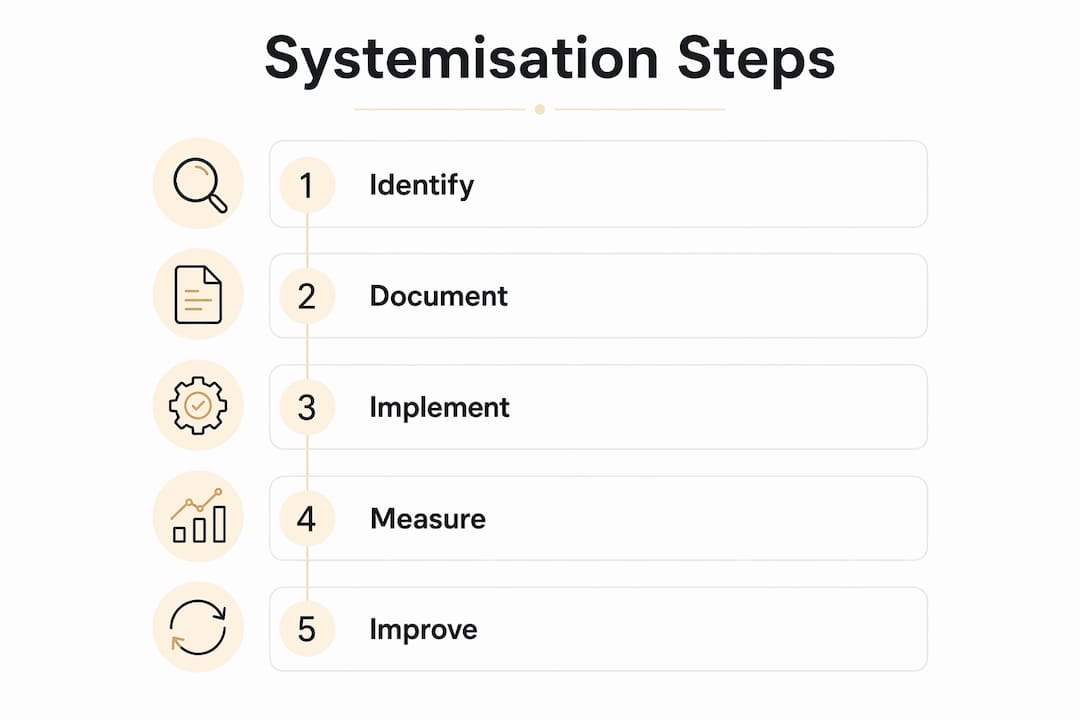
Map your existing workflows first. Walk through every major repeatable task in the business and document what actually happens, not what's supposed to happen. Use a simple flowchart or even a written checklist to start.
-
Identify your highest-impact processes. Not everything needs a system on day one. Focus on the tasks that happen most frequently, cause the most errors, or consume the most owner time.
-
Simplify before you standardize. Remove unnecessary steps, eliminate redundant approvals, and cut anything that doesn't add value. Automating a broken process just makes the breakage faster.
-
Document clearly and concisely. Write procedures in plain language. If a new hire couldn't follow it on their first week, rewrite it. Video walkthroughs work well for complex tasks.
-
Introduce automation tools that fit your scale. Workflow automation platforms like Zapier and Microsoft Power Automate connect your existing apps and handle repetitive tasks without custom code. Make (formerly Integromat) offers visual automation for more complex multi-step workflows and integrates with over 3,000 apps.
-
Train your team and manage the transition. New systems fail when staff don't understand why the change is happening. Explain the benefit to them personally, not just to the business. Run the new process alongside the old one briefly to build confidence.
-
Monitor, measure, and refine continuously. The DMAIC framework — Define, Measure, Analyze, Improve, Control — gives you a repeatable cycle for keeping systems sharp as the business evolves. Build in a quarterly review so processes don't drift back to informal habits.
Pro Tip: Start your documentation with the processes that consume the most of your own time. If you're the one constantly answering the same questions or fixing the same problems, that's your highest-priority system to build first.
Avoid the trap of trying to document everything at once. Businesses that attempt a full systems overhaul in one sprint almost always stall. Pick three to five core processes, get those working well, then expand.

Australian SMEs that got systemisation right
The proof is in what happens after the work is done. Across Australia, businesses in trades, construction, family operations, and service industries have used structured systemisation approaches — including the SYSTEMology methodology developed by Australian entrepreneur David Jenyns — to fundamentally change how they operate.
SYSTEMology case studies from Australian SMEs show a consistent pattern:
- A family-owned construction business reduced owner working hours significantly after documenting its project management and subcontractor coordination processes, allowing the owner to step back from day-to-day site management
- A trades contracting firm improved job margins by standardizing its quoting and scheduling workflows, cutting the time between quote and booking by days
- A service business eliminated its onboarding bottleneck by building a documented client intake process, reducing the owner's involvement in new client setup from hours to minutes
The common thread: before systemisation, the owner was the system. After, the business had its own operating logic.
This shift also has a direct impact on business valuation. A business with documented, repeatable systems is worth considerably more to a buyer than one where the owner's departure would cause operational collapse.
How Championbusinesscoaching helps Australian SMEs build lasting systems
Championbusinesscoaching works directly with Australian business owners to move from operational chaos to structured, scalable systems. The coaching is hands-on and specific to your business, not a generic framework dropped into your inbox.
What sets the approach apart:
- Personalized coaching that maps your actual workflows, not a theoretical model
- AI-powered business tools including cash flow forecasting, position description generators, and staff management resources that support the systemisation process directly
- 90-day coaching guarantee — if you don't see results, your session is free; that's a level of accountability most advisory relationships don't offer
- Limited client slots to maintain coaching quality, which means the guidance you receive is genuinely tailored
- 5-star Google rating reflecting consistent client outcomes across trades, service businesses, NDIS providers, and more
- Specialist knowledge across verticals including mortgage brokers, bookkeepers, food and beverage, and construction
The coaching programs cover strategic planning, hiring, compliance, and profitability alongside operational systems, so the work connects to your broader business goals rather than sitting in isolation.
Pro Tip: Before your first coaching session, write down the three tasks you personally handle that you wish someone else could do. Those are your first three systems to build.
For businesses that want to go deeper on continuous improvement cycles and how top Australian consultants apply them, Championbusinesscoaching's resources cover the full DMAIC approach in practical terms.
Strategic consulting support is also available through partners like Solano Advisory Group, which focuses on systemisation as a value driver for B2B businesses.
How do you know if your systems are actually working?
Building systems is one thing. Knowing whether they're delivering is another. Measurement is what separates a business that improves from one that just documents.

Start with a small set of process-level metrics tied to the workflows you've systemised. For a client onboarding process, that might be time from first contact to signed agreement. For a production workflow, it could be error rate or rework hours per week. The specific metric matters less than the consistency of tracking it.
Process optimization frameworks recommend building a dashboard that gives you real-time visibility into how key workflows are performing. This doesn't require expensive software — a shared spreadsheet updated weekly can serve the same function for a small team.
Review your metrics on a set schedule: weekly for operational indicators, monthly for trend analysis, quarterly for a full process audit. When a metric moves in the wrong direction, treat it as a signal to revisit the underlying process, not to blame the person executing it. Systems fail before people do.
The other measure worth tracking is owner involvement. If you're still the one resolving the same issues six months after systemising a process, the system isn't working. That's the most honest performance indicator of all.
Key Takeaways
Systemisation works when it's built on documented, repeatable processes that reduce owner dependency and create measurable, consistent outcomes across the business.
| Point | Details |
|---|---|
| Start with high-impact processes | Document the tasks that consume the most owner time or cause the most errors before anything else. |
| Simplify before automating | Automating a broken process scales the problem; fix the workflow first, then add automation. |
| Use DMAIC for continuous improvement | The Define, Measure, Analyze, Improve, Control cycle keeps systems sharp as your business grows. |
| Measure owner involvement | If you're still resolving the same issues months later, the system needs rebuilding, not the person. |
| Championbusinesscoaching | Provides personalized systemisation coaching for Australian SMEs with a 90-day results guarantee and AI-powered business tools. |
Championbusinesscoaching gives you systems that actually stick
Most Australian business owners know they need better systems. The gap is between knowing and building. Championbusinesscoaching closes that gap with structured, one-on-one coaching that takes your specific business from reactive to repeatable.
The 90-day guarantee means you're not paying for advice that sits in a folder. You're paying for outcomes: documented processes, reduced owner dependency, and a business that can grow without you being the bottleneck. Coaching covers the full picture — operations, hiring, compliance, profitability, and the AI tools that make small business coaching faster and more effective than it used to be.
Slots are limited by design. If you're ready to build a business that runs on process rather than personality, book a consultation with Championbusinesscoaching and find out what's possible in 90 days.