
Run a 30 to 45 minute stay interview with your best performers and any role you'd struggle to replace this quarter. A stay interview is a structured, one-on-one conversation designed to find out what keeps someone at your company and what might quietly be pushing them toward the exit. The payoff is early warning: you find out about a flight risk while there's still time to fix it, not two weeks after the resignation letter lands.
TL;DR:
- Managers should run stay interviews twice a year for high-risk roles and focus on trust, transparency, and active listening to gather honest employee feedback.
- Group feedback themes and assign specific, measurable actions with owners and deadlines to ensure meaningful follow-through and organizational improvements.
- Training managers in active listening and probing skills is crucial, as these competencies prevent the process from becoming superficial or guarded.
- Conducting regular stay interviews, separate from performance reviews, gives employees a safe space to share concerns that can be addressed proactively.
- External coaching can help turn stay interview insights into actionable changes, preventing feedback from stalling and ensuring tangible retention results.
Table of Contents
- What Are Stay Interview Questions, and Why Does Trust Matter?
- What Benefits Do Stay Interviews Bring to Retention and Engagement?
- Stay Interviews vs. Exit Interviews vs. Regular One-on-Ones
- How to Conduct a Stay Interview: A Step-by-Step Guide
- A Stay Interview Question Bank Organized by Theme
- How to Turn Stay Interview Feedback Into Retention Action
- Common Mistakes That Undermine Stay Interviews
- Templates: Script, Question Set, and Follow-Up Log
- Key Takeaways for HR Leaders
- Why Coaching Often Determines Whether Stay Interview Insights Stick
- Turning Stay Interview Insights Into Measurable Retention Gains
- Sources
What Are Stay Interview Questions, and Why Does Trust Matter?
A stay interview is a proactive conversation between a manager and a current employee, built around one purpose: understanding why someone stays and what would make them leave. It's distinct from an exit interview in one critical way. You're asking these questions while the person is still on your team and still has a reason to answer honestly, because their answer might actually change something.
The mechanics are simple. You sit down, one-on-one, with a set of open questions, and you listen. The psychology is not simple at all. Employees only give real answers when they trust that honesty won't cost them anything. If someone worries that admitting they're bored, undervalued, or annoyed with their manager will show up in their next performance review, they'll give you the polished, safe version instead.
That's why the format matters as much as the questions. A stay interview run by someone the employee doesn't trust, in a room that feels like a disciplinary meeting, produces useless data. The two goals worth keeping in front of you: figure out what's working so you can protect it, and figure out what's cracking so you can patch it before someone updates their LinkedIn.
What Benefits Do Stay Interviews Bring to Retention and Engagement?
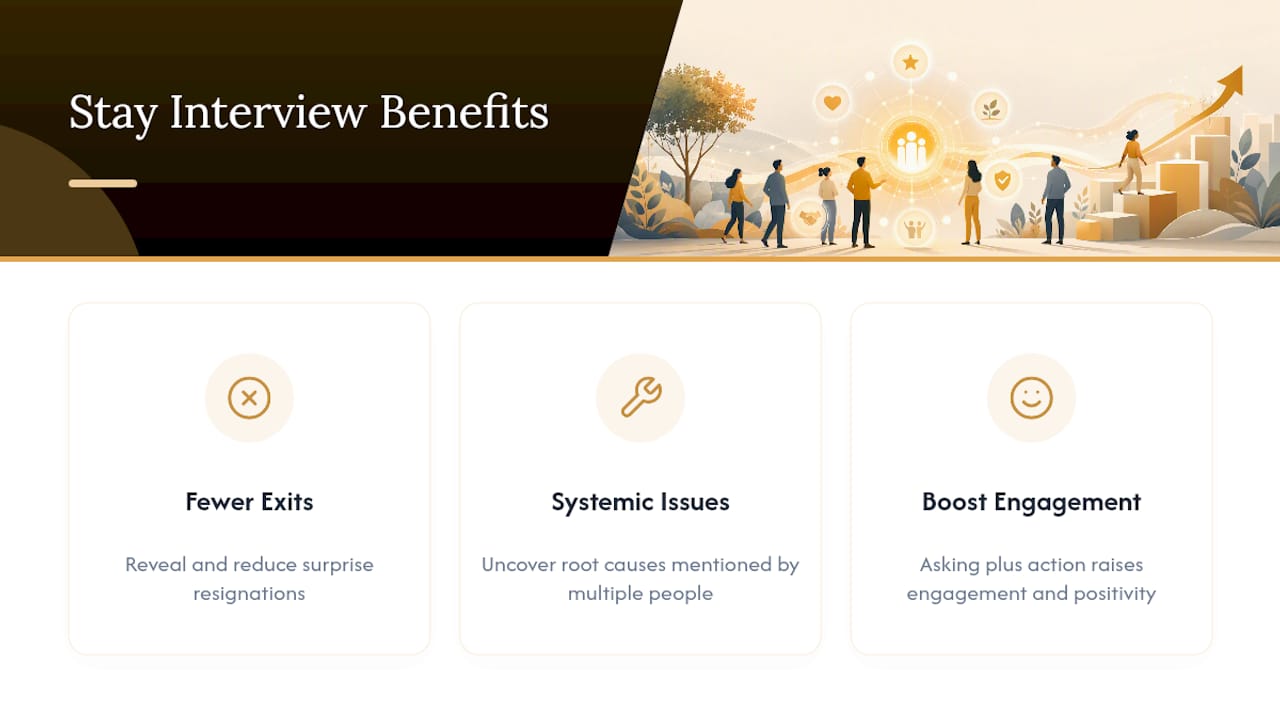
The most direct return is fewer surprise resignations. Coverage citing Gallup's research on voluntary departures found that a large share of employees who leave say their manager or company could have done something to prevent it. Stay interviews are how you find out what that "something" is before the person has already mentally checked out.
They're also a diagnostic tool for problems bigger than any one employee. If three people on the same team independently mention that approvals take too long or that a specific manager shuts down feedback, that's not a coincidence. That's a systemic issue you can now fix at the root instead of losing one person at a time and never connecting the dots.
There's a quieter benefit too: the act of asking changes how people feel about their job. Employees who get asked what they need, and then see action follow, tend to disengage less and speak more positively about the company, inside the building and out. Skip the interviews entirely and you only ever hear from employees when they're already halfway out the door, which is the worst possible time to learn anything useful.
Stay Interviews vs. Exit Interviews vs. Regular One-on-Ones
An exit interview tells you why someone already left. A stay interview questions employees while you still have room to act, which is the entire point. One gives you a postmortem; the other gives you a warning shot with time to respond.
Resist the temptation to fold a stay interview into a performance review. Combining the two teaches employees to filter their answers, because anything they say might affect their rating or their raise. Keep stay interviews separate, low-stakes, and clearly framed as "how can we make this job work better for you," not "how are you performing."
Regular one-on-ones and stay interviews aren't competing formats. You can and should drop stay-interview style questions into routine one-on-ones for a lower-pressure version of the same insight. But for roles you can't afford to lose, schedule a dedicated stay interview so the topic gets full attention instead of getting squeezed into the last five minutes of a status update.
How to Conduct a Stay Interview: A Step-by-Step Guide
Who runs it matters. The direct manager usually gets more candid, specific answers because they know the day-to-day friction points, but HR should run the interview instead when trust between manager and employee is shaky, or when the manager themselves might be part of the problem being discussed.
Timing counts almost as much as the questions. Don't wait for an annual cycle. Run stay interviews for high-value and flight-risk roles once or twice a year, and consider a lighter check-in for everyone else. New hires around the 90-day mark and long-tenured employees approaching a natural transition point (a promotion cycle, a return from leave) are both worth a dedicated session.
Here's a practical sequence for running one well:
- Schedule it like it matters. Send a calendar invite with a plain-language subject line ("Quick chat about how things are going") so nobody thinks it's disciplinary.
- Pick a neutral, private setting. A closed office, a walk outside, or a video call with cameras off if that eases tension. Avoid the manager's own office if it reads as a power dynamic.
- Block 30 to 45 minutes. Enough time to get past the polite answers without turning into a marathon session.
- Open by stating the purpose. Tell the employee this is about keeping their job good, not evaluating their performance.
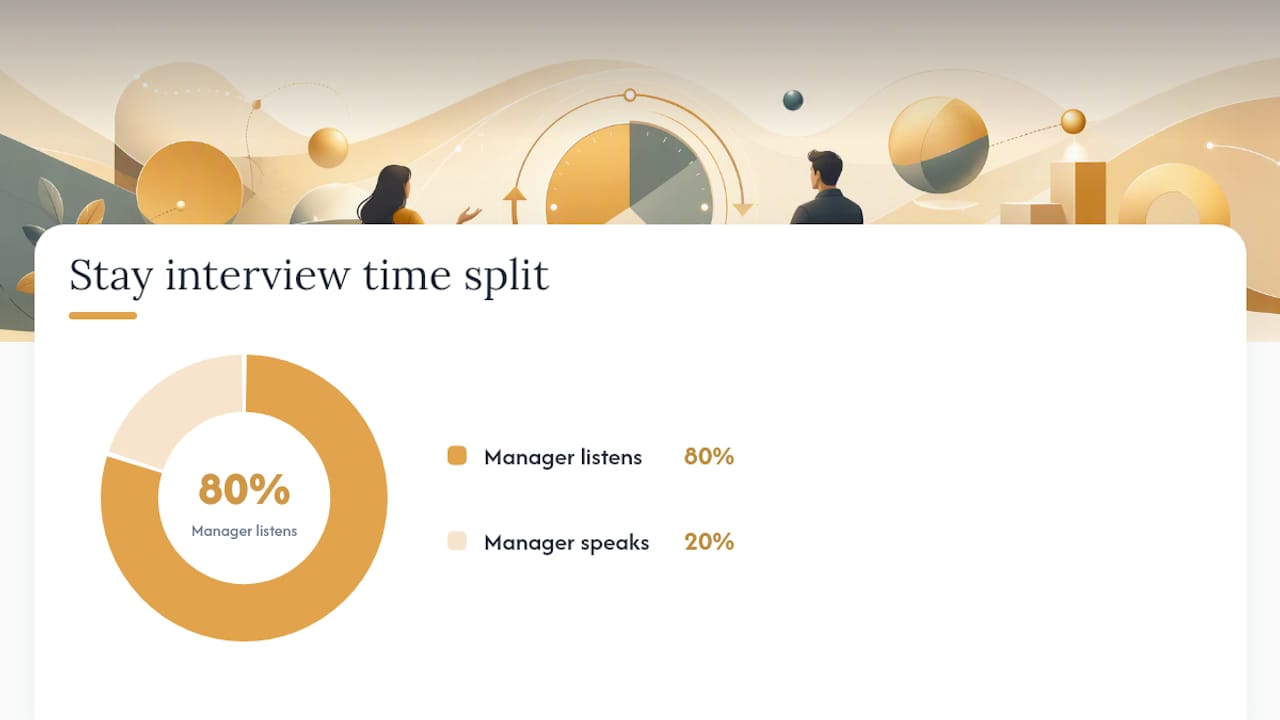
- Ask, then go quiet. Aim to listen roughly 80% of the time, and let silence do some of the work.
- Probe instead of defending. When an answer touches a nerve, resist explaining yourself. Ask "tell me more" or "can you give me an example" instead.
- Take notes on paper or a shared doc, not just memory, and write down exact phrases when possible.
- Close the loop. Tell the employee what happens next and roughly when they'll hear back.
Pro Tip: If your first instinct after a hard answer is to explain why things are the way they are, bite it back. Every second spent justifying a decision is a second the employee isn't giving you more information.
Managers who haven't been trained in active listening tend to turn stay interviews into monologues without noticing. If that sounds like a gap on your team, structured management coaching is often the fastest way to close it.
A Stay Interview Question Bank Organized by Theme
Don't recite these word for word. The best practitioners treat questions as conversation starters, not a script to march through, because a rigid script kills the natural follow-up that produces the good answers. Mix and match based on the role, the time you have, and what came up last time you talked.
Job satisfaction
- What part of your work makes the day go by fast?
- What's the one task you'd hand off tomorrow if you could?
- If you could redesign your role from scratch, what would change?
- What's something you used to enjoy about this job that's faded?
- What would make Monday mornings easier?
- On a scale of 1 to 10, how satisfied are you with your day-to-day work right now?
Manager support
- What do I do that helps you most, and what gets in your way?
- When was the last time you felt genuinely supported here, and what happened?
- Is there anything I'm not giving you enough of, whether that's time, information, or feedback?
- How comfortable are you bringing me bad news?
- On a scale of 1 to 10, how supported do you feel by your direct manager?
Growth and development
- Where do you want to be in two years, and are we helping you get there?
- What skill would you like to build that you're not currently using?
- Is there a project you'd raise your hand for if it existed?
- What's stalled your growth here, if anything?
- On a scale of 1 to 10, how clear is your path for advancement?
Recognition and motivation
- When did you last feel truly appreciated for your work, and by whom?
- What kind of recognition actually means something to you?
- Do you feel your contributions get noticed by people beyond your immediate team?
- On a scale of 1 to 10, how recognized do you feel for your work?
Work environment and flexibility
- What would make your workload feel more manageable?
- Is there anything about your schedule or setup that's harder than it needs to be?
- How well is the current flexibility working for your life outside work?
- On a scale of 1 to 10, how sustainable does your current workload feel?
Retention risk
- What might tempt you to look elsewhere?
- If you got a call from a recruiter tomorrow, what would make you take the meeting?
- What would need to change for you to see yourself here in three years?
Tools and technology
- What tool or process wastes the most of your time each week?
- Is there something you wish we had that would make your job easier?
Purpose and meaning
- Do you feel like your work connects to something bigger than the task list?
- What would make this job feel more meaningful to you?
Combining open-ended and scale-based questions gives you two different but complementary things: rich, specific stories from the open questions, and a number you can track across quarters and teams from the scale items. A "6 out of 10" on manager support this quarter versus an "8 out of 10" next quarter tells you something a transcript alone can't.
For roles with tight schedules, pick two or three themes instead of all eight. A frontline supervisor role might lean on manager support and work environment; a senior specialist role might lean harder on growth and purpose. If you want a wider bank of interview technique ideas beyond stay interviews specifically, SwarmStack's stakeholder interview question guide has useful probing formats that translate well.
How to Turn Stay Interview Feedback Into Retention Action
Raw notes from six or eight stay interviews aren't useful until someone looks across all of them for patterns. One employee mentioning slow approvals is an anecdote. Three employees on different teams mentioning it independently is a process problem.
- Sort themes, not individual quotes. Group answers by category (workload, recognition, growth, manager relationship) and count how often each comes up.
- Pick two or three priorities for the next quarter. You cannot fix everything at once, and trying to guarantees nothing gets fixed well.
- Assign an owner and a deadline to each action. "We'll look into it" dies quietly. "Sarah will revise the approval workflow by March 15" does not.
- Tell people what changed. Even a short team update ("Based on feedback, we're piloting a new approval process") shows the interviews weren't performative.
- Track it somewhere visible. A shared spreadsheet works fine for a small team; larger organizations can flag themes inside their HRIS. What matters is that someone checks it monthly, not that the tool is fancy.
If a lot of what surfaces points to structural gaps, like unclear roles, thin succession planning, or process bottlenecks, that's usually a sign the fix needs to go beyond one manager's to-do list. Broader organizational or consulting support tends to work better than asking individual managers to solve a company-wide problem alone.
Common Mistakes That Undermine Stay Interviews
The single fastest way to kill trust in this process is running the interview and then doing nothing with the answers. Employees notice within one cycle whether their feedback led anywhere, and going silent after asking teaches people that speaking up wastes their time.
- Getting defensive when an answer stings. The moment a manager starts explaining or justifying a decision, the employee stops giving honest input for the rest of the conversation.
- Bundling the interview with a performance review. Anything tied to a rating or a raise gets a filtered, safer answer instead of the real one.
- Reading questions off a script word for word. It feels like an interrogation instead of a conversation, and people respond to interrogations with short, guarded answers.
- Skipping manager training entirely. Listening and probing are skills, not instincts, and most managers have never been taught either one formally.
- Running it once and calling it done. A single stay interview is a snapshot. The value compounds when it becomes a recurring habit.
Templates: Script, Question Set, and Follow-Up Log
You don't need anything elaborate to start. A six-question script covers the essentials in a 30-minute slot:
- What makes you want to stay here right now?
- What might make you consider leaving?
- What would you change about your role if you could?
- When did you last think about looking elsewhere, and what triggered it?
- What can I do differently as your manager?
- What would make next year better than this one?
Run this cadence with high-value and flight-risk roles twice a year, and a lighter version with everyone else annually. New hires get a shorter check-in around 90 days, focused mostly on onboarding friction rather than long-term career questions.
For follow-up, a simple one-page log keeps actions from disappearing into someone's notebook:
| Field | Purpose |
|---|---|
| Issue raised | The specific concern, in the employee's words where possible |
| Proposed fix | What's being done about it |
| Owner | Who is responsible for making it happen |
| Due date | When it should be resolved or reviewed |
| Status | Open, in progress, or closed |
Keep this log visible to whoever is accountable for retention decisions, not buried in a personal file only one manager can see.
Key Takeaways for HR Leaders
Start this quarter with your highest-value and highest-risk roles, not a company-wide rollout. Build your question set around a mix of open-ended and scale items so you get both stories and trackable numbers. Train managers to listen more than they talk and to probe instead of explain. Document every action with an owner and a deadline, and tell staff what changed as a result. Skip any of these four and the whole exercise slides toward theater.
Why Coaching Often Determines Whether Stay Interview Insights Stick
The gap most companies hit isn't a shortage of good questions. It's follow-through. Managers gather honest feedback, get busy, and the promised fixes quietly stall. External coaching tends to help here because it puts a recurring check-in on the calendar that isn't optional, forcing the "we'll look into it" list into actual completed items with dates attached. It also complements whatever HR is already tracking internally, rather than replacing it, by giving managers a structured place to work through the harder conversations stay interviews surface.
— Duncan
Turning Stay Interview Insights Into Measurable Retention Gains
Knowing what your team needs and actually building the fix are two different skills, and most managers were never trained in the second one. Championbusinesscoaching works with Australian business owners specifically on that gap: turning stay interview themes, whether it's workload, growth paths, or manager friction, into a documented plan with deadlines and someone accountable for hitting them.
This isn't a replacement for running your own stay interviews. It's support for the part that usually stalls: converting a stack of honest feedback into changes your team can actually see. Coaching sessions run on a 90-day guarantee, so if the action plan doesn't move the needle, the coaching session is free. If your last round of stay interviews turned up more issues than your team has bandwidth to fix alone, book a free consultation with Champion Business Coaching and start building the follow-through plan this month.
Sources
- What Are Stay Interviews? A Guide with Questions to Retain Your Best Talent
- How to Conduct Stay Interviews: 5 Key Questions
- Examples of stay interview questions (SurveyMonkey)
- Conducting stay interviews to improve employee retention (Indeed)