
A working staff onboarding checklist covers pre-boarding through day 90, not just a first-day welcome pack. It follows the 30-60-90 day framework: foundational learning in the first 30 days, role ownership by day 60, full productivity by day 90, with the Fair Work Information Statement and payroll setup completed before anyone arrives. The first move: finish every pre-boarding task and calendar-lock a 30-day check-in before your new hire's start date.
TL;DR:
- Completing all pre-boarding tasks and calendar-locking 30, 60, and 90-day review checkpoints before the start date improves new hire momentum and reduces first-day chaos.
- The onboarding process should extend beyond the first day, including structured check-ins at 30, 60, and 90 days, to ensure proper role integration and retention.
- Proper onboarding involves specific legal compliance steps such as delivering employment contracts, setting up payroll, and scheduling mandatory training, especially under Australian law.
- Remote, technical, and leadership hires require tailored onboarding steps, including early equipment shipping, technical buddy pairing, and early organizational briefings.
- Managers must own the review schedule and relationship-building, while HR handles compliance, to prevent onboarding from stalling after initial weeks.
Table of Contents
- The Complete Staff Onboarding Checklist, Phase by Phase
- Getting Pre-Boarding Right Before Day One
- What Should Day One and Week One Look Like?
- Running the 30-Day Review and Enabling the Role
- Weeks 5 Through 12: Handing Over Real Ownership
- Closing Out Months 4 Through 6
- Compliance and Admin Essentials You Can't Skip
- What Metrics Actually Tell You Onboarding Is Working
- Adjusting the Checklist for Remote, Technical, and Leadership Hires
- Who Owns What: Manager Responsibility and a Simple RACI
- A Coach's View on Why Most Onboarding Plans Stall
- Get Help Designing a 90-Day Onboarding Program That Sticks
- Where to Check the Rules Yourself
- Sources
The Complete Staff Onboarding Checklist, Phase by Phase
Onboarding is a months-long process, not a single event, and treating it that way is exactly what separates hires who stick around from hires who quit inside a year. Here's the phase-by-phase breakdown you can lift straight into your own tracker.
Pre-boarding (offer accepted → day 1)
- Send contract, Fair Work Information Statement, and TFN declaration
- Provision laptop, logins, email, and system access
- Send manager welcome note and confirm start logistics
- Assign a buddy and schedule initial meetings for the first day
Day 1 and week 1
- Run orientation: team intros, tools walkthrough, first small task
- Book the manager's initial one-on-one meeting and outline first-week goals
30/60/90 and months 4 to 6
- Hold the 30-day review, assign real deliverables, and set 60-day targets
- Run the 90-day review and decide on ownership handover
- Integrate the hire into standard review cycles by the sixth month
Getting Pre-Boarding Right Before Day One
Everything you finish before the start date is the difference between a new hire's first day feeling organized or feeling like a scramble. Get this phase wrong and you'll spend week one fixing logistics instead of building momentum.
- Issue the employment contract and deliver the Fair Work Information Statement as required for every new employee in Australia.
- Collect the TFN declaration, set up payroll, and confirm superannuation fund details.
- Order and ship hardware, and create accounts for email, chat, and core systems so they're active before day one.
- Send a short welcome note from the manager confirming start time, location, and who they'll meet first.
- Assign a buddy and put the first 30- and 90-day check-ins directly on the calendar.
Pro Tip: Build one master pre-boarding template and reuse it for every hire. Standardizing this phase, the way you'd standardize any recurring internal document, removes the guesswork that causes half of all first-day chaos.
What Should Day One and Week One Look Like?
Day one shouldn't be a wall of paperwork. It should feel like the start of a relationship, with just enough structure to remove anxiety.
A workable day-1 timeline: morning welcome and team introductions, an IT systems check, a manager 1:1 covering role expectations, lunch with the buddy, and one small, completable task before they go home. That last piece matters more than people think. A new hire who finishes something real on day one walks out feeling capable instead of overwhelmed.
Week one priorities shift slightly:
- Give role context: how their work connects to team and company goals
- Introduce them to key stakeholders outside their immediate team
- Start initial training on core tools and workflows
- Run a short end-of-week pulse check with the manager
- Document what was covered so week two doesn't repeat it
Front-loading every process and policy into week one is a common mistake. Pacing onboarding across the full 90 days reduces burnout and keeps retention higher than cramming everything up front.
Running the 30-Day Review and Enabling the Role
Weeks two through four are where orientation turns into actual contribution. This is the stretch where role-specific training, shadowing sessions, and small deliverables replace generic company overview material.
- Assign role-specific training and pair the hire with someone doing similar work for shadowing.
- Set one or two small deliverables they can complete independently by week four.
- Keep a weekly 1:1 cadence between manager and new hire, not just an open-door policy.
- At the 30-day mark, run a structured review: what outcomes landed, what blocked progress, and what the next milestone looks like.
- Set realistic 60-day objectives based on what the 30-day review actually revealed, not what the job description assumed.
The 30-day review is also where managers catch quiet problems, mismatched expectations or unclear priorities, before they turn into resignation letters.
Weeks 5 Through 12: Handing Over Real Ownership
By week five, the training wheels should be coming off. This phase is about assigning full projects, easing the buddy out of daily involvement, and shifting the manager from instructor to overseer.
- Hand over ownership of a complete project or account, not just tasks
- Reduce buddy check-ins to weekly or as needed
- Have the manager shift from close supervision to outcome tracking
The 90-day review is the real milestone. Cover performance against the goals set in week four, gather input from a skip-level manager or key stakeholder, and leave the meeting with a written development plan for the next quarter.
Not every hire is ready to close onboarding at day 90. If the role is genuinely complex, if the 90-day review surfaces real skill gaps, or if the business itself changed mid-ramp, extend structured onboarding to six months rather than force a deadline that doesn't fit.
Closing Out Months 4 Through 6
The final phase is about integration, not more training. Fold the hire into your standard performance review cycle, finalize their development plan for the next two quarters, and treat them as a fully embedded team member rather than "the new person."
This is also the point to close the loop administratively: confirm system access matches their actual role, remove any temporary permissions, and archive the onboarding file. Run a short onboarding satisfaction survey, and use what comes back to update your templates before the next hire starts. Skipping this step means every new hire relearns the same gaps the last one hit.
Compliance and Admin Essentials You Can't Skip
Onboarding checklists live or die on the boring administrative layer underneath them. Miss this and even a great cultural onboarding process leaves you exposed.
- Deliver the Fair Work Information Statement to every new employee, as required under Australian employment law
- Confirm the employment contract covers hours, pay, leave entitlements, and probation terms
- Set up payroll, collect the TFN declaration, and enroll the employee in superannuation
- Schedule required workplace safety and induction training before or during week one
- Document probation length and review dates clearly in the contract
Government guidance for employers frames agreeing employment conditions and completing inductions as core, non-negotiable onboarding tasks, not optional extras layered on top of culture-building. When in doubt on a specific clause or entitlement, check the primary source rather than relying on a template written for a different state or industry.
What Metrics Actually Tell You Onboarding Is Working
Most companies track too much and learn too little. A small set of high-signal metrics beats a dashboard nobody checks.
- Time-to-productivity: the date a new hire completes their first fully independent deliverable
- 30- and 90-day retention: simple, brutal, and the clearest signal your process works
- Onboarding satisfaction score: a short survey at 30 and 90 days, mixing rating questions with one open text prompt on what would have helped
- Date of first meaningful contribution: often more useful than a generic productivity metric
Capture each one cheaply: pull retention and start dates from payroll, log the first-deliverable date in your project tool, and send the satisfaction survey through whatever form tool you already use. Review the numbers quarterly and adjust the checklist itself. A metric that never changes anything isn't worth collecting.
Adjusting the Checklist for Remote, Technical, and Leadership Hires
The base checklist holds for almost every role. Three variants need specific additions.
Remote hires: ship equipment a full week early, not the day before start. Set explicit communication norms (response times, which channel for what) since remote hires can't read the room the way an in-office hire can. Schedule at least one virtual social session in week one that isn't work-related.

Technical hires: assign a technical buddy in addition to the general onboarding buddy, and start them on a low-risk "good first issue" to build early confidence. Cover security access and a guided codebase tour in week one, not week three.
Leadership hires: arrange briefings with each direct report to surface team history and dynamics, and schedule early skip-level meetings to get context the org chart won't show.
Pro Tip: If your team uses AI tools day to day, build a short AI onboarding module into week one rather than expecting new hires to pick up your specific workflows by osmosis.
Who Owns What: Manager Responsibility and a Simple RACI
Onboarding fails most often when everyone assumes someone else owns it. The fix is simple: the hiring manager owns the relationship, while HR owns compliance and technical enablement.
- Manager: weekly 1:1s, role clarity, culture introduction, 30/60/90 reviews
- HR: contracts, Fair Work Information Statement, payroll, superannuation, IT provisioning coordination
- IT: hardware, account access, and troubleshooting in week one
- Buddy: informal questions, social integration, day-to-day context
The most common failure mode is HR treating onboarding as complete after week one, leaving the manager to improvise weeks two through twelve with no structure. The second most common: managers who delegate every 1:1 to the buddy and never build a direct relationship themselves. Both are fixable with a shared checklist and a calendar that doesn't let those reviews slip.
A Coach's View on Why Most Onboarding Plans Stall
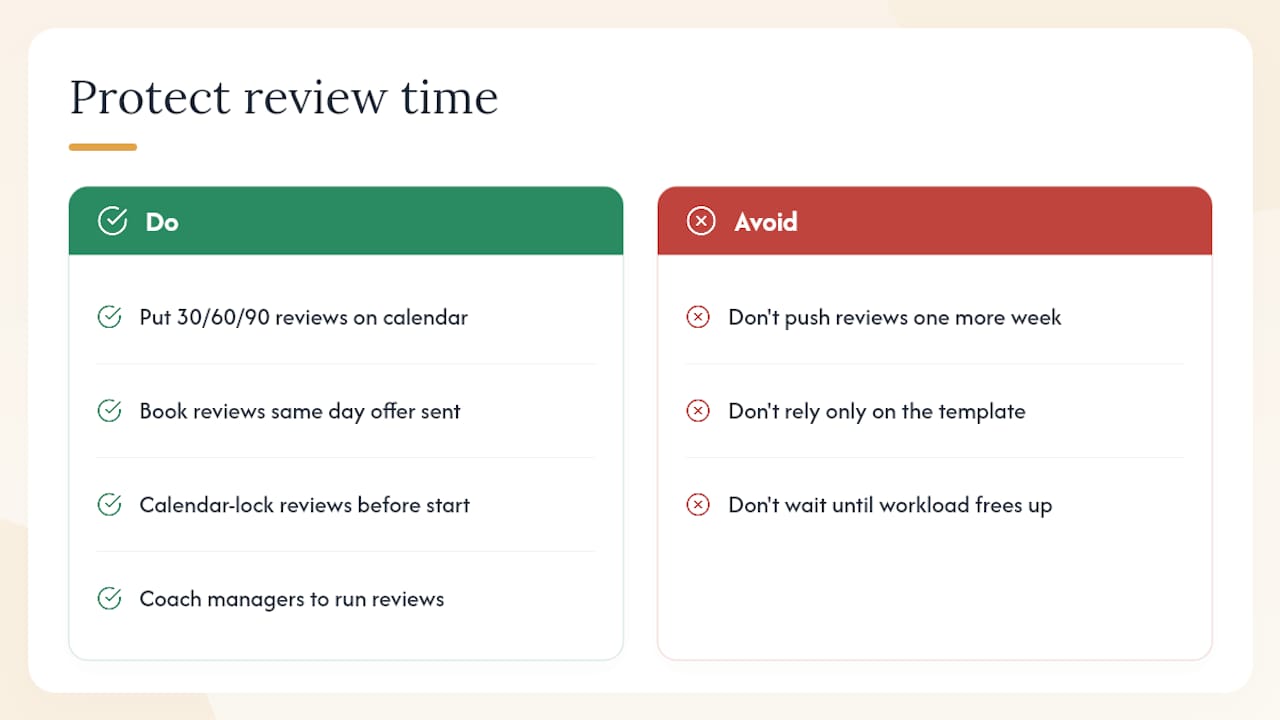
Most onboarding plans I've seen fail not because they're badly designed on paper but because nobody actually protects the calendar time to run them. One coaching client had a beautiful 90-day template sitting in a shared drive, untouched, because the manager kept pushing the 30-day review "one more week" until it never happened. The fix wasn't a better template. It was making that manager put the review on the calendar the same day the offer letter went out.
That's the gap coaching closes: not writing the checklist, but building the habit of actually running it under real workload pressure. If you want one experiment to try this week, pick your next new hire and calendar-lock all three reviews, 30, 60, and 90 days, before their first day. Nothing else about the process needs to change yet. Just protect the time.
— Duncan
Get Help Designing a 90-Day Onboarding Program That Sticks
Most onboarding checklists sit unused after week two because nobody builds the habit of running the reviews. Championbusinesscoaching works directly with managers to turn a checklist into an actual practice, with manager coaching, ready-to-use onboarding templates, and AI-assisted tools for tasks like drafting position descriptions and employment contracts faster.

Coaching engagements come with a 90-day guarantee: if the agreed results don't show up, the coaching session is free. That's a meaningful backstop if your last three hires walked before their first review ever happened. If you're ready to put structure around onboarding instead of hoping the checklist gets used, start with Champion Business Coaching's advisory services and book a session to map out your next 90 days.
Where to Check the Rules Yourself
For anything contract-related, go straight to Fair Work Ombudsman for employment contract requirements and the Information Statement employers must provide. Business.gov.au walks through employer onboarding obligations step by step, including inductions. For the retention research behind the 90-day approach, National Training's onboarding guide is worth a read, and for a template you can adapt for technical or remote hires, see Evalflow's onboarding checklist.
Sources
- 30-60-90 day onboarding plan | Workable resources
- Business
- Employment contracts | Fair Work Ombudsman