
Small business coaching is the process of using expert guidance and proven frameworks to help owners grow profitably, build scalable systems, and develop the leadership skills needed to step out of daily operations. For Australian small business owners and solo entrepreneurs, the gap between working hard and building something that runs without you is rarely closed by effort alone. It takes structure, accountability, and a clear methodology. Programs built around frameworks like the 7-Stage Growth Framework have guided over 1,100 founders toward scalable, sellable businesses. Championbusinesscoaching delivers exactly this kind of structured, results-focused support across Australia.
What are the primary benefits of small business coaching?
Small business coaching produces measurable results across revenue, leadership, and operations. Coaches like Ana McRae have helped 50+ businesses across 20 industries scale toward $1M+ in revenue. That outcome is not accidental. It comes from applying consistent frameworks to pricing, marketing, and operational structure.
The core benefits fall into four areas:
- Revenue growth. Coaching targets pricing strategy, sales process, and profit margins directly. Owners stop discounting out of habit and start pricing for value.
- Leadership development. The shift from operator to CEO is the single most important transition a small business owner makes. Coaching accelerates that shift by identifying where you are still doing work that should be delegated.
- Scalable systems. Documenting repetitive processes converts personal knowledge into business assets. This is often the most transformative part of the coaching engagement.
- Operational freedom. When systems replace the owner as the bottleneck, the business can grow without burning the owner out.
Pro Tip: Track your time for one week before your first coaching session. The tasks you repeat most often are your first candidates for documentation and delegation.
Coaching also addresses the full business picture. Focusing solely on sales while ignoring finance, operations, and team structure creates unsustainable growth. A good coach covers all four pillars, not just the revenue line.
How does small business coaching work in practice?
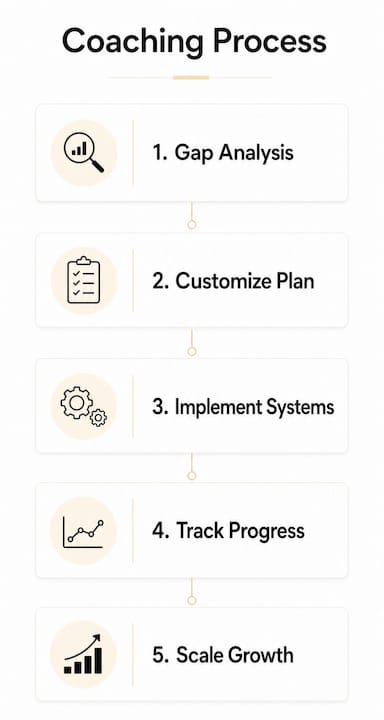
The coaching process follows a clear structure. It is not open-ended conversation. Every engagement moves through defined phases designed to produce results quickly.
- Gap analysis or game plan session. The coach reviews your actual business numbers and task list. Starting with real business data enables focused plans that yield immediate, measurable results. This session identifies your top three bottlenecks before any strategy is built.
- Custom coaching plan. The coach builds a plan aligned with your specific business stage, revenue goals, and operational gaps. There is no generic template. A tradie in Brisbane has different constraints than a service-based consultant in Sydney.
- Regular accountability sessions. Accountability changes behavior, not just intentions. Weekly or bimonthly sessions keep execution on track and prevent the drift that kills most growth plans.
- Implementation support. The coach works alongside you on priorities like pricing restructure, team delegation, or marketing systems. This is hands-on, not theoretical.
- Review and recalibration. At set intervals, the coach measures progress against the original gap analysis and adjusts the plan based on what the numbers show.
Pro Tip: Bring your last three months of revenue data and a list of every task you personally completed last week to your first session. Coaches who use real data produce faster results.
Delivery formats vary. One-on-one executive coaching suits owners who need deep, personalized attention. Virtual formats work well for business owners outside major cities. Group cohort programs add peer accountability and are well suited to solo founders who benefit from shared learning. Championbusinesscoaching offers online coaching and mentoring across Australia, making quality coaching accessible regardless of location.

What challenges does coaching for small businesses solve?
Most small business owners face the same core problems, even across different industries. Coaching targets these directly rather than offering generic advice.
- Owner burnout. When you are the salesperson, the operations manager, and the accountant, burnout is not a risk. It is a certainty. Coaching restructures your role before the exhaustion becomes permanent.
- Single-person bottlenecks. Leadership blind spots cause owners to unintentionally make themselves the bottleneck. The business cannot grow past what one person can personally manage.
- Lack of documented systems. Without written processes, every task depends on the owner's memory. New staff cannot onboard effectively, and quality becomes inconsistent.
- Unfocused priorities. Most owners have 20 things on their list and no clear framework for deciding which three actually move the needle. Coaching installs that framework.
- Structural inefficiencies. Marketing, finance, and operations problems compound quietly. By the time they become visible, they have already cost significant revenue.
Business owners often maintain operating roles due to personality-driven leadership blind spots rather than genuine necessity. A coach identifies these patterns and resets them with specific behavioral changes, not motivational advice. This is why entrepreneurship coaching produces results that self-help books and podcasts rarely do.
How to find the right business coach for your small business
Choosing a coach is a business decision, not a personal one. The wrong fit costs time and money. The right fit accelerates growth by years.
Use these criteria when evaluating any coaching program or coach:
- Certified frameworks. Look for coaches who use documented, repeatable methodologies. The 7-Stage Growth Framework and gap analysis processes are examples of structured approaches that produce consistent results.
- Proven track record. Ask for specific client outcomes, not testimonials. Revenue milestones, time-to-delegation, and system documentation rates are measurable results.
- Cross-industry experience. Coaches skilled in growth frameworks and leadership psychology deliver more value than coaches matched only by industry niche. The principles of scaling a business transfer across sectors.
- Alignment on communication style. You will share your real numbers and your real problems with this person. If the communication style does not work for you in the first session, it will not improve.
- Delivery format and pricing. Confirm whether the program is one-on-one, group-based, or virtual. Check whether pricing is per session, monthly retainer, or outcome-based. Championbusinesscoaching offers a 90-day coaching guarantee, meaning results are delivered or the session is free.
A business mentor differs from a coach in one key way. A mentor shares experience from their own business history. A coach applies frameworks to your specific situation regardless of whether they have run your type of business. For most owners seeking structured growth, a coach with proven methodology produces faster results than a mentor with relevant industry experience alone. The right coaching services combine both elements.
Key Takeaways
Small business coaching delivers the fastest results when it combines a structured gap analysis, documented systems, and consistent accountability sessions focused on leadership development and revenue growth.
| Point | Details |
|---|---|
| Start with a gap analysis | Use real business data to identify bottlenecks before building any growth plan. |
| Document your processes | Converting personal knowledge into written systems is the most transformative step in scaling. |
| Address the full business | Coaching must cover marketing, finance, operations, and team, not sales alone. |
| Choose frameworks over niche | Coaches with proven growth frameworks outperform coaches matched only by industry. |
| Accountability drives execution | Regular coaching sessions change behavior and maintain momentum where intentions fail. |
Why most owners wait too long to get a coach
The owners I work with most often say the same thing after their first few sessions: "I wish I had done this two years ago." That is not a compliment. It is a confession. Two years of spinning wheels, burning energy, and leaving revenue on the table because the problems felt manageable enough to ignore.
The founder operator mindset is the most expensive trap in small business. You built the business by doing everything yourself, so doing everything yourself feels like the right answer. It is not. It is the ceiling. The moment you become the bottleneck, growth stops being a function of effort and starts being a function of structure. Coaching forces that structure.
What surprises most owners is that the work is not complicated. The gap analysis reveals three or four specific problems. Fix those, and the business moves. The difficulty is not the complexity of the solutions. It is the willingness to stop doing the work and start building the system. That shift requires outside perspective. You cannot see your own blind spots from inside them.
The other thing I have observed consistently: owners who invest in scaling their business with a coach during a growth phase outperform those who wait for a crisis. Coaching is not a rescue operation. It is a growth accelerator. Use it before you need it, not after.
— Duncan
Championbusinesscoaching: structured growth for Australian business owners
Championbusinesscoaching works with small business owners and solo entrepreneurs across Australia to build profitable, well-run businesses through tailored coaching, advisory, and mentoring programs.
Every engagement starts with a clear diagnosis of where your business is losing time and money. From there, Championbusinesscoaching builds a custom plan focused on leadership development, operational systems, and revenue growth. The firm limits coaching slots to maintain quality, and backs every program with a 90-day guarantee. Results are delivered or your session is free. Rated 5 stars on Google, Championbusinesscoaching serves owners from startups to established enterprises. Explore coaching plans and packages or request a tailored session to get started.
FAQ
What is small business coaching?
Small business coaching is a structured engagement where an expert coach uses proven frameworks to help owners grow revenue, build systems, and develop leadership skills. The goal is to move the owner from daily operations into a CEO role.
How long does a coaching program typically take?
Most coaching programs run across multiple quarters, with meaningful results often visible within the first 90 days when the engagement starts with a gap analysis using real business data.
Does a business coach need experience in my industry?
No. Coaches with growth frameworks and leadership psychology deliver more value than coaches matched only by industry niche, because the principles of scaling transfer across sectors.
What is the difference between a business coach and a business mentor?
A mentor shares experience from their own business history. A coach applies structured frameworks to your specific situation, regardless of personal industry background, which typically produces faster and more measurable results.
How do I know if I need a business coach?
If you are the bottleneck in your own business, working more hours than you planned, or seeing revenue plateau despite consistent effort, those are clear signals that a structured coaching engagement will produce a measurable return.