
Calculate your fully loaded floor price before you touch a pricing model, then move toward value-based or tiered pricing wherever you can point to a measurable client outcome. Start today: run the floor-price formula on one service, then pilot a higher, value-anchored offer with a single client. Everything else in pricing strategy sits downstream of those two moves.
TL;DR:
- Calculating your fully loaded floor price with realistic billable hours prevents subsidizing work and ensures sustainable profitability.
- Choose a pricing model that aligns with service predictability, market position, and measurable client outcomes, starting with pilot tests.
- Regularly review and adjust your pricing based on market changes, input costs, and demand signals rather than setting prices once and forgetting them.
- Use market benchmarking and controlled pilot offers to identify optimal price points before full implementation or repricing.
- Applying psychological tactics like anchoring, framing, and tiered packages enhances perceived value and guides client purchasing decisions.
Table of Contents
- Set Your Service Pricing Strategy Goals Before You Touch a Number
- How to Calculate Your True Cost and Floor Price
- Common Pricing Models for Services and When to Use Each
- Market Research and Price Testing
- Implementing Prices Without Losing Clients or Control
- Metrics That Keep Your Pricing Strategy Honest
- Practitioner Checklist for Rolling Out a New Service Pricing Strategy
- Psychological Pricing Tactics in Service Pricing
- Discounting Strategies and Their Impact on Service Value Perception
- Customer Segmentation and Differential Pricing Approaches
- Adjusting Your Service Pricing Strategy as the Market Shifts
- What the Data Actually Supports, and Where Common Advice Falls Short
- Get Hands-On Help Rolling Out Your New Pricing
- Sources
Set Your Service Pricing Strategy Goals Before You Touch a Number
Most owners open a spreadsheet and start guessing at hourly rates before they've decided what the price actually needs to accomplish. That's backward. A service pricing strategy has to serve three goals at once: profit, utilization, and market position. Skip this step and you'll end up with a rate that pays the bills but slowly resents your calendar.
Start with margin. What net profit percentage do you need after paying yourself a real salary, not "whatever's left"? Most service owners target a net margin that covers overhead and generates profit, with the specific target depending on their costs, but the number only matters if you've actually calculated it against your costs, not guessed at it.
Then look at utilization, meaning the ratio of billable hours to hours you're actually in the business. A solo consultant working 40 hours a week typically bills a portion of those hours, accounting for admin, sales calls, and proposal writing. Price as if you'll bill 40 hours and you'll blow your own budget by month three.
Finally, decide on positioning. Are you competing on price, on convenience, or on outcomes? Budget positioning means volume and thin margins. Premium positioning means fewer clients, higher fees, and a service built around a clear, provable result. Government pricing guidance recommends setting these goals before you research the market or choose a model, precisely because the goals narrow your options.
Before moving forward, answer these on paper:
- What net margin do I need this quarter, and what would that mean in dollars?
- What take-home pay am I actually targeting, separate from business profit?
- What percentage of my working hours can realistically be billed?
- Do I want to compete on price, convenience, or proven outcomes?
Those four answers eliminate half the pricing models available to you before you've even opened a competitor's price list.
How to Calculate Your True Cost and Floor Price
Your floor price is the number below which you are paying to work. Most service businesses never calculate it, which is why so many stay busy and broke at the same time.
Here's the sequence, step by step:
- List every direct cost tied to delivering the service: software licenses, subcontractor fees, materials, travel, insurance specific to that service line.
- Allocate a share of overhead (rent, admin wages, general insurance, accounting) across your services based on time or revenue share.
- Account for non-billable hours honestly. If you work 40 hours and bill 25, your billable percentage is 62.5%, not 100%.
- Add your desired salary as a real cost line, not a residual. Include the tax and GST obligations that apply to your structure.
- Divide total costs by realistic billable hours to get your break-even, fully loaded hourly cost.
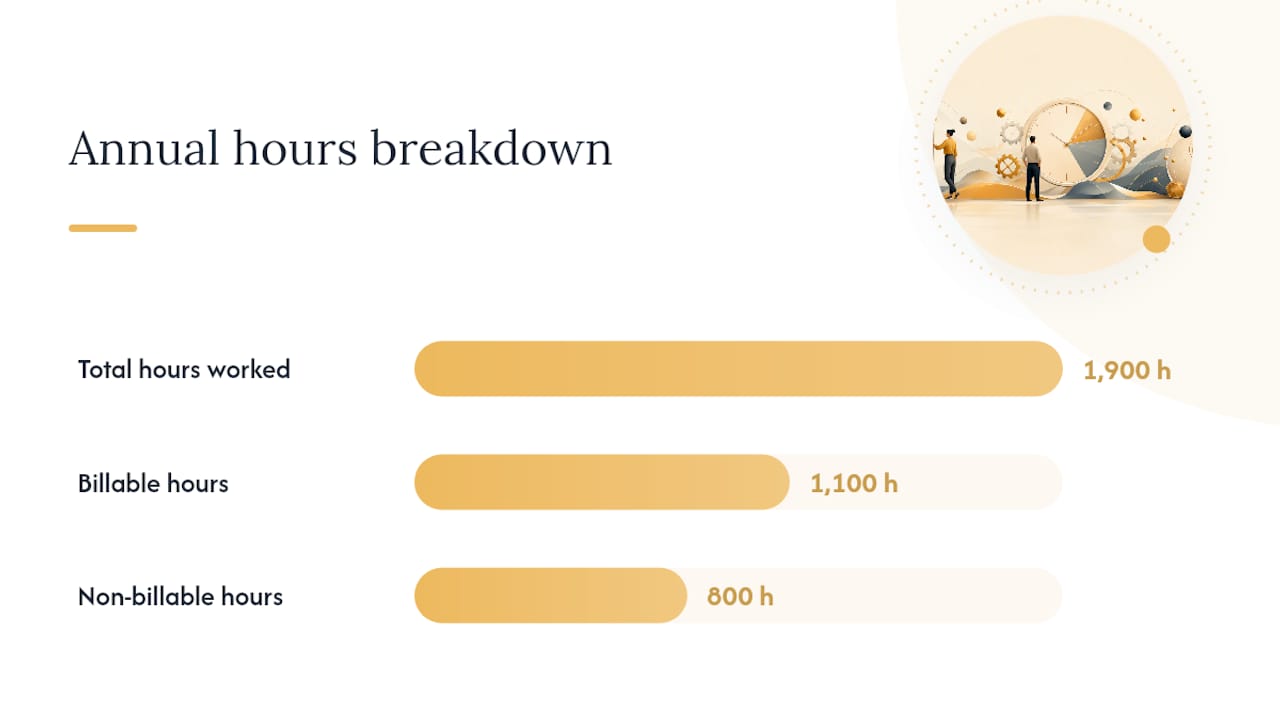
A worked example makes this concrete. Say your annual costs, including your target salary, total $120,000. You work 1,900 hours a year but only bill 1,100 of them after accounting for admin, sales, and downtime. Your floor rate is $120,000 divided by 1,100, or roughly $109 an hour. Anything you charge below that is subsidized by your own unpaid labor.
Small-business pricing guidance backs this same approach: fully loaded costs divided by a realistic billable-hour assumption, not an optimistic one. That's the first number in what's known as the 3-number framework: floor, market rate, and value ceiling. Your floor is the break-even number you just calculated. Market rate is what comparable providers charge for similar work. Value ceiling is the maximum a client would rationally pay given the outcome you deliver, which is often far higher than either of the other two numbers.
Pro Tip: Run your floor-price math on your lowest-margin service first. If that number embarrasses you, you've found the service that's quietly draining your business.
For the tax and GST side of this calculation, check current thresholds and obligations directly with the Australian Taxation Office rather than relying on a competitor's blog post, since rates and registration requirements change and vary by structure.
Common Pricing Models for Services and When to Use Each
Once your floor price is locked in, the real decision is which pricing model actually fits the work. The ACCC groups service pricing into five broad categories, and each one solves a different problem.
Cost-plus pricing adds a fixed margin on top of your calculated cost. It's simple and defensible, but it caps your upside. If you get faster or better at delivering the work, cost-plus punishes you by shrinking your margin as your hours drop.
Hourly pricing bills for time worked. It's the default for unpredictable scope, like legal work or IT troubleshooting where nobody knows how long the fix will take. Its weakness is obvious: it rewards slowness and makes efficient providers look expensive per hour even when they save the client money overall.
Competitive or going-rate pricing sets fees based on what similar providers charge. It works when your service is a commodity and clients are comparing you directly against alternatives. It works poorly when your actual differentiation is invisible in a simple rate comparison.
Value-based pricing ties your fee to the outcome you produce rather than the hours you spend. A bookkeeper who saves a client $40,000 in penalties by catching a compliance error delivers value wildly disproportionate to the two hours it took. TSIA's analysis of professional services pricing makes the case that firms able to quantify client impact consistently capture more margin than those still billing by the hour.
Tiered or retainer pricing packages a defined scope of deliverables into recurring monthly fees. It gives you revenue predictability and gives clients cost certainty, which is why it's become the default for ongoing marketing, bookkeeping, and coaching relationships.
Use this rule of thumb when choosing:
- Repeatable, low-variance work with predictable scope → fixed-fee or tiered pricing.
- Outcomes you can measure and attribute directly to your work → value-based pricing.
- Scope that shifts constantly or can't be defined upfront → hourly or retainer, with clear boundaries.
The ACCC also cautions against dynamic or surge pricing unless you communicate the fluctuation transparently. A cleaning service that quietly charges more on weekends without disclosing it upfront erodes trust faster than the extra revenue is worth.
Pro Tip: Don't switch your whole business to a new pricing model overnight. Pick one service, one client segment, or one new client, and pilot the model change there before rolling it out everywhere.
Market Research and Price Testing
Guessing at a market rate is how most owners underprice. Testing it is how you find out what the market will actually bear.
Start with benchmarking. Pull public pricing from three to five direct competitors, check trade association rate guides where your industry has them, and ask peers in non-competing markets what they charge. Public price lists are a starting point, not gospel. A lot of published "starting from" prices are deliberately low to get inquiries, so treat them as a floor signal, not a market average.
Then pilot before you commit. Time-limited offers, an A/B test between two landing pages with different price points, or an early-bird rate for the first five clients at a new tier all give you real signal without betting your whole client base. Small-business pricing research recommends exactly this: narrow, time-limited pilots that measure uptake and margin before a full rollout.

Packaging changes perception as much as the number does. Structuring three tiers, good, better, best, anchors the buyer's attention on the middle option and makes your premium tier look reasonable by comparison. This is the same logic behind tiered subscription pricing used across service industries, where a clear entry point and a clear premium point do most of the persuasion work.
A note on charm pricing: dropping a price to $997 instead of $1,000 works better on low-consideration retail purchases than on high-trust service engagements, where a round number can actually read as more confident and transparent. Test it, but don't assume it transfers.
- Check three to five competitor price points before setting your own.
- Run one pilot offer before repricing your entire client base.
- Structure at least three tiers so your target price looks like the reasonable middle choice.
Implementing Prices Without Losing Clients or Control
Raising a price badly costs you more clients than the increase itself. Timing and clarity fix that.
For existing clients, give notice in writing before a price increase, framed around the value they've received, not around your rising costs. For new clients, the new price simply is the price, effective immediately, with no need to explain a change that never existed for them.
- Send a short, direct notice: what's changing, when it takes effect, and what stays the same.
- Reiterate the specific outcomes or deliverables that justify the new rate.
- Give existing clients a brief window to lock in a project at the old rate if it's already scoped.
Every contract, regardless of pricing model, needs the same four guardrails: a defined list of deliverables (not just "availability"), a cap on revisions or included hours, a documented change-order process for anything beyond scope, and clear payment terms with a stated late-fee policy.
Pro Tip: Define retainers by deliverables, not by hours available. "12 blog posts and one strategy call per month" protects your margin far better than "up to 20 hours per month," which invites scope creep from day one.
Metrics That Keep Your Pricing Strategy Honest
Pricing isn't a decision you make once. It's a number you monitor.
Track your effective hourly rate (total fees divided by actual hours worked, not billed), utilization (billable hours divided by total working hours), and margin by engagement so you can see which clients or service lines are actually profitable versus just busy. Productive's guidance on professional services pricing recommends watching all three together, since a healthy utilization rate with a shrinking margin still means you're losing ground.
- Review pricing quarterly, with utilization consistently above 85% as a trigger to raise rates for new clients.
- Run one formal annual repricing across your whole client base, not just ad hoc adjustments.
- When you're underpriced, raise rates for new clients first, then test better packaging before touching existing contracts.
- Document specific case studies and results. They're the evidence that eventually justifies moving a service to value-based fees.
Practitioner Checklist for Rolling Out a New Service Pricing Strategy
Here's the condensed version to run through before you change a single number: calculate your floor price using fully loaded costs and realistic billable hours, set explicit margin and utilization targets, choose a model that matches the work's predictability and measurability, pilot the change with one client or offer, update your contract's deliverables and change-order clauses, and set a quarterly review date on your calendar right now.
Getting each step right in isolation is straightforward. Sequencing them correctly, and having someone catch the blind spot you can't see in your own numbers, is where most owners stall out. That's the gap coaching closes. Certain business coaching providers work directly with service-based businesses on exactly this kind of repricing, sometimes offering guarantees and controlling session availability to maintain personalized service quality. If pricing has felt like guesswork for the last two years, that's the fastest fix.
Psychological Pricing Tactics in Service Pricing
Numbers don't just get compared, they get felt. A few tactics show up repeatedly in service pricing because they consistently shift how a price lands, even when the underlying cost hasn't changed at all.
Anchoring is the strongest of these. Show a client your premium tier first, and your mid-tier suddenly looks like the sensible choice rather than the expensive one. This is why good-better-best packaging outperforms a single flat rate almost every time it's tested.
Framing matters just as much as the number itself. "$2,400 per project" and "$200 per week" describe the same total cost, but the second framing feels smaller because it's measured against a familiar, lower reference point. Service businesses that bill annual retainers often quote the monthly figure for exactly this reason.
Decoy pricing works by making one option deliberately less attractive so another looks obviously better by comparison. A mid-tier package priced only slightly below your premium tier, but missing a key deliverable, nudges buyers upward without you saying a word about it.
Round numbers signal confidence and simplicity, which matters more in high-trust service relationships than in retail. A $5,000 project fee tends to read as more considered than $4,997, even though the difference is trivial. Use precision pricing when you want to look data-driven, and round pricing when you want to look decisive.
Discounting Strategies and Their Impact on Service Value Perception
Discounting a service is not the same as discounting a product, and treating it that way quietly erodes what clients think you're worth.
A percentage-off discount on a physical good doesn't change the good itself. A percentage-off discount on your coaching, consulting, or design service raises an uncomfortable question in the client's mind: if the value was really there, why is it suddenly cheaper? That question doesn't arise with products the same way, because a product's cost of manufacture is visibly separate from its price. Your service's price is the visible signal of its worth, and cutting it cuts that signal.
That doesn't mean discounts are always wrong. A time-limited founding-client rate, clearly framed as temporary and tied to a specific reason (a new offer, a pilot cohort, a referral), protects perceived value because the discount has a logical boundary. An open-ended discount with no end date and no stated reason does the opposite. Clients start anchoring to the discounted price as the real price, and your next full-price quote feels like a price increase even when it isn't.
If you need to compete on affordability, change the deliverable instead of cutting the fee. A smaller scope at a lower price protects your rate per unit of work far better than the same scope at a lower total price.
Customer Segmentation and Differential Pricing Approaches
Not every client should pay the same rate for functionally different reasons, and pretending otherwise leaves money on the table with your best clients while pricing out ones you actually want.
Segment by the value you create, not just by who asks nicely for a discount. A client whose problem costs them $200,000 a year in inefficiency can rationally pay far more for the same hours of consulting than one whose problem costs them $8,000. Value-based pricing works precisely because it lets you charge differently for the same skill applied to different stakes.
Segment by sophistication too. A first-time small-business owner buying strategic planning needs more hand-holding, more explanation, and more revision cycles than a repeat client who already trusts your process. That difference is real cost, and it justifies real price variation, whether through a beginner package with more built-in support or a streamlined rate for experienced repeat clients.
Geography and urgency create legitimate segments as well. Rush work, after-hours availability, or travel to a client site all carry real additional cost and reasonably carry a different rate, disclosed upfront rather than buried as a surprise line item.
The one segmentation to avoid is charging different prices for the identical scope of work based purely on what you think a client can afford, with no disclosed reason. Beyond the fairness problem, it's operationally fragile: word travels between clients, and an undisclosed pricing gap discovered after the fact damages trust faster than almost any single pricing mistake.
Adjusting Your Service Pricing Strategy as the Market Shifts
A price you set eighteen months ago is a snapshot of a market that no longer exists. Costs move, competitors move, and client expectations move, usually faster than most owners revisit their rate card.
Watch three signals as triggers for a pricing review rather than waiting for an annual date on the calendar. Rising input costs, whether that's software subscriptions, subcontractor rates, or your own cost of living, erode margin silently if your price stays flat. Utilization consistently above capacity signals demand your current price isn't filtering. And a wave of new competitors entering at a lower price point means you need to clarify your differentiation, not necessarily match their number.
When a competitor undercuts you, the instinct is to drop your own price to match. Resist it. Matching a lower competitor rate without matching their (usually thinner) cost structure just drags your floor price down with it. The stronger response is usually to sharpen what makes your offer different and let a segment of price-sensitive buyers go to the competitor, since they were rarely your most profitable clients anyway.
Economic downturns change client priorities more than they change client budgets. Clients facing tighter conditions often still spend, but they spend on services with a clearer, more provable return. That's the environment where value-based pricing, backed by documented case studies, outperforms hourly billing most sharply, because it answers the exact question a nervous buyer is asking.
What the Data Actually Supports, and Where Common Advice Falls Short
Most pricing advice online tells you to "charge what you're worth," which is true and also useless, since it gives you no method for finding that number. The government guidance and practitioner frameworks referenced throughout this piece point somewhere more concrete: calculate your floor with real numbers, benchmark the market honestly, and only then reach for value-based pricing once you can actually prove an outcome.
Where conventional advice falls short is in treating pricing as a one-time decision rather than an operating rhythm. Most owners set a rate once, out of anxiety or guesswork, and never revisit it until a crisis forces the conversation. The businesses that price well treat it the way they'd treat any other KPI: reviewed quarterly, adjusted deliberately, and tested before it's rolled out broadly.
If you take one thing from this: don't wait for perfect certainty about your value ceiling before you charge more. Test it. A single client, a single pilot offer, a single tier priced higher than feels comfortable will tell you more in ninety days than another year of research ever will.
— Duncan
Get Hands-On Help Rolling Out Your New Pricing
Reading the framework is the easy part. Running the floor-price math correctly, choosing the right model for your specific client mix, and holding your nerve through a price increase conversation is where most owners actually get stuck, and where a second set of eyes pays for itself fast. Champion Business Coaching builds this work directly into its coaching packages: pricing workshops, done-with-you cost and floor-price templates, and KPI dashboards that track utilization and margin so you're not guessing whether the new price is working.

Every engagement runs on a 90-day guarantee, meaning if the agreed results don't show up, your coaching session is free. Coaching slots stay deliberately limited to keep sessions focused rather than generic, which is part of why the practice holds a 5-star rating on Google. If you run a trades, bookkeeping, or other service-based business and you're ready to stop pricing by guesswork, book a coaching consult and bring your current rate card. That's the fastest way to find out exactly where your floor, market rate, and value ceiling actually sit.
Sources
The ACCC's pricing guidance covers price displays, surcharging, and transparency obligations. Business.gov.au outlines the stepwise pricing-strategy process. The Australian Taxation Office governs GST registration and thresholds relevant to any floor-price calculation.
- Setting prices - Australian Competition & Consumer Commission (ACCC)
- Business
- How to Price Your Services: Small Business Guide - StartCosts
- What Are Professional Services Pricing Models – 2026 Guide - Productive
- What should you charge for professional services - TSIA