
Cutting costs without killing what makes your business work is a strategic capability, not a one-time austerity exercise. Deloitte's analysis frames it plainly: pairing process redesign with analytics produces higher-quality, sustainable savings than blunt cuts ever do. Start here, today:
- Cancel unused subscriptions. Pull your last three months of bank and credit card statements and flag every SaaS or service charge your team hasn't touched. This takes two hours and often frees $500–$3,000 per month.
- Negotiate your top three vendor contracts. Consolidating spend or committing to longer terms typically unlocks 5–15% discounts with no change to service quality.
- Automate one recurring manual task. Accounts payable, invoice matching, or weekly reporting are common first targets. The time savings compound fast.
- Audit your facility footprint. If remote or hybrid work has reduced headcount in the office, you may be paying for space you no longer need.
- Benchmark your operating expense ratio. Calculate it now (formula below) so every future initiative has a measurable baseline to beat.
Prioritization rule: Score every initiative by impact × ease. Quick wins (high impact, low effort) go first. Never cut a cost line that directly protects revenue, customer experience, or compliance.
Key Takeaways
Reducing operating costs sustainably requires a baseline, a prioritized initiative list, clear ownership, and a governance routine that prevents savings from creeping back.
| Point | Details |
|---|---|
| Calculate your baseline OER first | Divide total OPEX by net revenue before any initiative so savings are verifiable. |
| Score initiatives by impact × ease | Prioritize the highest combined score; quick wins above 15 start this week. |
| ZBB can cut costs up to 25% | Bain's analysis shows zero-based budgeting lowers cost bases by as much as 25% for sustained performers. |
| Assign one named owner per initiative | KPMG's guidance is clear: vague ownership kills follow-through on cost programs. |
| Protect revenue-critical spend | Never cut customer experience, compliance, or core talent to hit a short-term target. |
Table of Contents
- What are operating costs and how do you calculate them?
- Proven strategies to reduce operating costs across your business
- How to prioritize initiatives, assign owners, and measure results
- Durable cost discipline: zero-based budgeting and operating model redesign
- Your 30/60/90-day cost reduction checklist
- What cost audits actually reveal — and why most businesses get this wrong
- Ready to turn cost savings into a growth engine?
- Sources
What are operating costs and how do you calculate them?
Operating costs are the expenses a business incurs to keep running day to day. They split into two buckets:
- COGS (Cost of Goods Sold): Direct costs tied to producing your product or delivering your service — raw materials, direct labor, manufacturing overhead.
- OPEX (Operating Expenses): Everything else required to run the business — rent, utilities, payroll for non-production staff, marketing, insurance, software subscriptions, and professional fees.
What to exclude: Interest expense, taxes, and one-time items (asset sales, restructuring charges) are non-operating. Keep them out of your OPEX baseline so you're comparing apples to apples over time.
How to calculate your operating expense ratio
The operating expense ratio (OER) tells you what percentage of revenue you're spending to operate the business.
A lower OER means more of each revenue dollar reaches profit. Census Bureau industry data and public sector tables can help you set a realistic OER benchmark for your industry.
Worked example:
Common line items to audit:
- Payroll and contractor fees
- Rent and facilities costs
- Utilities and energy
- Software and SaaS subscriptions
- Freight, shipping, and logistics
- Insurance premiums
- Professional services (legal, accounting)
- Inventory carrying costs
Run this audit quarterly.
Proven strategies to reduce operating costs across your business
The most effective cost reduction strategies cluster around six functions. Each group below includes a timeline label: Quick (under 30 days), Medium (30–90 days), or Long (90+ days).
Procurement and suppliers
- Consolidate purchases with fewer vendors to hit volume thresholds that trigger discounts. (Quick)
- Request competitive bids on your top five spend categories annually. (Medium)
- Negotiate payment terms — extending DPO (Days Payable Outstanding) from 30 to 45 days improves cash flow without touching price. (Quick)
- Implement just-in-time (JIT) inventory for high-turnover SKUs to cut carrying costs. (Medium)
Stripe's cost reduction guide identifies supplier negotiation and JIT inventory as two of the highest-ROI levers available to most businesses.
Pro Tip: Before any supplier negotiation, pull 12 months of spend data by vendor and category. Walk in knowing your total annual spend, your payment history, and one competitive alternative. Suppliers respond to specifics, not vague requests for "a better deal." Timing matters too — negotiate at contract renewal, not mid-term.
Workforce and scheduling
- Audit overtime patterns. Chronic overtime often signals a scheduling problem, not a staffing shortage. (Quick)
- Cross-train employees across two or more roles to reduce dependency on contractors during peak periods. (Medium)
- Review contractor and temp-agency spend — many businesses pay agency margins for roles that could be hired directly at lower total cost. (Medium)
- Align shift schedules with actual demand data rather than historical habit. (Medium)
Automation and technology
Automation's ROI is clearest when you target shadow systems: the side spreadsheets, manual email approvals, and copy-paste loops that nobody has formally budgeted but everyone relies on. Mapping and automating those exact steps with workflow tools or AI can deliver savings without touching headcount.
High-impact starting points:
- Accounts payable automation (invoice capture, matching, approval routing). (Medium)
- Automated reporting and dashboard updates replacing manual weekly builds. (Quick)
- Contract analytics tools that flag renewal dates and auto-escalation clauses. (Medium)
- Predictive spend classification to catch budget drift before month-end. (Long)
Measure post-implementation: track hours saved per week, error rate reduction, and processing cost per transaction.
Facilities and energy
- Conduct an energy audit. Lighting, HVAC scheduling, and equipment standby modes are common sources of waste that cost nothing to fix. (Quick)
- Renegotiate your commercial lease at renewal — or explore subletting unused space. (Medium)
- Preventive maintenance on equipment reduces expensive unplanned repairs and extends asset life. (Medium)
- If your team is hybrid, model whether a smaller footprint or co-working arrangement reduces your fixed cost base. (Long)
Subscriptions and SaaS
This is the fastest category to audit. Most businesses are paying for tools their teams stopped using six months ago.
- Export every recurring charge from your accounts payable system. (Quick)
- Assign each subscription to an owner who confirms active use monthly. (Quick)
- Consolidate overlapping tools — many businesses run three project management platforms simultaneously. (Medium)
- Negotiate annual contracts in exchange for a discount on tools you know you'll keep. (Quick)
Process and quality improvement
- Map your three most labor-intensive processes and identify the steps that add no customer value. (Medium)
- Reduce rework by fixing root causes rather than adding inspection steps. (Medium)
- Standardize repeatable tasks with documented SOPs so training time and error rates fall together. (Long)
Red flags — what not to cut: Customer-facing service quality, compliance and regulatory spend, core talent, and any cost line that directly generates revenue. Cutting these to hit a short-term target typically costs more to restore than the savings were worth.
How to prioritize initiatives, assign owners, and measure results
Ideas don't save money. Executed initiatives with owners and deadlines do.
The impact × ease scoring matrix

Score each initiative on two dimensions, each from 1 (low) to 5 (high):
Work the list from highest to lowest priority score. Anything scoring 15 or above is a quick win worth starting this week.
Estimating ROI and payback
A simple payback calculation keeps expectations honest:
- Estimate annual savings (hours saved × hourly rate, or direct spend reduction).
- Estimate implementation cost (software, consulting, staff time).
- Payback period = Implementation Cost ÷ Annual Savings.
A $6,000 AP automation setup that saves $2,000 per month pays back in three months. That's a strong case for the investment.
Governance checklist
KPMG recommends documenting clear ownership and measurable targets for every cost initiative. Without that, follow-through drops sharply.
- Assign one named owner per initiative (not a team, a person).
- Set a monthly review cadence with a one-page status update.
- Tag each initiative as P&L impact (reduces expense) or balance sheet impact (reduces working capital) so finance can track correctly.
- Report savings against baseline, not against budget — budget can be gamed; baseline cannot.
KPIs to track
- OER (operating expense ratio) — your headline metric
- DSO (Days Sales Outstanding) and DPO (Days Payable Outstanding)
- Invoice processing cost per transaction
- Total SaaS and subscription spend per employee
- Headcount revenue productivity (revenue per FTE)
Durable cost discipline: zero-based budgeting and operating model redesign
One-off cost cuts tend to creep back within 18 months. The businesses that hold their gains treat cost management as an ongoing operating discipline, not a project.
Zero-based budgeting (ZBB) and zero-based redesign (ZBR)
ZBB requires every budget line to be justified from zero each cycle, rather than incrementing last year's spend. ZBR goes further: it redesigns the operating model itself — org structure, spans of control, process architecture — before rebuilding the budget.
Bain's analysis shows ZBB can lower a company's cost base by as much as 25%, and companies that sustain those gains significantly outperform peers over time.
Who should lead it: A cross-functional team with a CFO or COO sponsor, a finance lead, and operational owners from each major cost category. External facilitation accelerates the first cycle.
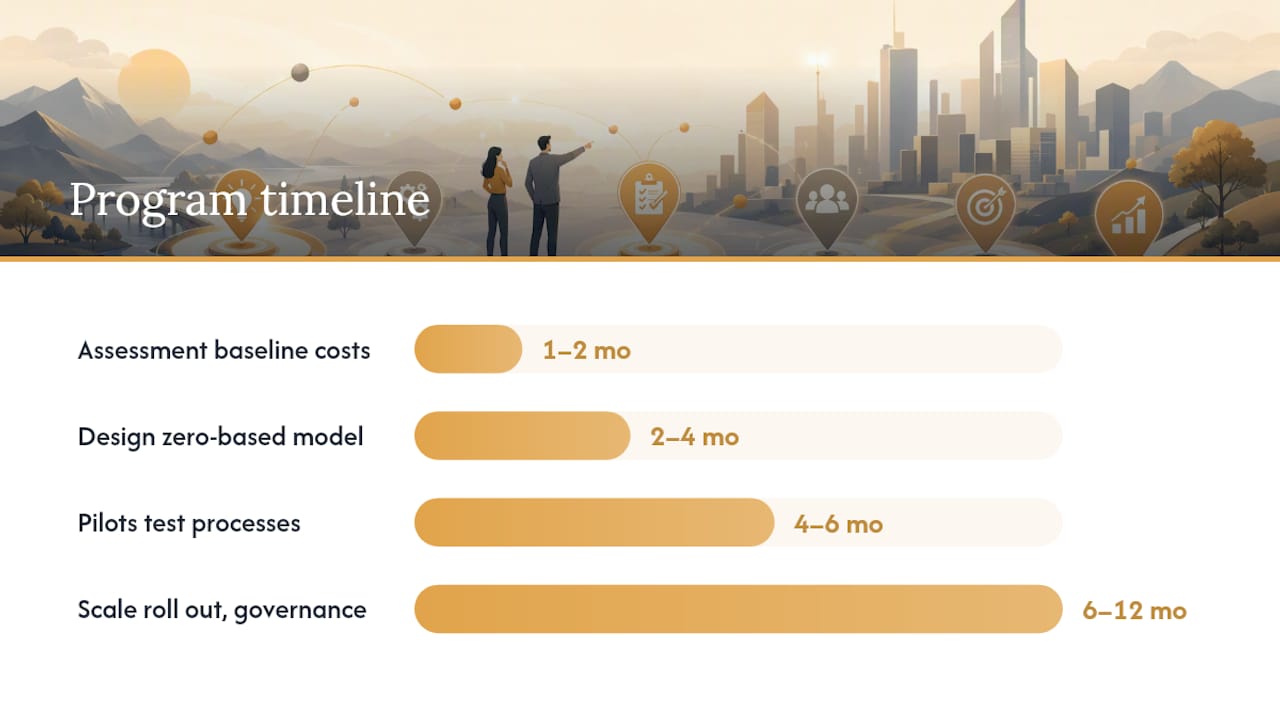
Program timeline
| Phase | Months | Key Activities |
|---|---|---|
| Assessment | 1–2 | Baseline costs, map processes, identify top — cost drivers |
| Design | 2–4 | Build zero-based model, identify structural changes, set targets |
| Pilots | 4–6 | Test redesigned processes in 1–2 business units |
| Scale | 6–12 | Roll out across the organization, embed governance |
Grant Thornton's Q1 2026 research found that 28% of finance leaders do not plan to cut costs at all, preferring targeted discipline over broad reductions. That's a meaningful signal: the best operators are building capability, not just trimming.
That buffer lets you respond to a downturn without emergency cuts.
Pro Tip: Cost creep is almost always a governance failure, not a spending failure. Prevent it by tying cost targets to individual performance reviews, running rolling 12-month forecasts (not just annual budgets), and scheduling a quarterly "zero-based challenge" on your top five cost categories. The discipline is in the calendar, not the spreadsheet.
Your 30/60/90-day cost reduction checklist
Measure your baseline OER before you start. Every item below needs a before-and-after number to be verifiable.
30 days (Quick wins)
- Cancel or downgrade unused SaaS and subscriptions. Owner: Finance or Operations. Savings: Medium.
- Audit overtime and flag scheduling inefficiencies. Owner: HR or Operations. Savings: Medium.
- Pull vendor spend data and identify top three renegotiation targets. Owner: Finance. Savings: High.
- Switch off equipment and lighting on a scheduled timer. Owner: Facilities. Savings: Low.
- Assign a named owner to every active cost initiative. Owner: CFO or GM. Savings: Enables all others.
60 days (Medium-term moves)
- Complete first vendor renegotiation using 12-month spend data. Owner: Finance or Procurement. Savings: High.
- Launch one AP or reporting automation pilot. Owner: Operations or Finance. Savings: Medium.
- Conduct an energy audit and implement no-cost fixes. Owner: Facilities. Savings: Low–Medium.
- Review contractor and temp-agency spend for direct-hire opportunities. Owner: HR. Savings: Medium.
- Consolidate overlapping software tools. Owner: IT or Operations. Savings: Medium.
90 days (Structural shifts)
- Complete a full cost audit across all P&L line items. Owner: Finance. Savings: High.
- Model lease renegotiation or footprint reduction options. Owner: Finance + Facilities. Savings: High.
- Implement cross-training program for two or more key roles. Owner: HR. Savings: Medium.
- Present ZBB or ZBR business case to leadership. Owner: CFO. Savings: Long-term, High.
For small businesses in the $500K–$2M revenue range, targeting 4–6 high-impact line items can produce meaningful savings in a single quarter without touching headcount.
What cost audits actually reveal — and why most businesses get this wrong
The single thing that surprises most business owners in a cost audit isn't the big line items. It's the accumulation of small ones nobody owns. A $200 subscription here, a $400 monthly retainer there, a contractor invoice that auto-renews every quarter — none of them individually justify a conversation, so nobody has one.
The second surprise is how rarely costs are tied to outcomes. Most businesses can tell you what they spend on marketing. Very few can tell you the cost per acquired customer, the revenue per dollar of payroll, or the processing cost per invoice. Without those ratios, cost management is guesswork.
The framing that works in coaching is this: cost optimization isn't about spending less. It's about spending better. Every dollar you free from a low-value activity is a dollar you can redeploy into something that grows the business. That reframe changes the conversation from "what do we cut?" to "what do we want to fund?"
A few things worth keeping in mind as you work through your own program:
- Engage your team early. The people closest to the work almost always know where the waste is. A 30-minute team session asking "where do we do things twice?" consistently surfaces more ideas than a top-down audit.
- Protect momentum. The first 30 days of a cost program generate energy. If the first round of wins isn't communicated and celebrated, the initiative stalls before the structural changes take hold.
If you want a structured starting point, the 30/60/90 checklist above is the right place to begin. For a deeper program, Championbusinesscoaching works with business owners to run cost audits, build governance frameworks, and turn one-off savings into durable operating discipline.
Ready to turn cost savings into a growth engine?
Championbusinesscoaching works with business owners and managers across Australia to build cost programs that stick. The 90-day coaching guarantee means you see measurable results or the session is free. Whether you need help running your first cost audit, building a ZBB model, or holding your team accountable to savings targets, the coaching programs are built around your specific numbers and operating model.
Book a free consultation and bring your last three months of P&L. That's all you need to start.
Sources
- The New Case for Zero-Based Cost Management | Bain & Company
- Cost optimization strategies | Deloitte Insights
- Cost management in 2026 | Grant Thornton
- Optimize, not just cut, costs: How to manage costs during uncertainty
- A guide to cost reduction strategies for businesses | Stripe
This article is general information, not a substitute for advice from a qualified financial advisor. Consult a qualified financial professional about your own circumstances before acting on anything here.