
Use a decision-first 90-day framework: pick 3–5 priorities, name an owner and metric for each, run an action-first QBR to lock commitments, then hold weekly check-ins to protect them. The next step is concrete: block a 30 to 90 minute leadership session this week and walk out with a written decision list, not a slide deck.
TL;DR:
- Limiting priorities to 3–5 with clear owners and metrics prevents overcommitment and ensures teams focus on achievable goals within capacity.
- Running a decision-first quarterly review capped at five slides accelerates consensus and significantly improves commitment hit rates compared to traditional status meetings.
- Weekly updates with escalation rules and a commitment tracker keep progress visible, reducing drift and enabling timely course corrections.
- Fixes for common planning failures include capacity-based commitment lines, a short intake process, and accountability through designated owners.
- Facilitating the process with a coach can streamline implementation, generate concrete commitments, and deliver results within 90 days, backed by a performance guarantee.
Table of Contents
- What Is a Quarterly Planning Framework, and Why 90 Days?
- A Six-Part Blueprint You Can Copy This Quarter
- How to Run the Quarter: Timeline and Template Fields
- Meeting Formats: QBR, Weekly Check-Ins, and Monthly Reviews
- Templates to Build: Trackers, KPI Trees, and Scorecards
- How Do You Prioritize Without Overcommitting?
- Weekly, Monthly, and Quarter-Close Follow-Up
- Why Do Quarterly Plans Fail, and What Fixes Them?
- A Coaching Perspective on Quarterly Planning
- How Championbusinesscoaching Helps Run Your First Quarter
- Sources
What Is a Quarterly Planning Framework, and Why 90 Days?
A quarterly planning framework is a repeatable structure for deciding what a team will do over the next 90 days, who owns each commitment, and how progress gets checked before the quarter ends. Ninety days is long enough to finish meaningful work and short enough that priorities do not drift into vague annual goals nobody revisits until December.
Most quarterly business plan efforts fail for a specific reason: they produce a document instead of a decision. Teams spend a week building slides, present them once, then never look at the deck again. A real quarterly planning process flips that. It treats the quarter as a small number of binding commitments, tracked weekly, with a named owner accountable for each one.
The reinforcing part matters more than most guides admit. The commitments closed at the end of one quarter become the starting scorecard for the next, which is what keeps the whole cycle honest over time rather than resetting to zero every 90 days.
A Six-Part Blueprint You Can Copy This Quarter
Every quarterly business review process needs the same six moving parts, run in order. Skip one and the cycle breaks down somewhere in month two.
- Prepare — leaders and team owners fill out an intake form with proposed priorities, supporting data, and current capacity.
- Decide — a prioritization workshop scores ideas and narrows the list to what the quarter can actually hold.
- Commit — each surviving priority gets a named owner, a metric, a target, and a due date.
- Communicate — the decision list and commitment tracker go out to the full team, not just leadership.
- Execute — weekly check-ins track status against the commitment tracker.
- Review — a quarter-close session scores hit rate and feeds unfinished or new priorities into the next cycle.
The inputs are simple: last quarter's results, current capacity, and a short list of candidate priorities. The output is a single decision list plus a commitment tracker, owned by a designated facilitator (often a general manager or operations lead) who runs the workshop and holds people to the calendar, not just the plan.
How to Run the Quarter: Timeline and Template Fields
Treat the 90 days as four checkpoints, not one big planning event.
- Pre work (week before) — send an intake form asking for a proposed priority, expected impact, effort estimate, and current team capacity. Gather last quarter's commitment tracker as evidence.
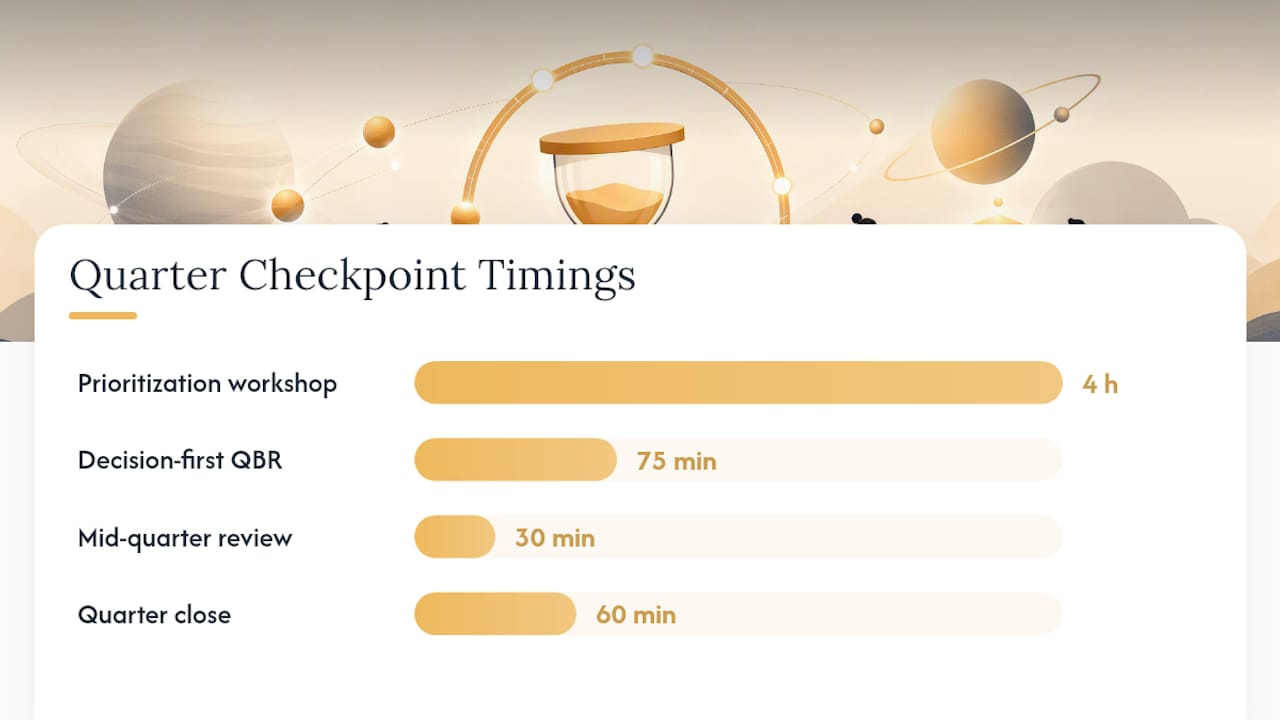
- Prioritization workshop (half day) — score each candidate priority using RICE or a simple impact/effort grid, then rank. Structured pre-work and a consistent scoring method cut down political debate and speed up alignment considerably.
- Decision-first QBR (60 to 90 minutes) — present 3–5 decisions up front, capped at five slides total.
- Mid-quarter review (30 minutes, week six) — check leading indicators and adjust if a commitment is off track.
- Quarter close (60 minutes) — score commitment hit rate and roll open items into the next intake form.
Every commitment record needs four fields, no more: owner, metric, target, and due date, plus a status column updated weekly.
Pro Tip: Write each priority as an if-then plan ("If hiring stalls past week four, then we pause the marketing hire and reallocate budget to the ops role") before the quarter starts. A 2024 meta-analysis of 642 tests found this kind of if-then implementation planning reliably improves follow-through compared with a plain goal statement.
Meeting Formats: QBR, Weekly Check-Ins, and Monthly Reviews
The decision-first QBR is the anchor meeting of the whole quarterly review process. Structure it in four blocks:
- Decisions (first 20 minutes) — present the 3 to 5 decisions that need a yes or no, not a status update.
- KPI review (15 minutes) — walk the KPI tree, flagging anything red.
- Commitments (15 minutes) — confirm owners, metrics, and due dates for the quarter ahead.
- Risks (10 minutes) — name the two or three biggest threats to the plan and who owns watching them.
Companies running this action-first format hit roughly 78% of their commitments, compared with about 34% for teams that run traditional status-review decks, according to practitioner data on QBR structure.
Weekly check-ins run on a traffic-light script: each owner gives a 60-second update (green, yellow, or red), and anything red gets escalated to a named decision-maker before the meeting ends. Monthly reviews sit between the weekly cadence and the full QBR, giving a checkpoint to catch drift before it becomes a missed quarter.
Templates to Build: Trackers, KPI Trees, and Scorecards
Three artifacts do almost all the work in a functional quarterly goals template system.
- Commitment tracker: columns for owner, metric, target, due date, status, and notes. A sample row: "Owner: Sarah T., Metric: new client bookings, Target: 12, Due: March 31, Status: on track."
- KPI tree: top-level metrics (revenue, margin, retention) branching down into the team-level metrics that drive them, so nobody argues about which number matters most.
- Weekly scorecard: one row per commitment, refreshed in about 15 minutes each Monday, feeding directly into the check-in script.
Pro Tip: Keep the scoring column mechanical. Pick one prioritization method, RICE or impact/effort, and enforce a single spreadsheet column per criterion so comparing ideas is a calculation, not a negotiation.
How Do You Prioritize Without Overcommitting?
Overcommitment kills more quarters than bad ideas do. Fix it with three rules.
- Cap company priorities at 3 to 5, and limit each team to 1 to 3 of their own inside that set.
- Run the T-shirt test: if a priority cannot be described in one sentence a new hire would understand, it is not ready for the quarter.
- Set a commitment line: draw it after the priorities the team's real capacity supports, and push everything below the line into the "if capacity allows" bucket.
Capacity accounting makes the line real instead of aspirational. Knowledge workers nominally have 40-hour weeks, but after meetings and administrative load, most only have 15 to 20 hours of deep work available. A five-person team at 18 deep-work hours each has 90 hours a week to spend on quarterly commitments, not 200. Do that math before the workshop, not after the QBR, and the trade-off conversation, what gets dropped to make room, happens on purpose instead of by accident.
Weekly, Monthly, and Quarter-Close Follow-Up
Commitments made in the QBR only survive if the follow-up rhythm holds.
- Weekly: each owner posts a status update; any blocker gets escalated within 48 hours rather than sitting in a parking lot.
- Monthly: a short review checks leading indicators against the KPI tree and flags anything trending off course.
- Quarter close: tally the commitment hit rate (commitments completed divided by commitments made) and carry unfinished items into the next intake form.
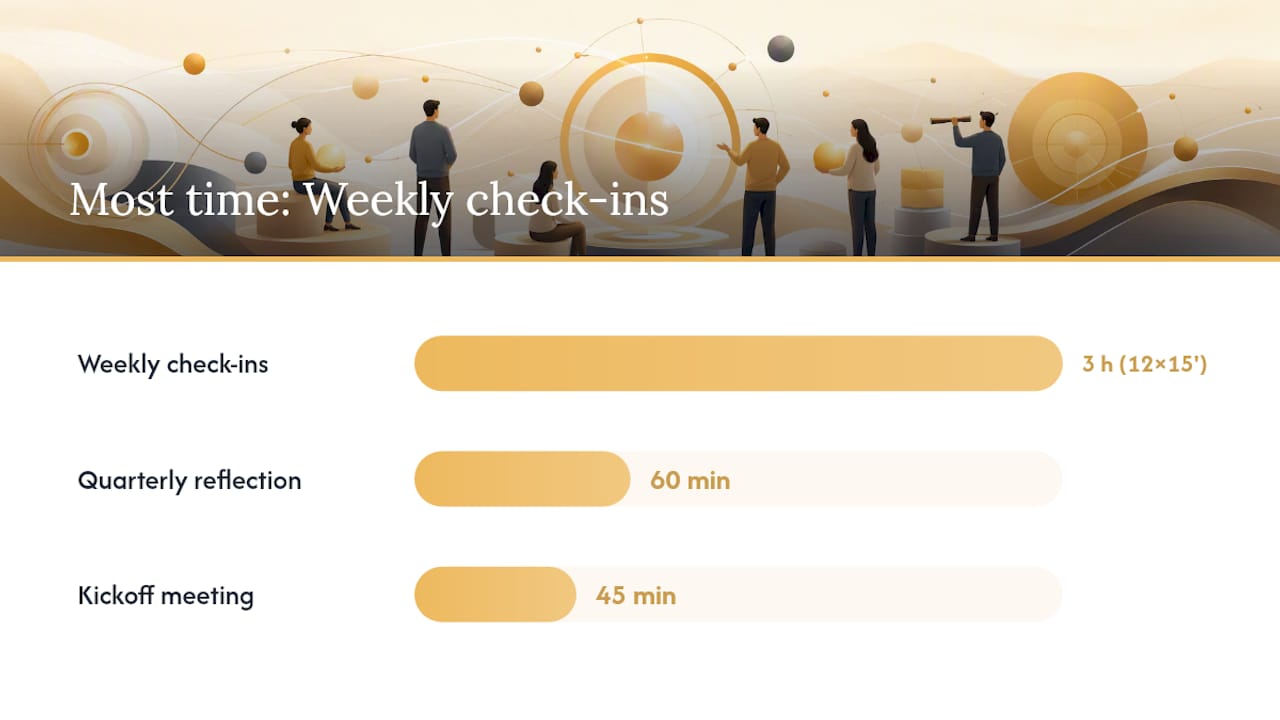
The Focus Quarter template keeps this cheap: a 45-minute kickoff, twelve 15-minute weekly check-ins, and a 60-minute quarterly reflection, roughly five hours of meeting time across three full months.
Pro Tip: If a decision cannot be resolved in seven minutes of discussion, stop debating. Assign a named owner and a five-business-day deadline instead of letting it drift into next week's meeting.
Named-owner and weekly-update rules consistently reduce slippage and keep commitment status visible to the whole team, not just the person responsible.
Why Do Quarterly Plans Fail, and What Fixes Them?
Four failure patterns show up in nearly every organization that has tried and abandoned quarterly planning before.
- Planning theater: a 40-slide deck nobody references after the kickoff. Fix it with an action-first QBR capped at five slides and 3 to 5 decisions.
- Overcommitment: too many priorities for the team's real hours. Fix it with a capacity budget and a hard commitment line drawn before the workshop.
- No ownership: commitments with no single accountable person drift silently. Fix it by requiring one named owner per commitment plus a weekly status update.
- Prep failures: teams walk into the workshop without data, so debates turn political. Fix it with a short intake form and a shared evidence pack sent out a week ahead.
A Coaching Perspective on Quarterly Planning
The frameworks in this article are not theoretical. They reflect what actually separates businesses that hit their quarterly goals from those that keep rewriting the same plan every 90 days: fewer priorities, named owners, and a meeting that ends in decisions instead of applause.
The most common mistake is not lack of ambition, it is lack of arithmetic. Teams write down more than their real capacity can carry, then blame execution when the plan collapses in week seven. A capacity-honest commitment line, checked weekly, fixes more quarters than any new goal-setting framework ever will.
Championbusinesscoaching builds this discipline directly into its coaching engagements, backed by a 90-day guarantee: results or the coaching session is free. Readers who want a facilitated version of this process, rather than building it alone, can bring a coach into the room for the first prioritization workshop.
— Duncan
How Championbusinesscoaching Helps Run Your First Quarter
Most businesses that try quarterly planning alone burn a full day building slides nobody revisits by week three. Championbusinesscoaching skips that step entirely: a coach facilitates the prioritization workshop and the decision-first QBR directly, so the leadership team walks out with a signed commitment tracker instead of a deck.
That facilitation sits inside broader business coaching programs covering strategic planning, capacity accounting, and the weekly check-in cadence that keeps commitments from slipping. Coaches also help teams build the KPI tree and commitment tracker fields covered above, so nothing gets built from scratch twice. For teams that want a facilitated planning conversation rather than a solo effort, structured coaching and consulting support can shape how those priority discussions actually run.
Every engagement carries the 90-day guarantee: results or the coaching session is free. To get started, book a consultation and set a date for the first prioritization workshop before the quarter starts, not after it has already slipped a month.
Sources
- Meta-analysis: implementation intentions across 642 tests (2024)
- Run a Quarterly Business Review That Drives Action - PMGuru
- Quarterly Planning Template: The Focus Quarter (12-Week Guide)
- The Complete Guide to Quarterly Planning - Cutline