
A probation period in Australia is a contractual trial phase, usually three to six months, that lets an employer and a new hire confirm the role is a good fit. It is not a separate legal category. The single most important reality is this: probation does not switch off statutory protections. The Fair Work Ombudsman confirms employees keep National Employment Standards (NES) entitlements throughout, and dismissal still generally requires notice or payment in lieu, except in cases of serious misconduct.
- Typical probation length is commonly from a few months up to around a year for senior roles
- NES rights (pay, leave accrual, super) apply from day one
- Unfair dismissal protection kicks in after a minimum employment period, not after probation ends
Quick fact: the minimum employment period for unfair dismissal claims generally depends on the size of the employer, with longer periods often applied to smaller businesses, regardless of how long the contract labels someone as "on probation."
Whether you're an employer setting up your first contract or an employee wondering what happens if things go sideways, check your actual employment contract for notice terms before assuming anything. This guide covers both sides.
Key Takeaways
Probation in Australia is a contractual trial period, typically three to six months, that never suspends an employee's NES entitlements or protection from unlawful dismissal.
| Point | Details |
|---|---|
| Probation length | Most contracts set 3 to 6 months, with up to 12 months for senior roles. |
| Rights don't pause | Pay, super, leave accrual, and safety protections apply from day one of employment. |
| Notice still applies | Employers generally owe at least one week's notice or pay in lieu, except for serious misconduct. |
| Unfair dismissal threshold | 6 months for most employers, 12 months for small businesses under 15 staff |
| Structured support | Champion Business Coaching provides contract templates and coaching to help employers document probation fairly. |
Table of Contents
- What a Probation Period Actually Means in Australia
- How Long Is Probation in Australia?
- What Employees Are Entitled to During Probation
- Notice and Termination Rules During Probation
- Reaching the End of Probation: Confirm, Extend, or Terminate
- Who's Responsible for What During Probation
- A Practical Probation Timeline and Checklist
- If You Think Your Dismissal During Probation Was Unfair
- Sample Wording for Probation Clauses
- Why So Many Probation Decisions Fall Apart at the Commission
- Getting Probation Right Before It Becomes a Problem
- Where to Verify These Rules
- Frequently Asked Questions
- Sources
What a Probation Period Actually Means in Australia
Probation is a trial window an employer builds into an employment contract, not a status defined by the Fair Work Act itself. It exists so both sides can test the fit: the employer evaluates performance and cultural fit, and the employee gets a genuine look at the job before committing long term. As Sprintlaw explains, probation should be spelled out in writing, supported by documented check-ins, but it creates no separate legal tier of employment.
That distinction matters because employees are full employees from their first shift. They are covered by:
- The National Employment Standards
- Any applicable modern award or enterprise agreement
- Workplace health and safety laws
- Anti-discrimination and adverse action protections
If a modern award sets specific probation or notice terms for the role, those terms sit above whatever the individual contract says. Always check the award before assuming the contract is the final word.
How Long Is Probation in Australia?
Most Australian probation periods run three to six months, and that range covers the overwhelming majority of standard hires. Senior or executive roles sometimes stretch to nine or twelve months, reflecting the longer runway needed to judge performance at that level, according to guidance from the Fair Work Ombudsman.
Contractual probation and the Fair Work Act's minimum employment period are two different clocks, and mixing them up causes real confusion. Probation is set by the employer in the contract. The minimum employment period, by contrast, is fixed by law: 6 months for most employers, 12 months for small businesses with under 15 staff. An employee can be "confirmed" past probation at the three month mark and still not qualify for unfair dismissal protection until that legal threshold passes.
Pro Tip: Match the probation length to how long it genuinely takes to assess the role. A three-month probation for a complex technical hire often isn't enough time to see real performance data. If you need more time, extend it properly with a documented reason rather than letting it quietly lapse.
What Employees Are Entitled to During Probation
Employees on probation keep every NES entitlement that applies to permanent staff, including ordinary pay, superannuation contributions, and leave accrual. Nothing about being "on probation" pauses these rights, and the Fair Work Ombudsman is explicit on this point.
That covers:
- Minimum wage and applicable award pay rates
- Superannuation guarantee contributions
- Annual leave and personal leave accrual (for permanent employees)
- Public holiday entitlements
- Protection from workplace discrimination and unsafe conditions
- Adverse action protections, which apply from day one with no minimum service requirement
Here's a scenario worth knowing: if an employee is terminated during month four of a six month probation period, any accrued but untaken annual leave must still be paid out. Probation shortens the trial, not the entitlements. Check your modern award or enterprise agreement too — some set out specific notice or review clauses for probationary staff that override generic contract wording.
Notice and Termination Rules During Probation
Being on probation does not mean an employer can terminate someone on the spot without notice. Outside of serious misconduct, notice periods in line with the National Employment Standards still generally apply, and the Fair Work Commission's guidance requires written notice of the termination date or payment in lieu.
| Length of continuous service | Minimum notice period |
|---|---|
| 1 year or less | 1 week |
| 1 to 3 years | 2 weeks |
| 3 years | 3 weeks |
| More than 3 years | 4 weeks |
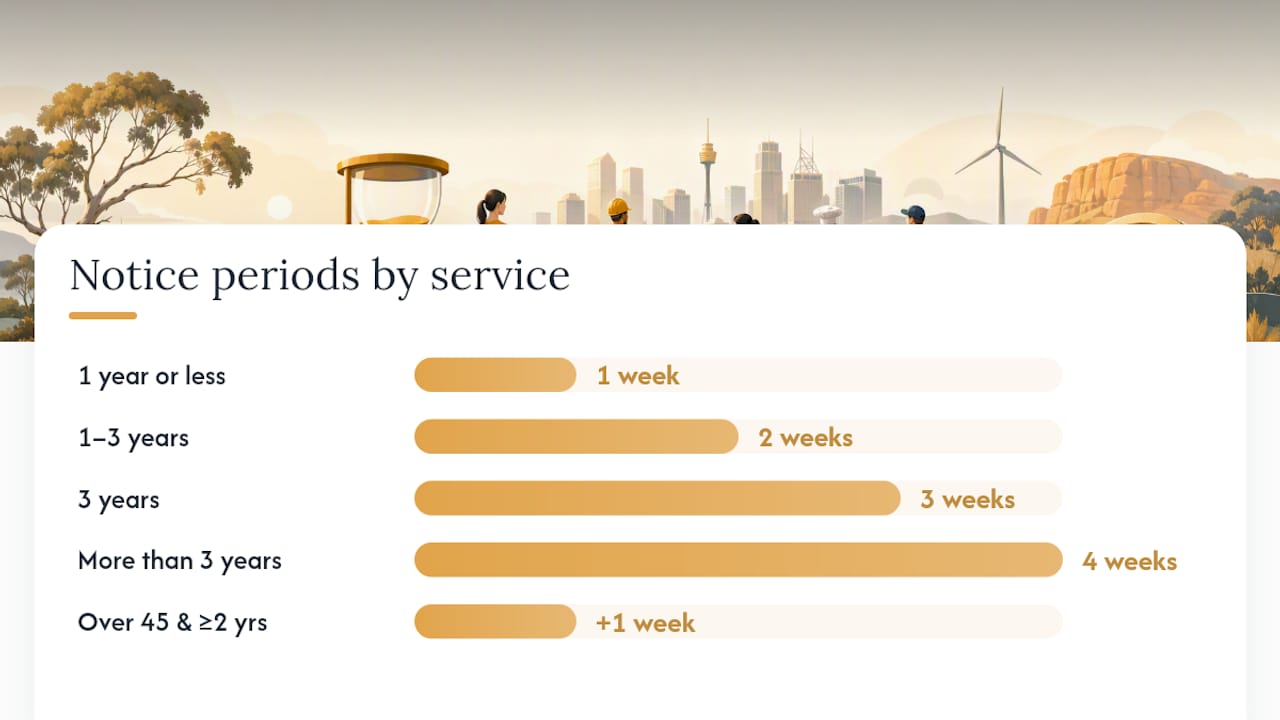
Add one extra week if the employee is over 45 and has completed at least two years of service. Most probationary dismissals fall into the "1 year or less" row, meaning a single week of notice or pay in lieu, but always cross-check the contract and award for anything more generous.
Whether an employee can challenge the dismissal as unfair depends on the minimum employment period: 12 months for small businesses under 15 employees, 6 months for everyone else. If they clear that threshold, they have a limited time after dismissal to lodge an unfair dismissal application with the Fair Work Commission. That window is strict and rarely extended.
One separate track matters regardless of tenure: adverse action claims have no minimum service requirement. An employer cannot lawfully terminate someone during week two of probation for a discriminatory or retaliatory reason and expect the short tenure to shield them.
Reaching the End of Probation: Confirm, Extend, or Terminate
Three outcomes exist at the end of a probation period, and each carries different obligations.
- Confirm employment. The role becomes ongoing under existing or updated terms; document the confirmation in writing.
- Extend probation. Only do this with a clear, written reason (inconsistent performance, insufficient data to judge fit) and a defined end date, ideally with the employee's acknowledgment.
- Terminate. Provide the required notice or pay in lieu, pay out accrued leave, and document the performance basis for the decision.
A short extension letter should cover the original probation end date, the specific reason for extending, the new review date, and what improvement looks like. A termination letter should state the effective date, the notice or payment in lieu provided, and a brief, factual basis for the decision. Employers who skip documentation at this stage are the ones who end up defending vague, inconsistent decisions later. Seek's guide to probation makes the same point: unused leave still gets paid out, and termination should be handled the same way regardless of how the probation "went."
Who's Responsible for What During Probation
Probation works when both sides act reasonably, not just when the employer sets expectations. Employers need to define what success looks like; employees need to actually engage with the feedback they're given.
Employer responsibilities:
- Set clear KPIs and expectations at the start, not halfway through
- Schedule regular, documented check-ins (not just a single meeting at the three month mark)
- Provide adequate training and resources to succeed in the role
- Keep objective written records of performance conversations
Employee responsibilities:
- Ask for clarity early if expectations feel vague
- Request feedback rather than waiting for a formal review
- Keep your own notes on conversations and instructions received
- Raise concerns about workload, safety, or treatment promptly, in writing where possible
Pro Tip: If performance issues show up, use an informal conversation first. Reserve a formal, written performance improvement step for issues that persist after that initial chat. A documented paper trail protects everyone, and it's exactly what a coherent, structured KPI process, as Sprintlaw's employer guide recommends, is designed to produce.
A Practical Probation Timeline and Checklist
Following a structured timeline reduces legal risk and produces better hiring decisions, because it forces documented check-ins instead of a single pass/fail judgment at the finish line.
- Day 1: Issue the written contract with the probation clause, KPIs, and review dates clearly stated.
- Two week check-in: Informal conversation confirming onboarding is on track and expectations are understood.
- Midpoint review: Formal, documented assessment against the original KPIs, with written notes.
- Final review (before end date): Decision point: confirm, extend with reasons, or terminate with notice.
A basic probation clause might read: "The employee's employment is subject to a probationary period of [3/6] months from the commencement date. During this period, either party may terminate employment by providing [X weeks'] notice or payment in lieu, except in cases of serious misconduct. The employer may extend the probationary period by up to [1 to 3 months] where additional time is required to assess performance."
Pro Tip: Keep extensions to one to three months. Anything longer starts to look less like a genuine assessment period and more like an attempt to delay statutory entitlements, which is exactly the kind of pattern the Fair Work Commission scrutinizes.
If You Think Your Dismissal During Probation Was Unfair
Start documenting immediately if you believe a probation dismissal was unfair or discriminatory. Timelines are tight, and evidence gets harder to gather the longer you wait.
- Gather your employment contract, any performance reviews, emails, and text messages related to the dismissal.
- Contact the Fair Work Ombudsman for a free assessment of your situation and entitlements.
- Work out which claim applies: unfair dismissal (requires meeting the minimum employment period) or adverse action (no minimum service required).
- Speak with an employment lawyer or your union before lodging anything formal.
If unfair dismissal applies, you have a limited time from the dismissal date to lodge with the Fair Work Commission. Adverse action claims run on a different, generally longer timeframe, but don't sit on either option once you suspect something was wrong.
Sample Wording for Probation Clauses
A solid probation clause states four things plainly: the duration, when reviews happen, what notice applies during the period, and how outcomes get communicated. Vague language is where disputes start.
Two short examples:
Standard clause: "This position includes a probationary period of six months. Performance will be reviewed at eight and twenty weeks. Either party may end employment during probation with one week's notice or payment in lieu."
Extension-friendly clause: "The employer may extend the probationary period once, by up to three months, where further assessment is reasonably required. The employee will be notified in writing of any extension and the reasons for it."
Do:
- State a specific duration and review dates
- Reference the applicable award's minimum notice if it's higher than the contract default
Don't:
- Use "at will" language borrowed from US contract templates; it has no standing under Australian law
- Assume probation removes the need to check the Small Business Fair Dismissal Code if you're a small employer
Pro Tip: Small businesses should keep a printed or saved copy of the Small Business Fair Dismissal Code checklist on file every time they dismiss a probationary employee. It's the clearest evidence you followed a fair process if a dispute ever lands at the Fair Work Commission.
Why So Many Probation Decisions Fall Apart at the Commission
The pattern shows up again and again: employers treat probation as a grace period where normal rules don't apply, then get blindsided when a dismissal gets challenged. It's rarely bad faith. It's usually a manager who assumed "still on probation" meant "no paperwork needed."
The employers who avoid trouble aren't necessarily the ones with the best lawyers. They're the ones who ran a boring, repeatable process: KPIs written down on day one, a check-in at two weeks that actually happened, notes from every performance conversation. That discipline is what Sprintlaw's guide for employers points to when it recommends scheduled feedback over ad hoc conversations.
The other underrated issue is on the employee side. Workers assume probation means they have fewer rights, so they don't push back on vague expectations or ask for feedback in writing. That silence works against them if things later go wrong, because there's no paper trail showing they raised concerns early. Probation is meant to run both ways: it is a two way test, not a one sided audition, and both parties benefit from treating it that way from day one.
Getting Probation Right Before It Becomes a Problem
Champion Business Coaching helps Australian employers build probation processes that actually hold up, not just contracts that sound good on paper. If you're setting up a new hire's probation clause or trying to work out why your last three probationary reviews felt like guesswork, that's exactly where a structured coaching relationship pays for itself.

Through Business Coaching Australia, you get access to practical tools built for exactly this stage of the employment lifecycle: position description generators, employment contract templates, and staff management resources that turn "we'll figure it out as we go" into a documented KPI and review schedule from day one. Small business owners running their first few hires benefit most, since a missed notice period or an undocumented dismissal is where legal risk concentrates. If your onboarding and performance review process needs a second set of eyes, request a consultation and get a clear plan before your next probation clock starts ticking.
Where to Verify These Rules
- Fair Work Ombudsman: official guidance on probation length and entitlements.
- Fair Work Commission: NES notice period rules and unfair dismissal processes.
- Small Business Fair Dismissal Code: procedural guidance for small employers.
- Sprintlaw: plain-English breakdown of probation law and contract drafting.
Always check the modern award or enterprise agreement covering the role, and contact the Fair Work Ombudsman directly for disputes specific to your situation.
Frequently Asked Questions
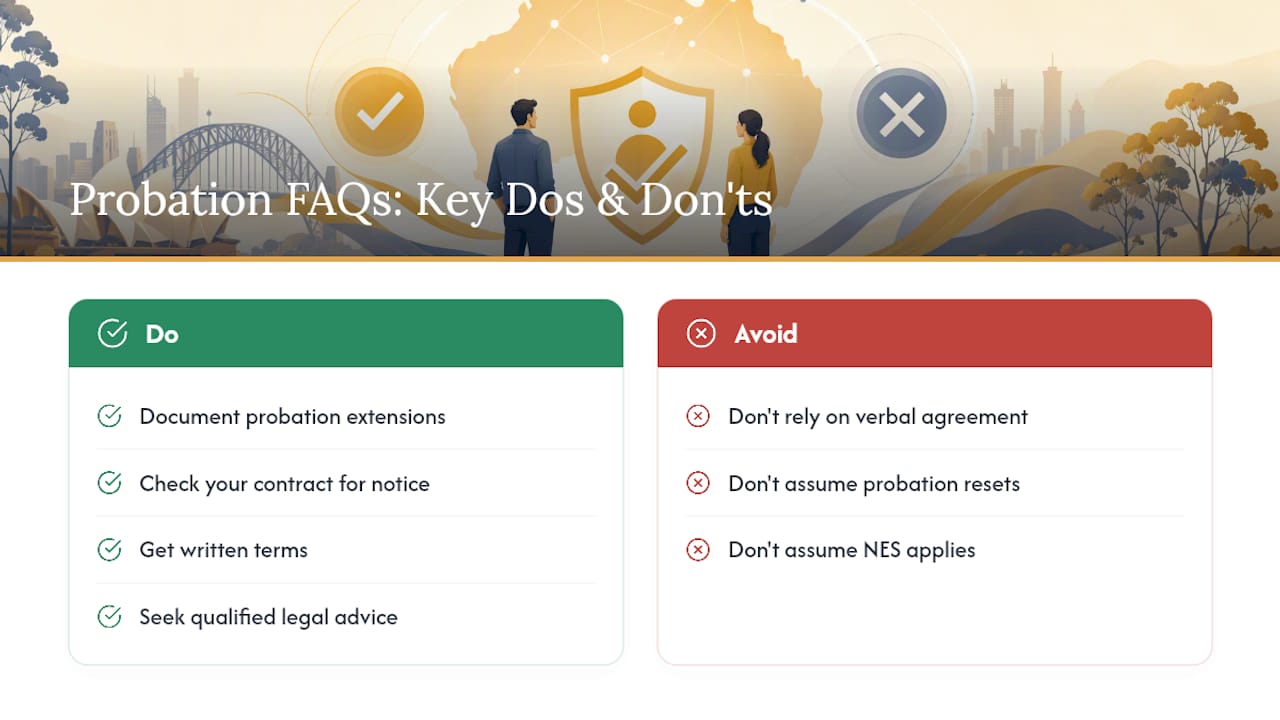
Can an employer extend probation without the employee's agreement? Generally yes, if the contract allows it, but a documented reason and clear new end date make the extension far more defensible if challenged later.
Does probation reset if I move to a new role internally? Not automatically. Continuous service usually carries over for the minimum employment period calculation, even if a new internal probation clause applies to the role itself.
Is a verbal probation agreement legally valid in Australia? It can be, but written terms are strongly recommended since disputes over notice periods or review dates are far harder to resolve without documentation.
What's the difference between probation and a fixed-term contract? Probation is a trial phase within an ongoing role. A fixed-term contract has a defined end date from the start and ends automatically unless renewed or converted.
Can I resign during probation, and what notice do I owe? Yes. Check your contract for the specified notice period during probation; if it's silent, the NES minimum notice periods for employees don't apply the same way, so award terms may govern instead.
This article is general information, not a substitute for advice from a qualified lawyer. Consult a qualified legal professional about your own circumstances before acting on anything here.
Sources
- Probation - Fair Work Ombudsman
- Fair Work Act 2009 — Notice of termination (NES guidance) - Fair Work Commission
- Probation Meaning: Probationary Periods Under Australian Employment Law - Sprintlaw
- Probation Periods in Australia 2026: Legal Rules, Notice Periods, and What Employers Get Wrong - Scalesuite