
The performance review process works when it stops being an annual event and becomes a cycle: regular coaching conversations backed by a structured formal review that documents outcomes and locks in development actions. Skip the continuous part and the formal review turns into guesswork based on the last six weeks. Start with a fixed check-in cadence and one clear development action per employee, then build the rest of the process around it.
TL;DR:
- Continuous coaching conversations and structured formal reviews improve motivation, fairness, and behavioral change more than annual reviews alone.
- Most organizations fail to implement calibration steps, which help ensure rating consistency and prevent bias across teams.
- Preparation involving evidence collection and specific examples, along with a structured, timeboxed review conversation, lead to more effective performance discussions.
- Follow-up actions must be SMART and consistently documented, with a 90-day review cycle to track progress and determine if formal Performance Improvement Plans are necessary.
- Using simple templates, routine check-ins, and rehearsal techniques for difficult feedback significantly enhances managers’ ability to conduct constructive reviews.
Table of Contents
- Why the Traditional Performance Appraisal Process Falls Short
- What Are the Five Stages of an Effective Review Cycle?
- How Should Managers and Employees Prepare for a Review?
- How Do You Run the Review Conversation?
- What Happens After the Review Meeting?
- What Templates and Tools Actually Help?
- A Coach's View on Making Reviews Actually Work
- Sources
Why the Traditional Performance Appraisal Process Falls Short
Most performance appraisal steps fail for a predictable reason: managers treat the formal sitdown as the entire process instead of the summary of one. Done right, a review process delivers four things reliably. It aligns individual work to team and company goals. It keeps people motivated because they can see progress, not just judgment. It creates real development, because feedback ties to specific behavior instead of vague impressions. And it generates a paper trail that holds up if a promotion, pay rise, or termination decision gets challenged.
McKinsey's research on performance management found that managers who pair ongoing development conversations with a structured formal review see stronger motivation and a stronger sense of fairness than managers who rely on annual reviews alone. That single finding should reshape how most businesses plan their review calendar.
The failure modes are consistent across industries:
- Recency bias: the manager remembers last month vividly and last quarter barely at all, so the review reflects the wrong window.
- Coaching collapse: check-ins turn into status updates about deadlines, and nobody discusses skill growth until the annual review forces it.
- Rating compression: almost everyone lands in the "meets expectations" band because managers avoid conflict, which makes the rating useless for pay or promotion decisions.
Pro Tip: If your ratings distribution has more than 80% of people in one band, the problem isn't your staff. It's that your managers aren't documenting evidence throughout the year, so they default to the safe middle.
What Are the Five Stages of an Effective Review Cycle?
An effective performance appraisal method runs on five connected stages, not one meeting. The Human Capital Hub's performance management framework maps this as planning, monitoring, reviewing, and rewarding, with a calibration step wedged between the review and the reward to keep ratings honest across teams.
Here's how the five stages break down in practice:
- Planning: manager and employee co-write goals at the start of the cycle. Owner: manager, with employee input. Output: a written goal set with measurable targets.
- Monitoring: weekly or bi-weekly check-ins track progress and surface blockers early. Owner: manager. Output: brief notes logged after each check-in.
- Formal review: a scheduled conversation that synthesizes the monitoring notes into a documented assessment. Owner: manager, informed by employee self-assessment. Output: signed review document.
- Calibration: peer managers and HR compare ratings across teams to catch bias before scores go final. Owner: HR facilitator. Output: adjusted, defensible ratings.
- Consequences and rewards: pay decisions, promotions, or development plans follow from the calibrated outcome. Owner: manager plus HR. Output: action plan with dates.
| Stage | Recommended cadence | Primary output |
|---|---|---|
| Planning | Start of cycle (annual) | Written, measurable goals |
| Monitoring | Weekly or bi-weekly | Logged check-in notes |
| Formal review | Quarterly or biannual, minimum annual | Signed review document |
| Calibration | Same window as formal review | Adjusted, cross-checked ratings |
| Consequences/rewards | Immediately after calibration | Pay, promotion, or development plan |
Calibration is the stage most Australian small businesses skip, and it's the one that catches a manager who rates their whole team "exceeds expectations" because confrontation feels uncomfortable. The Human Capital Hub notes that regular check-ins combined with multiple formal review cycles each year produce more behavior change than a once-a-year conversation ever will, largely because feedback arrives close enough to the behavior to actually correct it.
How Should Managers and Employees Prepare for a Review?
Preparation is where most performance evaluation process breakdowns actually start, weeks before anyone sits down. A manager walking in with vague impressions instead of evidence will default to whatever happened most recently, and the employee will sense it.
Manager checklist, in order:
- Pull the original goals set at the last planning stage and note what changed.
- Collate evidence from check-in notes, project outcomes, and any peer or customer feedback gathered during the cycle.
- Draft two or three specific behavioral examples for each point of feedback, positive and constructive.
- Practice the harder conversations out loud, or run them past another manager first.
- Book a calibration prompt with HR or a peer manager before the rating goes final.
Employee self-assessment prompts:
- What were your three biggest wins this cycle, with a specific example for each?
- Where did you miss a target, and what got in the way?
- What support, tools, or training would remove that blocker next cycle?
- What's one skill you want to build in the next 90 days?
Culture Amp's guidance on manager reviews recommends combining manager assessment, employee self-reflection, and peer input as the three legs of a fair review. Leave one out and the rating tilts toward whoever has the loudest voice in the room, usually the manager's.
A workable template needs just a handful of fields: goal versus actual outcome, three pieces of supporting evidence, one strength with an example, one growth area with an example, and a single agreed development action with a date attached. Anything more elaborate tends to go unfilled.
How Do You Run the Review Conversation?
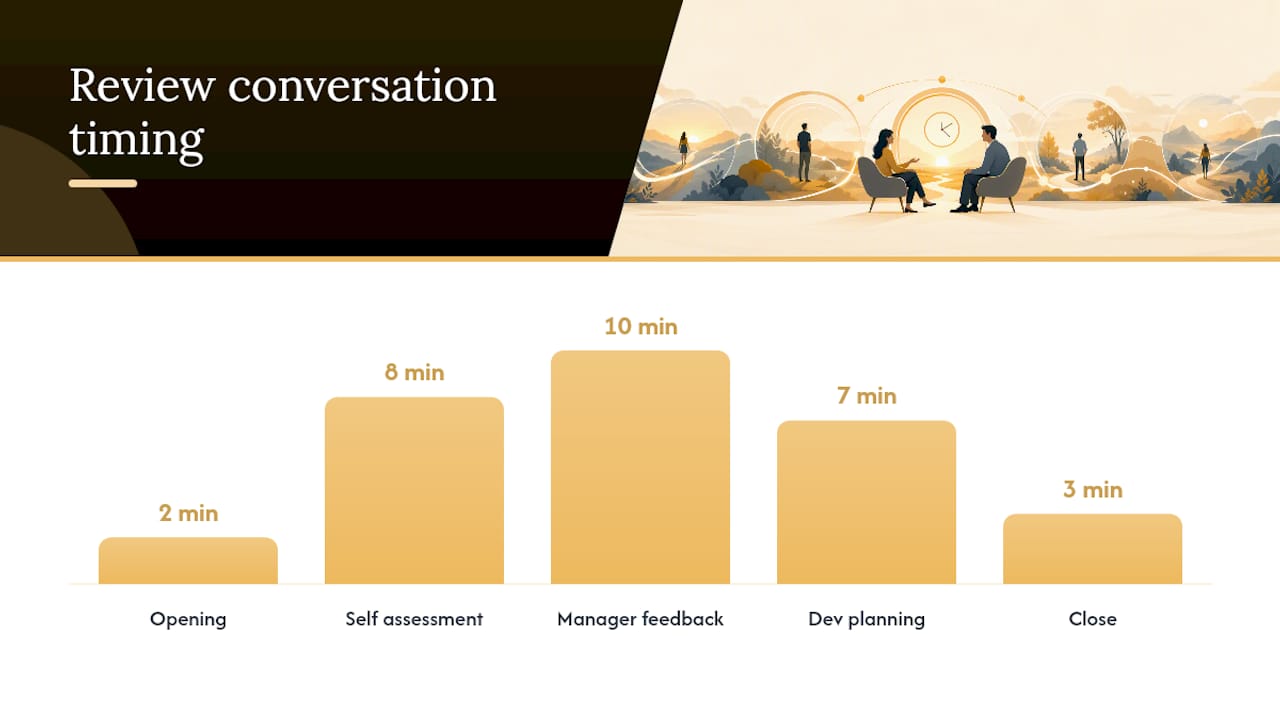
A 30-minute review conversation, timeboxed, beats an open-ended hour every time, because structure keeps both people honest and stops the meeting from drifting into a status update.
- Opening (2 minutes): state the purpose plainly. "This is a two-way conversation about the last quarter and what we build next."
- Employee self-assessment first (8 minutes): ask them to walk through their own wins and misses before you share your notes. This single sequencing choice does more for a productive performance review conversation guide than almost anything else, because it stops the manager's opinion from anchoring the whole discussion.
- Manager feedback (10 minutes): share your evidence, tie every point to a specific example, and resist generalizing ("you're always late" becomes "these three deadlines slipped, here's what I saw each time").
- Development planning (7 minutes): agree on one or two actions, not five, with dates and support attached.
- Close (3 minutes): summarize what was agreed and confirm the next check-in date.
The core communication technique across all five stages is simple: ask more, tell less. Instead of "your communication needs work," try "walk me through how that client update went from your side." The employee often identifies the same gap you saw, and a self-identified gap gets fixed faster than an imposed one.
Pro Tip: If you expect a defensive reaction, name it before it happens. Try: "I want to flag one area that might be tough to hear, and I want your read on it too." Naming the discomfort upfront usually lowers it.
When someone does get defensive mid-meeting, slow down rather than push through. Acknowledge the reaction ("I can see that lands differently than you expected"), ask a clarifying question, and if the temperature stays high, park the point and follow up in writing within 48 hours. Document what was said and agreed either way. A review conversation that gets heated and undocumented is the one that comes back to bite everyone in a dispute later.
McKinsey points out that managers who rehearse difficult feedback, including using generative AI tools to run through likely reactions, deliver clearer and less confrontational conversations than those who wing it.
What Happens After the Review Meeting?
The review conversation is worthless without a follow-up structure, which is where most employee evaluation process efforts quietly die. A development action needs to be SMART: specific, measurable, achievable, relevant, and time-bound. "Improve communication" is not an action. "Send a written project summary every Friday for the next eight weeks, reviewed together at the two-week mark" is.
Follow-up cadence matters more than the review itself in a lot of cases:
- Check in on the development action at the two-week mark, informally.
- Do a fuller progress check at 30 days.
- Reassess against the original metric at 90 days.
- Document each check-in, even a two-line note, so the record shows genuine support rather than a paper trail built for termination.
When performance doesn't improve despite documented support, that's the point to consider a formal Performance Improvement Plan. A fair PIP is specific about the gap, gives a realistic timeframe (usually 30 to 90 days), states exactly what support the business will provide, and spells out the consequence if targets aren't met. Fair Work's templates and tools are the right place to check the process is compliant before you start one, particularly if termination is a possible outcome. A well-structured performance improvement plan protects both the employee's chance to genuinely improve and the business's legal position if it doesn't work out.
What Templates and Tools Actually Help?
You don't need expensive software to run a good review process, but you do need consistent documentation, and the format matters less than whether people actually use it.
Self-assessment prompt template: three wins with evidence, two misses with context, one skill goal, one support request.
Manager evaluation form: goal versus outcome, three evidence points, one strength example, one growth example, agreed development action with a date.
30/60/90 follow-up plan: what changes by day 30, what evidence proves it by day 60, what the reassessment looks like at day 90.
Tool selection comes down to three categories, and most businesses only need one:
| Tool category | Best fit | Watch for |
|---|---|---|
| HRIS performance modules | Businesses with audit trails | Setup time and cost versus actual usage |
| Lightweight check-in apps | Teams wanting fast, frequent pulse feedback | Feature bloat nobody uses past month one |
| Shared documents | Small teams or solo managers starting out | No reminders, so cadence relies on discipline |
Pilot whatever you pick with one team for a full cycle before rolling it out company-wide, and measure adoption by a simple number: how many check-ins actually got logged versus how many were scheduled. If that gap is wide, the tool isn't the problem. The habit is. Reviewing your broader HR software options before committing saves you from paying for modules nobody opens.
A Coach's View on Making Reviews Actually Work
Most managers dread review conversations because they've never rehearsed one. I coach managers to run the hard version of the conversation out loud before they run the real one, sometimes with a colleague playing the employee, sometimes using AI as a sounding board to stress-test the wording of tough feedback before it lands on a real person. The rehearsal habit McKinsey documented isn't a nice extra. It's the difference between a manager who freezes mid-sentence and one who stays calm when the employee pushes back.
The businesses that get the most out of this process aren't the ones with the fanciest templates. They're the ones where the manager treats the check-in cadence as non-negotiable, the way they'd treat a client deadline. I've watched teams go from rating compression across the board to genuinely differentiated, defensible reviews within a single quarter, purely by adding structured weekly check-ins and one calibration conversation before ratings went final.
If you're building this discipline into your management team, structured coaching and a practice-based approach to leadership close the gap faster than another policy document ever will.
— Duncan
Sources
For the legal side of performance management, particularly where a review could lead to termination, Fair Work's templates and tools are the primary reference for Australian businesses, alongside guidance from the Fair Work Commission on procedural fairness.
For the research backing the continuous-conversation model, McKinsey's performance management insights and the Harvard Business Review study on narrative reviews are worth reading directly rather than secondhand.
For practical checklist structure, Culture Amp's manager guide and the Human Capital Hub's process breakdown both cover the planning-to-reward cycle in more depth than any single article can. If your team manages performance across distributed staff, this offshore team productivity guide covers check-in rhythms suited to remote setups.
Ready to build a review process your managers can actually run without dreading it? Book a session with Champion Business Coaching and get a structured plan built around your team, backed by a 90-day guarantee: real results, or the coaching session is free.
- What works—and doesn’t—in performance management (McKinsey)
- The definitive guide to the performance management process (Human Capital Hub)
- Templates and tools (Fair Work)
- A manager’s guide to employee performance reviews (Culture Amp)