
A working performance improvement plan follows six concrete steps: identify and document the issue, meet with the employee to agree on the plan, set SMART objectives, provide defined support, schedule regular check-ins, and document outcomes at every stage. Use a PIP when performance has genuinely dropped below a role's standard and coaching alone hasn't fixed it. Don't use one to manage out an employee you've already decided to fire, or to address a single bad week. Fair Work Commission unfair dismissal cases regularly turn on whether the PIP process was genuine or just paperwork before a foregone conclusion.
Here's the quick-action version you can copy into your calendar today:
- Write down the specific performance gap with dates and examples this week, before the memory fades.
- Send the draft to HR for a fairness check before you say a word to the employee.
- Book the kickoff meeting within five business days and bring a written copy of the plan.
- Set two to four measurable objectives with a 30, 60, or 90 day timeline.
- Lock in check-in dates on both calendars before the meeting ends.
- Have the performance evidence and dates ready before the meeting, not during it.
- Never launch a PIP without HR sign off, even in a small business.
- Build in employee input. A plan handed down with no discussion rarely gets genuine buy-in.
Pro Tip: Print the plan and bring two copies to the kickoff meeting: one for the employee to keep, one for both of you to sign. A plan that only lives in an email thread is much harder to defend later and easier for an employee to say they never saw.
Key Takeaways
A performance improvement plan works when it pairs objective, dated documentation with genuine manager support and a fixed review timeline, not when it's used as a formality before a decision that's already been made.
| Point | Details |
|---|---|
| Document with dates | Replace vague criticism with specific, dated incidents before drafting the plan. |
| Involve HR early | Route every draft through HR before the employee meeting to check fairness and reduce legal risk. |
| Set SMART objectives | Limit the plan to two to four measurable targets tied to a clear evidence source. |
| Coach, don't just audit | Treat check-ins as coaching conversations, not progress interrogations, to keep employees engaged. |
| Get expert support | Championbusinesscoaching helps managers build the plan and coaches them through the toughest conversations. |
Table of Contents
- What Are the Performance Improvement Plan Steps in Order?
- How Do You Write Measurable PIP Objectives?
- What Should a PIP Template Actually Include?
- How Long Should a Performance Improvement Plan Run?
- What Legal and Fairness Rules Apply to a PIP?
- What Should a Filled-In PIP Look Like?
- What Coaches See That Managers Often Miss
- Get Hands-On Support Running Your Next PIP
- Where to Find Official PIP Guidance and Templates
- Frequently Asked Questions
- Sources
What Are the Performance Improvement Plan Steps in Order?
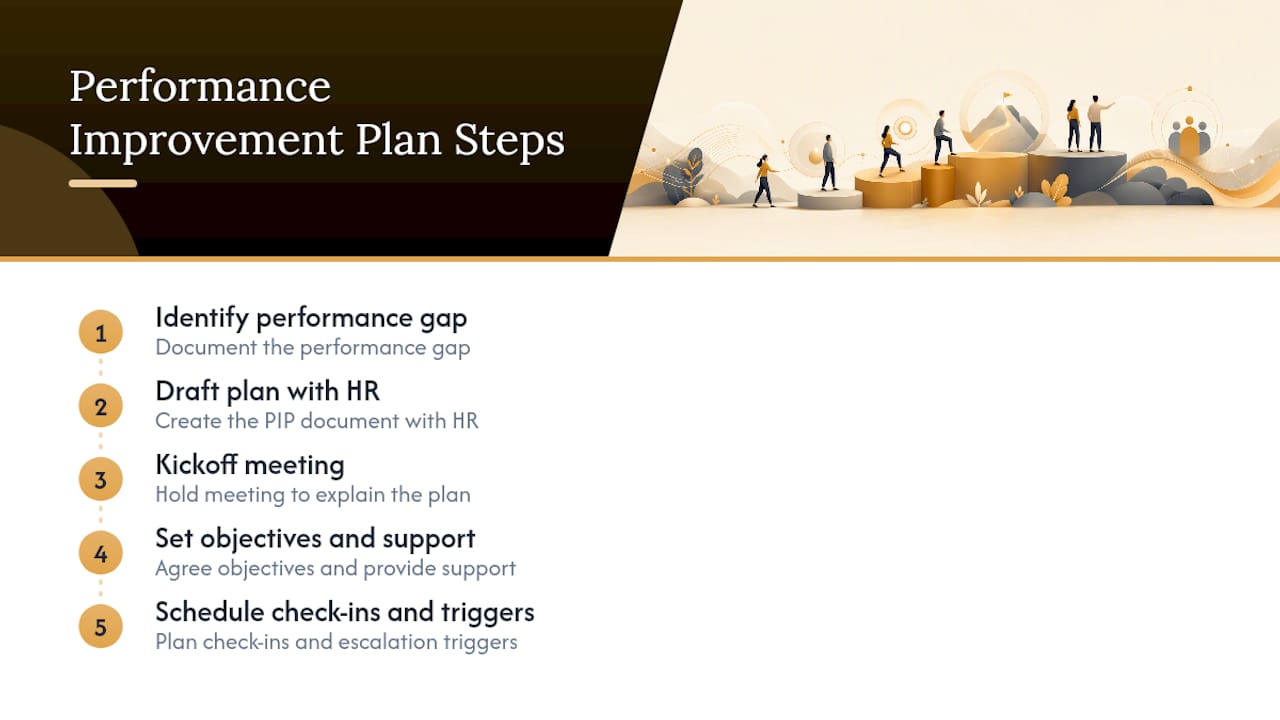
The process breaks into five stages, and skipping any one of them is usually what gets a PIP thrown out later as unfair or poorly documented. Each step has a clear owner and a clear output.
Step 1: Identify and document the performance gap
Write down what's actually going wrong, with dates. "Poor attitude" isn't evidence. "Missed three client deadlines in February (2/3, 2/17, 2/24) despite two prior verbal reminders" is. The Society for Human Resource Management recommends anchoring every PIP in specific incidents rather than vague labels, because vague criticism is the single fastest way to make a plan look retaliatory rather than corrective.
Step 2: Draft the plan and route it through HR
Before you say anything to the employee, get a second set of eyes on the draft. HR checks that the language is fair, the targets are achievable, and nothing in the wording exposes the business to a discrimination or retaliation claim. This is also the point where you confirm a PIP is even the right tool. The AIHR guide to performance improvement plans recommends assessing whether the issue is really a performance problem, or a training gap, a resourcing problem, or a personal circumstance that needs a different response entirely.
Step 3: Hold the kickoff meeting
This is the highest-stakes conversation in the whole process, and most managers under-prepare for it. Keep the tone factual and forward-looking, not punitive. A simple script:
"I want to talk through some performance concerns I've noticed and work with you on a plan to address them. I've written up specific examples and some objectives I think are achievable. I want your input on this too, what do you think would help you hit these targets?"
Ask the employee to respond. Note their input in writing. Get a signature acknowledging they received the plan, not necessarily that they agree with every word of it.
Step 4: Set objectives, timeline, and support
Define what success looks like in numbers, not adjectives, and commit in writing to what support you'll provide, whether that's shadowing a senior colleague, a training course, or more frequent one-on-ones.
Step 5: Schedule check-ins and escalation triggers
Weekly or biweekly check-ins aren't optional extras, they're the backbone of the plan. The SHRM guidance is direct on this: regular documented check-ins create the record that shows whether the plan actually worked, and they give the employee real chances to course-correct rather than one shot at the end.
| Role | Responsibility |
|---|---|
| Manager | Documents incidents, runs meetings, tracks progress, delivers support |
| HR | Reviews plan for fairness, advises on legal risk, keeps a copy of record |
| Employee | Provides input, meets objectives, raises obstacles early |
Pro Tip: Put the escalation trigger in writing at the kickoff meeting, not at week six when things are already going badly. "If two consecutive check-ins show no progress, we'll discuss next steps" removes the surprise element later.
How Do You Write Measurable PIP Objectives?
Vague objectives are the number one reason PIPs collapse under scrutiny. SMART objectives fix that: Specific, Measurable, Achievable, Relevant, Time-bound. Applied to a PIP, that means translating a category like "communication" into something you can actually check off a list.
- Specific: name the exact behavior, not the general trait.
- Measurable: attach a number, a rate, or a clear yes/no outcome.
- Achievable: something the employee can realistically hit given their role and current skill level.
- Relevant: tied directly to the job, not a personality trait.
- Time-bound: a real date, not "soon" or "ongoing."
Here's how that plays out across common PIP categories:
| Vague ("don't") | SMART version ("do") | Evidence source |
|---|---|---|
| "Be more reliable with attendance" | "No more than one unplanned absence per rolling 30 days" | Timesheet or attendance system |
| "Improve sales performance" | "Close $15,000 in new business per month for the next 90 days" | CRM sales report |
| "Pay more attention to detail" | "Fewer than two client-reported errors per month" | Error log or client complaint tracker |
| "Respond faster to clients" | "Reply to client emails within 4 business hours" | Email timestamps or ticketing system |
| "Show more initiative" | "Submit one process improvement suggestion per fortnight" | Meeting notes or submission log |
Notice the pattern: every "do" version has an evidence source attached. If you can't say where you'd find proof the target was hit, the objective isn't measurable yet, it's still an opinion dressed up as a goal.
Pro Tip: Ask the employee to restate the objective in their own words at the kickoff meeting. If they describe it differently than you meant, you've just caught a misunderstanding before it becomes a dispute six weeks in.
What Should a PIP Template Actually Include?
A defensible PIP isn't a one-page warning letter. It's a working document with specific fields that get filled in and referenced throughout the process. The Lattice PIP process guide outlines a template structure that covers the performance gap, SMART goals, review timeline, manager support commitments, and success criteria, and that structure holds up well in practice.
Your template should include:
- Performance gap statement: dated, specific examples of the shortfall
- SMART objectives: two to four measurable targets, no more
- Timeline: start date, review dates, and end date
- Manager support: exactly what training, tools, or coaching you're committing to provide
- Check-in schedule: dates locked in at kickoff, not "as needed"
- Success criteria: what "improved" looks like in plain terms
- Consequences: what happens if targets aren't met
- Signatures: employee, manager, and HR representative, with dates
For documentation of the meetings themselves, keep it simple. After every check-in, write a short summary within 24 hours: what was discussed, what progress was shown, what the employee said, and any new commitments made. Store it in the employee's personnel file, not in a personal notes app or a manager's private inbox.
You don't have to build this from scratch. The Fair Work Ombudsman's downloadable performance improvement plan template covers most of these fields already and gives you a starting structure you can adapt to your business rather than writing one cold.
| Documentation type | What to record | Where to store it |
|---|---|---|
| Kickoff meeting | Date, attendees, objectives agreed, employee input | Personnel file, signed copy |
| Check-in notes | Progress against each objective, obstacles raised | HR system or personnel file |
| Support provided | Training completed, coaching sessions held, dates | Personnel file |
| Final outcome | Decision, evidence reviewed, next steps | Personnel file, signed copy |
How Long Should a Performance Improvement Plan Run?
Most PIPs run between 30 and 90 days, and the right length depends on the role and the complexity of the gap. Shorter timelines under 30 days rarely give an employee a fair chance to show sustained change, while 90 day plans suit more senior or technically complex roles where improvement takes longer to demonstrate, according to Profit.co's guidance on PIP timelines.
Match the timeline to the job, with shorter durations for straightforward, quickly-measurable issues, medium durations for skill-based gaps needing some retraining, and longer durations for complex or senior roles where behavior change takes longer to show results.
A sample check-in cadence for a 60 day plan looks like this:
- Week 1 kickoff: agree on objectives, confirm support, set expectations.
- Week 2 and 4: brief check-ins on progress, obstacles, and any adjustments needed.
- Week 6 (midpoint): a fuller review comparing progress against each objective.
- Week 8 (final): outcome decision meeting.
If an employee shows a serious, immediate lapse mid-plan, like a safety breach or a repeat of the exact issue the PIP was meant to fix, you can accelerate the timeline. Document the trigger event with the same rigor as everything else: date, description, and how it relates to the original objectives. Never accelerate a plan based on a manager's gut feeling alone.
What Legal and Fairness Rules Apply to a PIP?
Procedural fairness is the single biggest factor in whether a PIP holds up if an employee later disputes their treatment. The Fair Work Ombudsman's best-practice guide on managing underperformance sets out the core principles: the employee needs clear notice of the concern, a genuine opportunity to respond, and a fair, unbiased process throughout.
A PIP that exists only to build a paper trail before a decision that's already been made isn't a performance improvement plan, it's a liability. Genuine procedural fairness means the outcome is genuinely still open when the plan starts.
That distinction shows up constantly in Fair Work Commission unfair dismissal decisions, where the tribunal looks closely at whether the employee had real notice, real support, and a real chance to improve, not just a document with their name on it.
Your fairness checklist should cover:
- Notice: the employee knew exactly what was expected and where they fell short.
- Involvement: the employee had a genuine chance to give input on the plan.
- Support: you provided the training or resources you committed to, not just promised them.
- Right to respond: the employee could raise concerns or disagree at any check-in.
- HR review: someone outside the direct reporting line reviewed the plan before and during the process.
State and territory government bodies also model this well. Business Queensland's employer resources and the Queensland public service's own PIP guidance both treat documentation and consistent process as the baseline, not an optional extra, which is a useful benchmark even for private-sector managers who assume this level of rigor is only for large organizations.
Evidence that holds up under scrutiny includes dated performance records, training attendance logs, written meeting summaries, and, where relevant, witness notes from a second manager present at key conversations. A plan built on this kind of evidence is far harder to challenge than one built on a manager's recollection of "a pattern of issues."
What Should a Filled-In PIP Look Like?
Here's a mini-template with the fields filled in enough to show you the level of detail that works. Copy the structure, not the specifics.
Employee name: [Name] Role: [Job title] Manager: [Name] Start date: [Date] Review date: [Date] End date: [Date]
Performance gap: Missed three deadline commitments in the past six weeks (list dates), despite two informal conversations on [dates].
Objectives:
- Deliver all assigned tasks by agreed deadlines for the next 60 days, with no more than one exception.
- Provide daily written status updates on active projects.
Manager support: Weekly 30-minute check-in, access to project management training, adjusted workload for first two weeks.
Check-in dates: [List specific dates]
Success criteria: No missed deadlines in the final 30 days of the plan, with status updates submitted consistently.
For the kickoff conversation, keep the script short and factual:
"I've put together a plan based on some specific deadline issues we've discussed before. I want to walk through it with you, get your thoughts, and agree on the support that will actually help. This isn't about punishment, it's about giving you a clear path back to where we need you to be."
For check-ins, a simple opener works: "How are you tracking against the objectives we set? What's helping, and what's getting in the way?"
At the end of the plan, your outcome paragraph should match one of three patterns:
- Improved and closed: "Based on the evidence reviewed across the plan period, [employee] has met the agreed objectives. The PIP is now closed, and standard performance management applies going forward."
- Extension: "[Employee] has shown partial progress toward the objectives but has not yet met the full criteria. The plan is extended by [X] days with the following adjusted support: [details]."
- No improvement, next steps: "Despite the support and time provided, [employee] has not met the objectives set out in the plan. The next step under our performance management process is [formal warning / further review / termination consideration], to be handled in consultation with HR."
Pro Tip: Draft all three outcome paragraphs before the plan even starts. Deciding in advance what "success," "partial progress," and "no improvement" actually look like keeps the final decision consistent and defensible, instead of something you're improvising under pressure at week twelve.
What Coaches See That Managers Often Miss
Most PIPs fail for a boring reason: the manager treats it as a paperwork exercise instead of a coaching relationship. You can hit every procedural box, dated evidence, SMART objectives, scheduled check-ins, and still get a poor outcome if the employee experiences the process as punitive rather than supportive. A checklist-only approach, without real weekly coaching attention, tends to produce compliance at best and resentment at worst.

The managers who get the best outcomes treat the check-in as a coaching session, not a progress audit. One pattern that shows up repeatedly: a manager who asks "what's getting in your way?" before asking "did you hit the target?" surfaces the real obstacle, whether that's a skills gap, an unclear process, or a workload issue, weeks earlier than a manager who only tracks numbers. That earlier signal is often the difference between an employee who turns performance around and one who quietly disengages until the plan ends in termination.
The evidence backs this up in a subtler way too. Employees who help shape their own objectives at the kickoff meeting tend to show more genuine commitment than employees handed a finished plan with no input, which is exactly why the AIHR framework puts employee involvement so high on the priority list. A PIP is a tool for two-way accountability, not a one-way instruction sheet, and managers who forget that distinction usually end up back in HR's office asking why a "textbook" process still ended badly.
Get Hands-On Support Running Your Next PIP
Reading the steps is one thing. Running a fair, well-documented PIP while also managing your team's daily workload, a client crisis, and everything else on your plate is another. Championbusinesscoaching works directly with managers and business owners to build the actual plan, coach you through the kickoff conversation, and stay in the loop through every check-in, so you're not improvising the hardest conversations in your business on your own.
Clients working with Championbusinesscoaching get a documented plan built around their specific situation, direct coaching on delivering difficult performance conversations, and ongoing support through the review period, backed by a 90-day coaching guarantee: real results, or your session is free. If a PIP is looming and you want a second set of eyes on the plan before you meet with the employee, book a consultation through Championbusinesscoaching's coaching services and get the process right the first time.
Where to Find Official PIP Guidance and Templates
Keep signed copies of every plan and check-in note in the employee's personnel file, not scattered across email threads or personal devices. Beyond your own records, a handful of official sources are worth bookmarking:
- The Fair Work Ombudsman's PIP template gives you a ready-made field structure to adapt.
- The Fair Work Ombudsman's managing underperformance guide covers the procedural fairness standard that Fair Work Commission decisions reference.
- Business Queensland's employer resources offer practical, employer-facing process guidance beyond the public sector.
- The SHRM guide to effective PIPs and AIHR's PIP template and guide both cover practical HR framing that complements the Australian regulatory guidance.
Frequently Asked Questions
How many steps are in a typical performance improvement plan? Most PIPs follow five to six core steps: identifying and documenting the issue, drafting and reviewing the plan with HR, holding a kickoff meeting, setting SMART objectives with a timeline, and running scheduled check-ins through to a documented outcome.
How long should a PIP last? Most plans run 30 to 90 days, depending on the complexity of the role and the type of performance gap. Straightforward issues like attendance often suit 30 days, while senior or technical roles often need 90.
What happens if an employee doesn't improve during a PIP? If the evidence shows the employee hasn't met the agreed objectives despite genuine support, the next step is typically a formal warning, further review, or termination, decided in consultation with HR and documented with the same rigor as the rest of the plan.
Do I always need HR involved in a PIP? Yes. Even in a small business, having someone outside the direct manager relationship review the plan for fairness reduces legal risk and helps ensure the process holds up if it's ever challenged.
Can a PIP be used to fire someone I've already decided to let go? No. A PIP is only legitimate if the outcome is genuinely still open when it starts. Using it purely to build a paper trail before a predetermined termination undermines procedural fairness and increases the risk of an unfair dismissal claim.
This article provides general information and isn't a substitute for professional HR or legal advice. Confirm current requirements with the Fair Work Ombudsman or a qualified employment law professional before finalizing any performance improvement plan.
This article is general information, not a substitute for advice from a qualified lawyer. Consult a qualified legal professional about your own circumstances before acting on anything here.
Sources
- 8 Steps for Effective Performance Improvement Plans
- performance improvement plan template
- Managing underperformance best practice guide
- Performance Improvement Plan Template & Guide - AIHR