
Online business courses in Australia are structured programs designed to equip learners with practical and theoretical skills to start, manage, or grow a business effectively. The Australian market offers everything from free government masterclasses through the Australian Taxation Office to nationally accredited Certificate IV and Diploma qualifications governed by the BSB Training Package. Whether you are a solo entrepreneur in regional Queensland or a manager in Sydney looking to sharpen your skills, the right course exists at the right price point. This guide breaks down every course type, explains what accreditation actually means for your career, and shows you how to pick the program that fits your goals in 2026.
What types of online business courses are available in Australia?
The Australian online business education market splits into three clear tiers: free or low-cost short courses, vocational qualifications, and academic degrees. Each tier serves a different purpose and delivers a different credential.

Free and low-cost short courses
The Australian Taxation Office runs free small business masterclasses covering tax obligations, record keeping, and cash flow basics. These cost nothing and require no prior study. They are ideal for new business owners who need practical knowledge fast, but they do not produce a formal qualification.
Micro-credentials sit just above free options in cost and depth. Prices typically stay under $200, and most complete in a matter of weeks. The catch is that micro-credentials often serve as pathway courses rather than standalone endpoints. They work best when they connect to a nationally accredited framework, not when treated as a career credential on their own.
Vocational qualifications: Certificate IV and Diploma
Certificate IV and Diploma programs follow the nationally recognized BSB Training Package curriculum, which means any unit you complete transfers between Registered Training Organisations (RTOs) across Australia. A Certificate IV in Entrepreneurship and New Business, for example, covers business planning, financial management, and marketing within a structured framework. Swinburne Open Education delivers this qualification as an online-native program built for self-paced study. Diplomas go deeper, often adding leadership, project management, and operations content.
Bachelor degrees and academic pathways
A Bachelor of Business Management requires 240 credit points, which translates to 24 units and roughly three years of full-time study. Accelerated options exist for learners who can commit more hours per week. Academic degrees suit those targeting management roles or planning to pursue postgraduate study. They carry more weight with large employers but cost significantly more than vocational options.
| Course type | Typical duration | Approximate cost | Accreditation |
|---|---|---|---|
| ATO masterclass | 1–3 hours | $0 | Non-accredited |
| Micro-credential | 2–8 weeks | Under $200 | Varies |
| Certificate IV | 6–12 months | Varies by provider | BSB Training Package |
| Diploma | 12–18 months | Varies by provider | BSB Training Package |
| Bachelor degree | 3 years (full-time) | University fees | Australian Qualifications Framework |
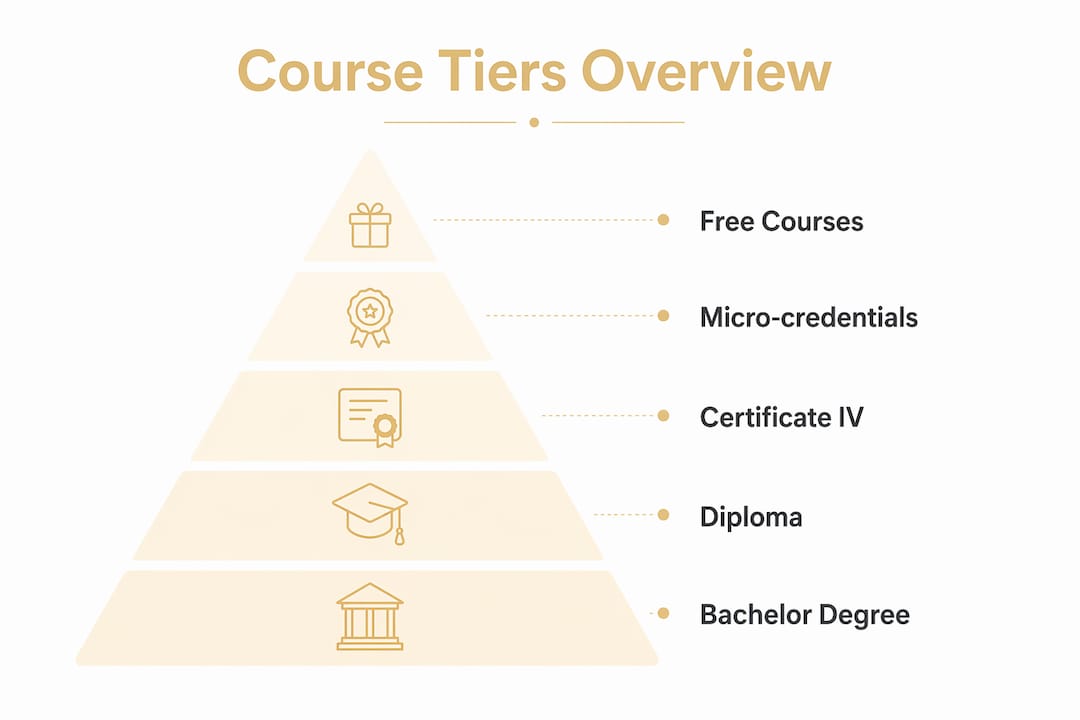
The table above shows that cost and time commitment scale directly with credential strength. Choose the tier that matches your immediate goal, not the one that sounds most impressive.
How do flexible online learning platforms support Australian learners?
Flexibility is the defining feature of online business training in Australia. Most RTOs give learners 24/7 access to course portals with self-paced study options. That means a tradie in Cairns and a retail manager in Melbourne can study the same program without ever sitting in the same room.
What you need to study online effectively
Technology requirements are straightforward but non-negotiable:
- A reliable high-speed internet connection (NBN or equivalent)
- A laptop or desktop computer with an up-to-date operating system
- A webcam and microphone for any live assessment components
- Access to standard productivity software such as Microsoft 365 or Google Workspace
Swinburne Open Education is one example of a platform designed from the ground up for online delivery. It structures content into weekly modules while still allowing learners to work ahead or catch up as life demands. That kind of built-in flexibility suits working adults who cannot commit to fixed class times.
Synchronous components you may not expect
Not every online course is fully asynchronous. Some assessments require physical presence or synchronous online supervision, even when the course materials are available entirely on demand. Live webinars, proctored exams, and group project sessions appear in many vocational programs. This matters if you live in a remote area or work irregular hours.
Pro Tip: Before enrolling, ask the provider for a full breakdown of synchronous requirements. Request this in writing so there are no surprises mid-course.
Why does accreditation matter for online business courses?
Accreditation is the difference between a credential employers recognize and a certificate that collects dust. Nationally recognized units come from RTOs registered with the Australian Skills Quality Authority (ASQA). Only these units count toward formal qualifications and credit transfers.
The BSB Training Package explained
The BSB Training Package is Australia's national standard for business, management, and administration training. Every Certificate IV, Diploma, and Advanced Diploma in business draws its units from this package. That standardization means your Diploma of Business from a provider in Brisbane carries the same weight as one completed in Perth. Employers and universities both recognize BSB-coded units when assessing candidates or processing credit applications.
Risks of non-accredited courses
Non-accredited courses, often labeled as "awareness" or "professional development" programs, do not produce formal qualifications. They can still teach useful skills, but they carry no credit transfer value and no guarantee of employer recognition. Not all short online courses are nationally accredited, and providers are not always upfront about this distinction. Always check whether a course lists a nationally recognized qualification code before paying.
Key accreditation checkpoints before you enroll:
- Confirm the provider holds current RTO registration with ASQA
- Verify the qualification code matches the BSB Training Package
- Check whether government funding applies to your situation via the Workforce Australia portal
- Ask about credit transfer options if you hold prior qualifications
Pro Tip: Government-funded Fee-Free TAFE places have strict eligibility criteria tied to residency and prior qualifications. Confirm your eligibility before selecting a course, or you may face full fees unexpectedly.
How to select the best online business course to meet your goals
Choosing the right program comes down to matching course content to your specific goal, not picking the most popular option. A course that works for a startup founder looks very different from one suited to an operations manager.
Follow these steps to narrow your options:
- Define your goal first. Are you starting a business, moving into management, or filling a specific skill gap? Your answer determines the course level and content you need.
- Set a realistic budget. Free ATO masterclasses cover tax basics at no cost. Certificate IV programs vary by provider. Bachelor degrees carry university-level fees. Know your ceiling before you browse.
- Check the time commitment. A Diploma taken part-time alongside full-time work typically runs 18 months. A micro-credential can wrap up in weeks. Be honest about how many hours per week you can commit.
- Verify accreditation. Confirm the provider is an RTO and the qualification sits within the BSB Training Package or the Australian Qualifications Framework.
- Look for mentorship and networking. Vocational training is most effective when it combines theory with real-world application. Courses that include mentoring or industry connections deliver more value than pure content delivery.
- Check pathway options. Micro-credentials that link into accredited frameworks maximize your training investment. A standalone short course that leads nowhere is a dead end.
- Review delivery mode details. Confirm whether any components require physical attendance or live online sessions, especially if you are in a regional area.
The College for Adult Learning and TAFE Queensland both offer programs that include mentoring components alongside standard curriculum. That combination of structured content and human support consistently produces better outcomes than self-study alone.
What are the additional benefits of online business courses in Australia?
The curriculum is only part of the value. Professional bodies often provide memberships and networking opportunities that extend well beyond what any course module covers. The Australian Institute of Office Professionals, for example, offers student membership to learners enrolled in relevant Diploma programs. That membership opens access to industry events, job boards, and peer networks.
Additional benefits worth factoring into your course selection:
- Professional memberships that give you industry credibility before you finish studying
- Peer networks formed through group assessments and online forums, which often become long-term professional contacts
- Career resources such as resume templates, interview prep guides, and employer directories
- Practical consulting components in some programs that let you apply skills to real business problems during study
Successful students prioritize courses that combine theoretical knowledge with mentorship and industry support. Generic training without human guidance produces slower results and higher dropout rates. Mentorship accelerates the gap between knowing something and being able to apply it under pressure.
Championbusinesscoaching works with Australian business owners and entrepreneurs who are actively studying or who have completed formal training but need help translating that knowledge into real business results. The business coaching services Championbusinesscoaching provides fill the gap between what a course teaches and what running a business actually demands.
Key Takeaways
Accredited online business courses in Australia deliver the most career value when they combine BSB Training Package qualifications, flexible delivery, and mentorship support.
| Point | Details |
|---|---|
| Accreditation is non-negotiable | Only BSB Training Package qualifications from RTOs carry credit transfer and employer recognition. |
| Free options exist and work | ATO masterclasses cost nothing and cover practical tax and cash flow skills for new business owners. |
| Micro-credentials need a pathway | Short courses add real value only when they connect to a nationally accredited framework. |
| Delivery mode affects your schedule | Some "fully online" courses still require live sessions or supervised assessments. |
| Mentorship multiplies course value | Programs that include industry support and coaching produce better outcomes than content alone. |
What I have learned from watching Australian learners choose the wrong course
The most common mistake I see is choosing a course based on price or speed alone. A $49 micro-credential sounds like a win until you realize it carries no accreditation, no credit transfer value, and no employer recognition. That is not a bargain. That is a sunk cost.
The second mistake is ignoring delivery mode details. I have spoken with learners who enrolled in "fully online" programs and then discovered they needed to travel for supervised assessments. That detail was buried in the course handbook, not the marketing page. Always read the handbook before you pay.
What actually works is a layered approach. Start with free ATO masterclasses to build foundational knowledge at no cost. Then move into an accredited Certificate IV or Diploma that sits within the BSB Training Package. Pair that formal study with mentorship from someone who has run a real business. The combination of structured curriculum, national recognition, and practical guidance is what produces results you can measure.
Affordability matters, but it should never override accreditation. A free course that leads nowhere costs you time. A $2,000 Diploma from a registered RTO that opens credit pathways to a Bachelor degree is a far better investment. Think in terms of where the credential takes you, not just what it costs today.
— Duncan
How Championbusinesscoaching supports your business education
Completing a course is the starting line, not the finish. Championbusinesscoaching works with Australian entrepreneurs and business owners who want to turn their formal training into measurable business results.
Championbusinesscoaching offers personalized business coaching that complements any level of online study, from Certificate IV graduates to Bachelor degree holders. The 90-day coaching guarantee means you see real progress or your session is free. With a 5-star Google rating and a limited number of coaching slots to protect quality, Championbusinesscoaching delivers the mentorship and clear action plans that formal courses rarely include. Explore the available coaching plans to find the right fit for your goals.
FAQ
What are the best online business courses in Australia?
The best courses depend on your goal. Accredited Certificate IV and Diploma programs from RTOs within the BSB Training Package offer the strongest career value, while free ATO masterclasses suit new business owners needing practical tax and cash flow knowledge fast.
How much do online business courses in Australia cost?
Costs range from $0 for government masterclasses to under $200 for micro-credentials, with vocational qualifications and degrees varying significantly by provider. Fee-Free TAFE options exist but carry eligibility requirements tied to residency and prior qualifications.
Are online business qualifications recognized by Australian employers?
Qualifications from RTOs within the BSB Training Package are nationally recognized and portable across Australia. Non-accredited short courses do not carry the same recognition and cannot be used for credit transfer toward further study.
How long does it take to complete an online business course in Australia?
Duration ranges from a few hours for ATO masterclasses to three years for a Bachelor degree studied full-time. Certificate IV programs typically run 6–12 months part-time, and Diplomas run 12–18 months depending on study load.
Do I need to attend classes in person for online business courses?
Most course materials are available entirely online, but some programs include synchronous components such as live webinars or supervised assessments that require real-time participation. Always confirm delivery mode requirements with the provider before enrolling.