
A one-on-one business coaching meeting is a paid, private session between a professional coach and a business owner or manager, focused on solving real strategic, operational, and profitability problems. If you want tailored, measurable results, the smartest next move is to book a discovery call with a qualified coach before committing to any program.
Three things to know before you start:
- Chemistry and mutual trust between coach and client are the single most important determinants of coaching success, according to US Chamber of Commerce guidance.
- A PLOS One systematic review found coaching delivers broad distal outcomes, including improved leadership behaviors and organizational commitment, but cautions that precise, universal ROI percentages are difficult to assign because coaching is highly customized.
- Championbusinesscoaching backs every engagement with a 90-day coaching guarantee: results, or your session is free.
Key Takeaways
Paid, personalised one-on-one business coaching produces measurable distal outcomes when you select for chemistry, define KPIs before the first session, and hold both parties accountable to a 90-day milestone review.
| Point | Details |
|---|---|
| Chemistry comes first | Test fit during a discovery call before committing to any paid program. |
| Define KPIs upfront | Set a baseline across profit, cash flow, and growth metrics before session one. |
| Use the 90-day framework | Review progress at days 30, 60, and 90; three "off track" scores at day 60 signals a methodology conversation. |
| Verify contract terms | Confirm guarantee scope, cancellation notice, and confidentiality clause in writing before paying. |
| Championbusinesscoaching | Offers tailored one-on-one programs with a 90-day guarantee, AI tools, and industry-specific expertise for Australian businesses. |
Table of Contents
- What does a one-on-one coaching session actually look like?
- One-on-one vs. group coaching: which one fits your situation?
- How do you choose the right coach?
- Pricing, budgeting, and realistic ROI expectations
- How to prepare for sessions and turn advice into results
- How do you measure whether coaching is working?
- What should your coaching contract include?
- Why Championbusinesscoaching is the recommended option
- Why personalised coaching still matters more than most owners expect
- Championbusinesscoaching: results-first coaching for Australian businesses
- Sources
What does a one-on-one coaching session actually look like?
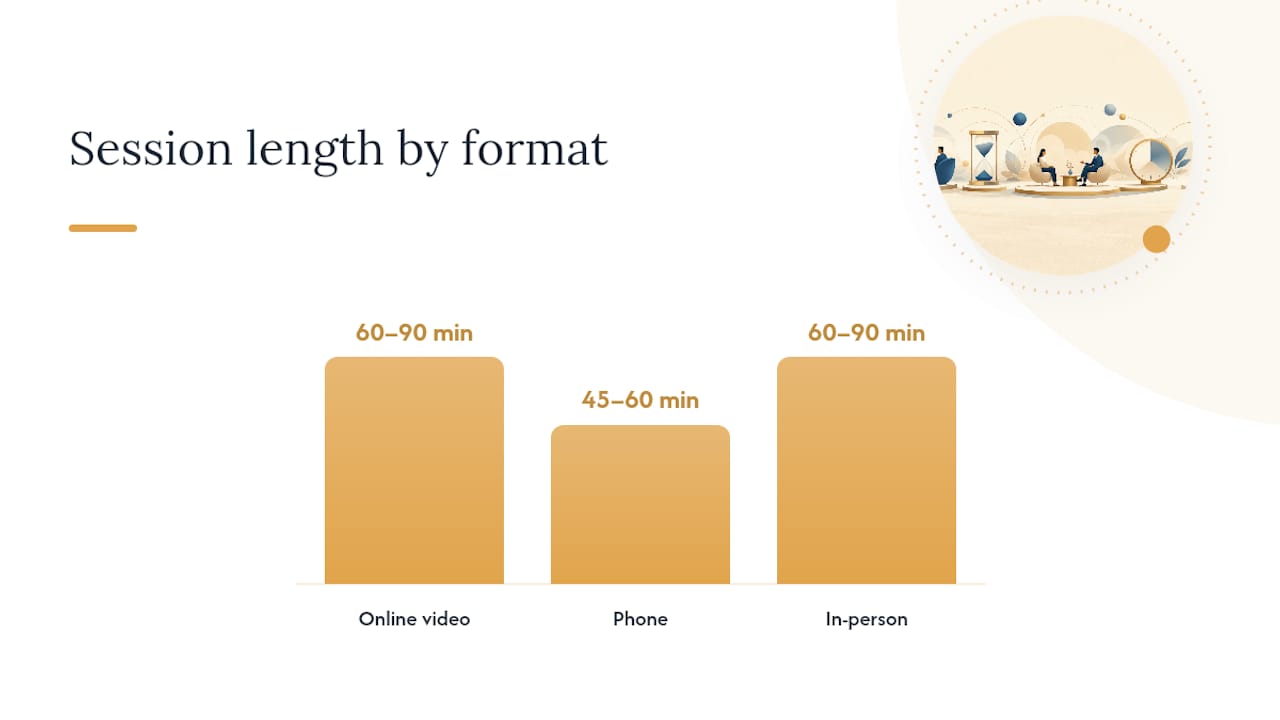
Most sessions run from under an hour up to around an hour and a half, delivered via online video, phone, or in-person. Weekly sessions suit owners in active problem-solving phases; monthly works for those in steadier growth cycles. A typical online coaching session follows a consistent structure:
- Check-in: What happened since last session? Quick wins and blockers.
- Focused challenge: The one problem that matters most right now.
- Root-cause questions: The coach digs beneath symptoms to surface the real constraint.
- Actions and homework: Specific tasks with owners and deadlines.
- Recap: Confirm commitments and set the next session's opening question.
Between sessions, most coaches offer check-in messages, templates, and tools. Commitment structures vary: monthly retainers, fixed 12-week programs, and ad-hoc hourly arrangements all exist, though structured programs tend to produce better follow-through than one-off sessions.
| Format | Typical length | Best for |
|---|---|---|
| Online video | 60–90 minutes | Remote owners, interstate clients |
| Phone | 45–60 minutes | Quick tactical check-ins |
| In-person | 60–90 minutes | Deep strategy work, local clients |
Pro Tip: Bring a one-page problem brief and a basic finance snapshot to your discovery call. Coaches who ask good questions about those two documents in the first 15 minutes are demonstrating exactly the process you'll get in paid sessions.
One-on-one vs. group coaching: which one fits your situation?
The core trade-off is depth versus cost. Evidence Bites research summarizes it clearly: one-on-one formats are more tailored and worth the extra cost for short, targeted interventions, while group formats can be more cost-effective over longer programs when peer learning is feasible.
| Situation | Better format |
|---|---|
| Confidential leadership issue | One-on-one |
| Complex operational restructure | One-on-one |
| Specialized industry (NDIS, trades, finance) | One-on-one |
| Peer learning across similar businesses | Group or cohort |
| Budget-constrained, longer program | Group or blended |
One-on-one is the right call when the problem is specific, sensitive, or requires deep industry knowledge. Group formats work when the peer dynamic adds value and the problems are broadly shared.
Pro Tip: For cost-sensitive businesses, a blended approach works well: start with one-on-one sessions for an initial sprint, then move to small-group follow-ups to scale the learning without scaling the cost.
How do you choose the right coach?
Start with a clear checklist, then use a discovery call to test it. Forbes Business Council contributors recommend clarifying your needs, interviewing multiple candidates, and confirming a coach's experience matches your business stage before committing.
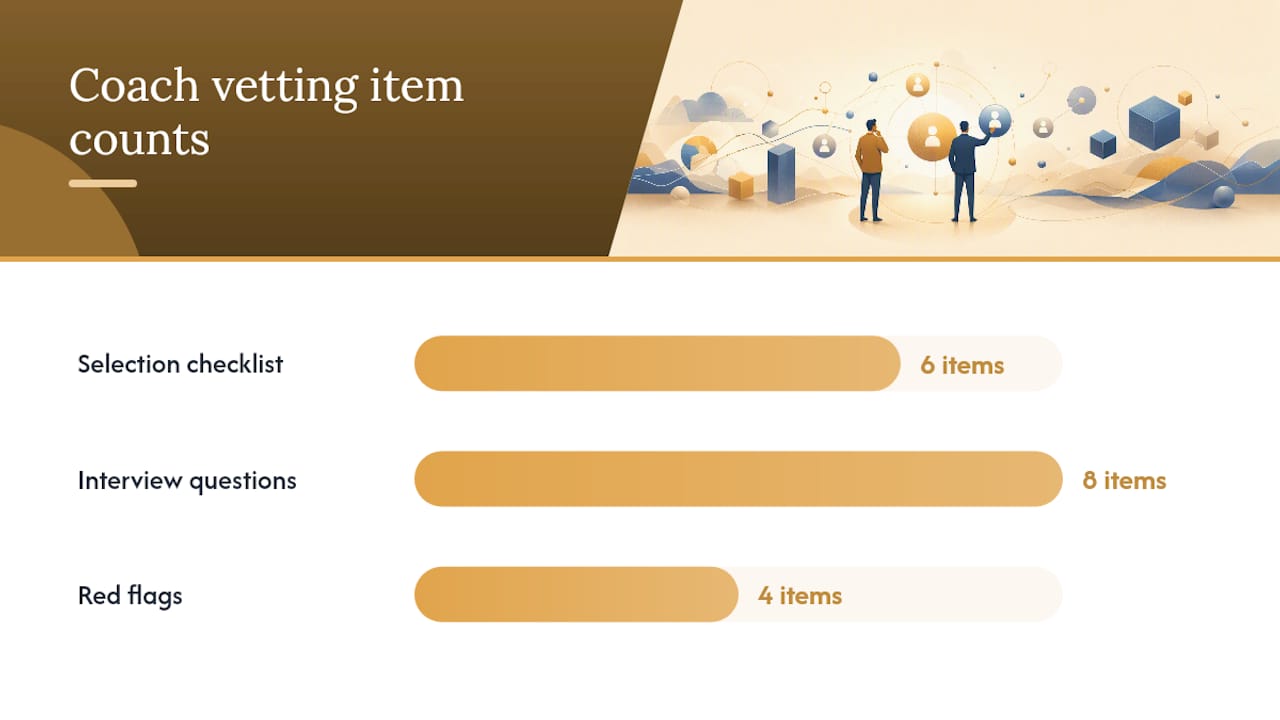
Selection checklist:
- Relevant industry experience (not just generic business advice)
- Measurable milestones built into the program
- Transparent pricing with no hidden fees
- References or case studies from similar businesses
- Clear methodology you can understand in plain language
- Willingness to offer a discovery call or short trial
Interview questions to ask during a discovery call:
- How do you structure a typical session?
- How often will we meet, and what happens between sessions?
- Can you describe a client with a similar challenge and what changed?
- How do you measure progress?
- What does your 90-day milestone framework look like?
- What are your cancellation and refund terms?
- Do you offer any guarantees?
- What credentials or training do you hold?
Coachdays guidance stresses that a good coach can explain their process simply. If the answer to "how do you structure a session?" takes five minutes of jargon, that's your answer.
Red flags: overpromising a fixed ROI figure, refusing to share references, opaque or bundled pricing, and programs that look identical regardless of your industry or goals.
Pro Tip: Ask for one reference from a business in your sector. A coach who hesitates is telling you something.
Pricing, budgeting, and realistic ROI expectations
Common pricing structures include hourly rates, monthly retainers, fixed 12-week programs, and hybrid packages. The Beancount hiring guide recommends starting month-to-month with clear 90-day milestones before committing to longer arrangements.
| Pricing model | Typical use case |
|---|---|
| Hourly rate | Ad-hoc problem-solving, one-off sessions |
| Monthly retainer | Ongoing advisory with regular sessions |
| 12-week fixed program | Structured transformation with defined outcomes |
| Hybrid package | Core program plus on-demand access |
Judge value by cost per outcome, not cost per hour. A $500/month retainer that adds $3,000 in monthly margin within 90 days is a different calculation than a $200/hour session with no defined deliverables.
On ROI: the PLOS One systematic review found coaching produces meaningful distal outcomes, but assigning a single reliable ROI percentage is difficult because interventions are highly customized. Track leading indicators (pipeline activity, decision speed, staff retention) alongside lagging ones (revenue, margin) for a balanced picture. ABM research confirms that paid professional mentoring supports both business growth and wellbeing, reinforcing the case for investing in qualified coaches.
How to prepare for sessions and turn advice into results
Preparation is where most owners underinvest. Arriving with a clear session outcome is one of the strongest predictors of progress. The US Chamber's guidance on coaching sessions recommends arriving with a defined outcome, documenting actions, and following through on homework.
Pre-session checklist:
- Current financial snapshot (revenue, margin, cash position)
- 1–3 priorities you want to resolve this session
- Recent wins and failures (honest, brief)
- Status update on last session's homework
30/60/90 action template:
- Days 1–30: Identify the single constraint most limiting growth. Define one KPI to move.
- Days 31–60: Implement the agreed action. Track the KPI weekly. Report back at each session.
- Days 61–90: Review results against baseline. Decide: continue, escalate, or pivot.
Sessions often shift from tactical problem-solving to uncovering deeper leadership patterns. That pivot is where the real value lives, but it only happens when you arrive with a precise outcome in mind rather than a vague topic.
Pro Tip: End every session by writing one sentence: "By next session, I will have done X." That sentence is your accountability contract.
How do you measure whether coaching is working?
Measurement starts before the first paid session. Establish a baseline across the KPIs most relevant to your goals, then track movement at 30, 60, and 90 days.
Sample KPIs by coaching goal:
- Profitability: gross margin percentage, net profit per job
- Cash flow: days sales outstanding, cash runway
- Growth: new client acquisition rate, average deal size
- Operations: delivery time, staff turnover rate
- Leadership: decision turnaround time, team engagement score
| Milestone | What to review |
|---|---|
| Day 30 | Are agreed actions completed? Is the primary KPI moving? |
| Day 60 | Is the trend consistent? Any new constraints surfaced? |
| Day 90 | Net change vs. baseline. Continue, escalate, or exit? |
Score each KPI as on track, at risk, or off track at each review. Three "off track" scores at day 60 is a signal to have a direct conversation with your coach about methodology, not to wait until day 90.
Mix leading indicators (activity, pipeline, decisions made) with lagging ones (revenue, profit). Leading indicators tell you whether the coaching is changing behavior; lagging ones confirm whether that behavior change is producing results. Scaling your business requires both lenses.
What should your coaching contract include?
A signed agreement protects both parties and sets clear expectations. Before paying, confirm these items are in writing:
- Scope of work and session frequency
- Deliverables (reports, action plans, tools)
- Payment schedule and what triggers invoices
- Confidentiality clause covering all business information shared
- IP and data use (who owns frameworks, templates, and session notes)
- Cancellation terms and notice period (30 days is standard)
- Guarantee terms in plain language
Questions to ask before signing:
- What exactly does your guarantee cover, and how do I claim it?
- What is the minimum commitment, and what happens if I need to pause?
- How are session notes stored and who can access them?
- What triggers a contract renewal, and is it automatic?
On guarantees: a 90-day coaching guarantee is a meaningful trust signal, but read the terms. A genuine guarantee specifies what "results" means, how progress is measured, and the exact remedy if milestones aren't met. Vague language like "satisfaction guaranteed" without defined criteria is not the same thing.
For renewals, negotiate a month-to-month option after the initial term. It keeps both parties accountable and removes the pressure of a long lock-in before you've validated the relationship.
Why Championbusinesscoaching is the recommended option
Championbusinesscoaching offers tailored one-on-one coaching programs for Australian business owners and managers across trades, NDIS, mortgage broking, food and beverage, and service businesses. Every engagement includes a 90-day coaching guarantee, AI-enabled business tools (cash flow forecasting, customer avatar builder, position description generator), and a limited intake to protect session quality.
Trust signals: 5-star Google rating, industry-specific case studies, and a clear coaching plans page with transparent pricing and guarantee terms.
What to expect from a discovery call:
- A 30-minute conversation focused on your current constraints
- A clear explanation of the coaching process and what the first 90 days look like
- No hard sell: the call is designed to test fit, not close a deal
Pro Tip: Come to the discovery call with one specific problem and one KPI you want to move. That framing tells the coach exactly what success looks like for you, and it tells you whether they can engage with specifics or only generalities.
Why personalised coaching still matters more than most owners expect
Most owners come into coaching expecting tactical answers. What they get, when the relationship is working, is something harder to describe: a shift in how they see the problem. Sessions that start with "my margins are too low" often end with a clearer picture of a hiring decision made two years ago, or a pricing model that was never tested against actual customer behavior.
The depth of that reflection is what separates a good coaching engagement from a consulting report. A report gives you recommendations. A coach gives you the capacity to make better decisions after the engagement ends. That's the outcome worth paying for, and it's why chemistry matters so much at the selection stage.
Run a 90-day test with defined KPIs. If the relationship is producing movement on your leading indicators by day 60, you have your answer.
Championbusinesscoaching: results-first coaching for Australian businesses
Spending months with the wrong coach is expensive in two ways: the fee you paid and the growth you didn't get. Championbusinesscoaching is built around the opposite model: a 90-day guarantee means you see measurable progress or the session is free, limited intake means your coach is focused on your business rather than managing a roster of 50 clients, and AI-powered tools give you cash flow forecasting and hiring resources between sessions rather than waiting for the next call.
The coaching plans cover one-on-one programs for trades, NDIS providers, service businesses, and more, with transparent pricing and no ambiguous lock-in language. If you're ready to test the fit, book a discovery call and bring one specific problem and one KPI you want to move. That's all you need to start.
Sources
- How to choose business coaches | CO- by US Chamber of Commerce
- Coaching as a developmental intervention in organisations: A systematic review of its effectiveness and the mechanisms underlying it | PLOS One
- Should I go for group or one-on-one consulting sessions? | Innovation Growth Lab - Evidence Bites
- Beancount
- How to Find the Right Business Coach for Your Business 2026 | Coachdays
- Seeking a business coach: 13 strategies for hiring the right one | Forbes