
The NDIS Practice Standards are the quality and safety benchmarks every registered NDIS provider must meet under the National Disability Insurance Scheme (Provider Registration and Practice Standards) Rules 2018. The NDIS Quality and Safeguards Commission enforces them. Every registered provider must satisfy the Core module, and depending on what supports they deliver, either a verification or certification audit, plus any relevant supplementary modules.
TL;DR:
- Most providers must demonstrate actual practice and evidence of participant involvement, rather than just having written policies or procedures.
- Evidence must be indexed, cross-referenced, and reflect recent actions, such as signed support plans, incident logs, and participant feedback.
- Governance systems should focus on functional, day-to-day oversight rather than volume of documentation, with clear role descriptions and accountability.
- Recent reforms require updating key personnel roles and reviewing policies related to pricing and supported living arrangements.
- A lean, well-maintained document set that shows concrete, recent evidence is more effective than extensive but outdated records.
Table of Contents
- How Are the NDIS Practice Standards Structured?
- What Are Quality Indicators and How Do Auditors Use Them?
- What Documents Do Auditors Expect to See?
- How Do You Build Compliant Governance and HR Systems?
- What Recent Reforms Should Providers Watch in 2026?
- Quick Compliance Checklist: Evidence by Outcome
- Where to Find Official Guidance and What to Do Next
- How Do the Practice Standards Actually Improve Participant Lives?
- Get Audit-Ready With Championbusinesscoaching
- Sources
How Are the NDIS Practice Standards Structured?
The Provider Registration and Practice Standards Rules 2018 set the legal skeleton, and everything else hangs off it. Every registered provider sits under the Core module, which covers four outcome areas: rights and responsibilities, governance and operational management, provision of supports, and the support provision environment. Get those four right and you have covered the baseline the NDIS Commission expects from anyone in the scheme.
Beyond the Core, supplementary modules kick in based on what you actually deliver:
- Specialist Disability Accommodation (SDA), for providers managing accommodation
- Specialist behaviour support, for anyone developing or implementing behaviour support plans
- Supported Independent Living (SIL), for shared-living support arrangements
- Early childhood supports, for providers working with young children under the NDIS early intervention pathway
- Specialist support coordination, for coordinators managing complex participant needs
Which audit path applies depends on risk. Lower-risk supports (think plan management or some therapeutic services) usually go through verification, a lighter-touch document check. Higher-risk or more complex supports require certification, a full onsite audit against every relevant Quality Indicator.
What Are Quality Indicators and How Do Auditors Use Them?
Quality Indicators are the specific, checkable benchmarks that turn a Practice Standard from a principle into something an auditor can actually assess. They come from the National Disability Insurance Scheme (Quality Indicators for NDIS Practice Standards) Guidelines 2018, and they sit under the same four domains as the Core module.
What auditors actually check: not whether you have a policy, but whether you can show that policy changed something for a participant. A rights-and-responsibilities indicator, for example, asks whether participants direct their own supports, not whether a document says they should.
Auditors assess four domains in practice:
- Rights and responsibilities: evidence that participants exercise choice and control over their supports, not just a statement that they can.
- Governance and operational management: whether leadership, risk systems, and incident reporting actually function, not just exist on paper.
- Provision of supports: whether support delivery matches individual plans and is responsive to changing needs.
- Support provision environment: whether physical and online environments are safe, accessible, and dignified.
The NDIS Commission expects outcome-focused evidence over paperwork volume, and it expects systems proportionate to the size of the provider, not corporate-scale infrastructure bolted onto a two-person outfit.
What Documents Do Auditors Expect to See?
Policies tell an auditor what you intend to do. Evidence tells them what you actually did. Auditors weigh the second far more heavily, because a beautifully written policy that nobody follows is worse than no policy at all; it signals a gap between paper and practice.
Prioritize your evidence file in this order:
- Signed service agreements and individual support plans that reflect participant goals in their own words
- Training records for every staff member delivering supports, including dates and content covered
- Incident logs with clear timelines, actions taken, and follow-up review
- Complaints records showing resolution, not just receipt
- Participant feedback, whether formal surveys or informal notes from support workers
- Governance records: meeting minutes, role descriptions, and risk registers
Index each document against the specific Quality Indicator it supports. Annotate a service agreement with the exact clause it demonstrates and a one-line note on how it proves the outcome. Auditors move faster, and more favorably, through a file that is cross-referenced than one they have to reverse-engineer.
Pro Tip: Ask a participant, in their own words, to describe a decision they made about their own supports in the last month, and record that as evidence. A genuine example of choice and control is worth more to an auditor than a folder of consent forms.
The NDIS audit checklist breaks this evidence list down further into a 90/30/365-day prep plan if you want a working timeline rather than just a list.
How Do You Build Compliant Governance and HR Systems?
Governance is where most providers either win or lose an audit before the auditor even walks in. It is not about volume of documentation; it is about whether the structure actually functions day to day.
- Written policies covering intake, risk, incident response, and complaints, each with a named owner
- Clear role descriptions for key personnel, matched to actual responsibilities under sections 13 and 13A notification obligations
- Board or management meeting minutes showing oversight, not just attendance
- Complaints and incident systems that track resolution timeframes and feed lessons back into policy
- Training records showing frequency and content, tied to supervision notes for frontline staff
Small providers should not try to replicate a large organization's IT compliance for SMEs governance stack. Focus first on the notification obligations, a working incident log, and one person clearly accountable for each policy area. That covers the highest-risk gaps auditors flag most often. Systemising these processes into repeatable checklists, rather than relying on memory, is usually the fastest route to consistency.
What Recent Reforms Should Providers Watch in 2026?
The Code of Conduct now explicitly covers key personnel, not just frontline workers, so governance documents need to name who holds oversight and show evidence of that oversight in practice. The Code of Conduct guidance also tightens rules around price differentiation for goods supplied to participants, closing a gap some providers had used to charge NDIS participants more than other customers.
Immediate actions worth taking:
- Update key personnel role descriptions to explicitly reference Code of Conduct obligations
- Audit your pricing for any goods or supports sold to participants against non-NDIS customers
- Review SIL-related policies against the latest Commission guidance, given ongoing reform attention on supported living arrangements
The Commission has signaled its proportionate approach continues, meaning enforcement scales with provider size and risk, but the paperwork trail expected of key personnel has gotten more specific.
Quick Compliance Checklist: Evidence by Outcome
Match each outcome to concrete evidence before an auditor asks for it.
- Support planning → individualized plans reflecting participant goals, reviewed and dated regularly
- Service agreements → signed, current, and specific to the participant's actual supports
- Incident management → logged incidents with response timelines and a closed-loop review
- Complaints handling → a register showing resolution outcomes, not just complaint counts
- Workforce competence → training certificates cross-referenced to the specific supports each worker delivers
- Safe environment → risk assessments for physical or online support settings, updated annually
- Participant rights → documented examples of choice and control in daily support decisions
- Governance oversight → meeting minutes linking decisions to specific policy updates
Common pitfall: providers often have the document but not the update trail, an incident log with no follow-up note, or a training certificate with no record of what was actually covered.
Pro Tip: If you are a solo provider, a lean set of six to eight well-maintained documents, each clearly dated and cross-referenced, beats a fifty-page policy manual nobody has read since it was written.
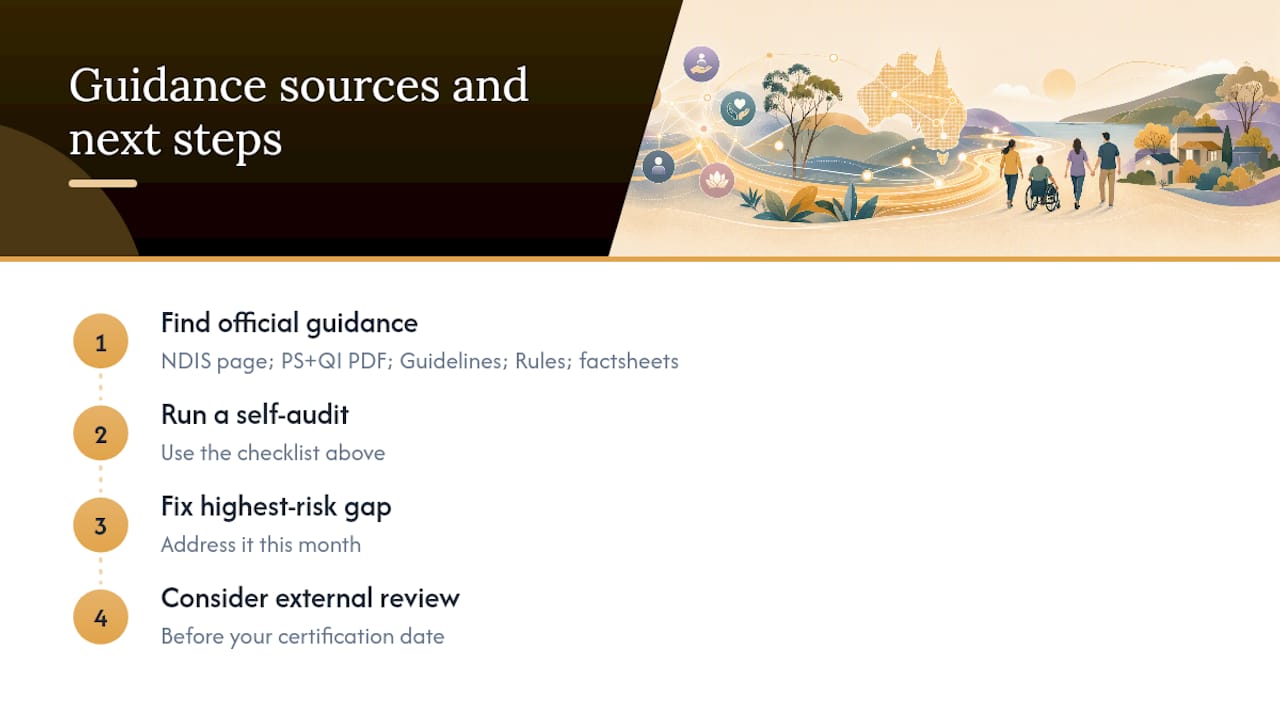
Where to Find Official Guidance and What to Do Next
Start with the NDIS Commission's Practice Standards page and the Practice Standards and Quality Indicators PDF for module detail and outcome mapping. Cross-check requirements against the Quality Indicators Guidelines 2018 and the underlying Provider Registration Rules. Easy-read fact sheets for participants sit on the same Commission site.
Next step: run a self-audit against the checklist above, fix your highest-risk gap this month, and consider an external review before your certification date arrives.
How Do the Practice Standards Actually Improve Participant Lives?
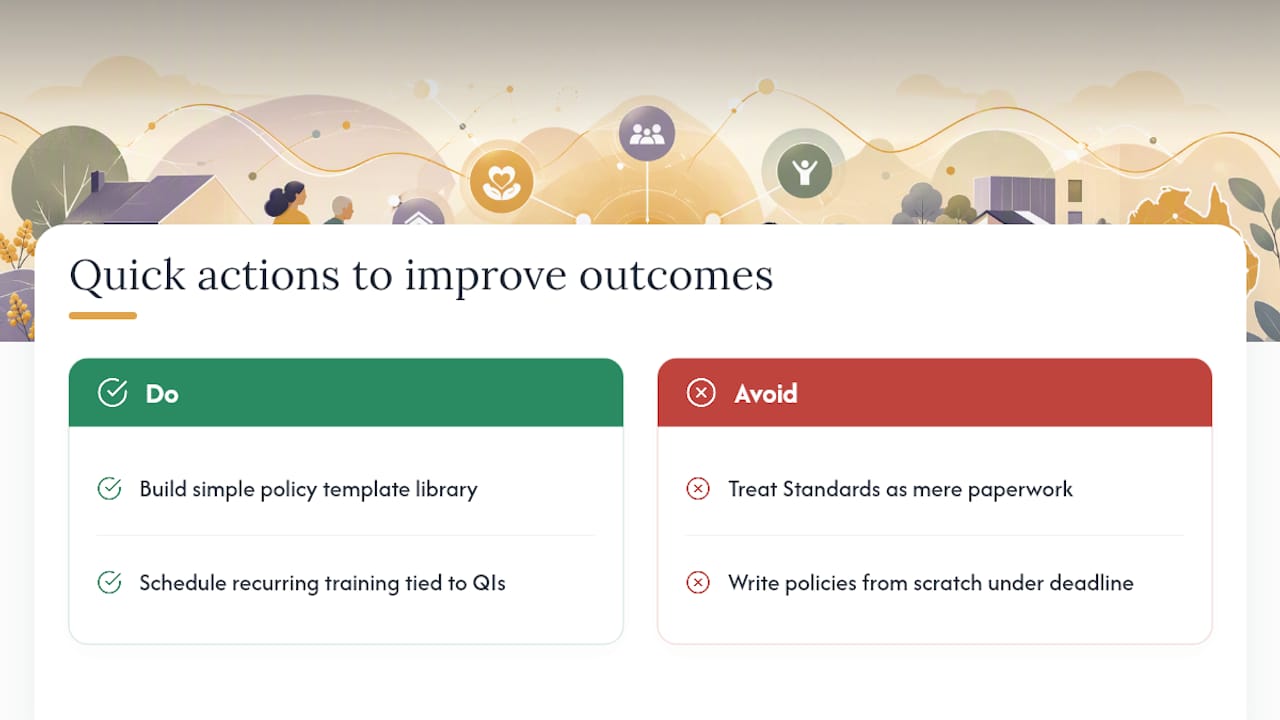
The Standards work when providers stop treating them as a paperwork exercise and start treating them as a description of what good support actually looks like. A provider who genuinely embeds choice and control into daily practice, not just intake forms, tends to pass audits with far less scrambling, because the evidence already exists in how they operate.
At Champion Business Coaching, we work with NDIS providers who want compliance systems that hold up under audit without swallowing every hour of their week. Two moves make an outsized difference fast: build a simple policy template library so nothing gets written from scratch under deadline pressure, and set a recurring staff training schedule tied to specific Quality Indicators rather than generic onboarding content. Neither takes long to set up. Both show up clearly in an auditor's file review.
— Duncan
Get Audit-Ready With Championbusinesscoaching
Championbusinesscoaching is the alternative to piecing together compliance advice from scattered PDFs and generic templates: one coach who maps your specific supports to the right Practice Standards modules and builds the evidence trail with you, not for you six months after you needed it.

Our NDIS-focused coaching covers audit-prep planning, policy templates built for your actual service type, staff training schedules, and AI-enabled tools for cash flow and workforce planning, all backed by a 90-day coaching guarantee: real progress within 90 days or your next session is free. Clients get a clear action plan instead of a folder of unused documents, whether they run a solo support coordination practice or a growing SIL provider with a dozen staff.
If your certification or verification date is on the calendar, book a consultation through Champion Business Coaching's business coaching page and get your compliance gaps mapped before the auditor finds them for you.
Sources
- NDIS Practice Standards | NDIS Quality and Safeguards Commission
- National Disability Insurance Scheme (Quality Indicators for NDIS Practice Standards) Guidelines 2018 - Federal Register of Legislation