
Your profit margin reveals whether your business is truly healthy or just busy. Even a trades operator with substantial yearly turnover can be losing ground if costs exceed income. Margins and profits are the two numbers that separate a thriving business from one that's running hard to stand still.
Here's what you need to track:
- Gross profit margin: Revenue minus the direct cost of delivering your product or service, expressed as a percentage. It shows whether your core work is priced correctly.
- Operating profit margin: Gross profit minus overhead costs like rent, admin salaries, and software. It reveals how efficiently you run the business day to day.
- Pretax profit margin: Operating profit adjusted for interest income or expense, before tax obligations hit.
- Net profit margin: The bottom line after every cost, including tax. This is the number that tells you what you actually keep.
Tools like Xero automate the data collection behind all four calculations, while specialist services like Growth Prop focus specifically on margin reporting for builders and construction SMEs. Championbusinesscoaching works with Australian trades and SME owners to turn these numbers into decisions, not just reports.
How to calculate your profit margins as an Australian SME
The formulas are straightforward. The discipline is applying them consistently.

| Margin Type | Formula | What It Tells You |
|---|---|---|
| Gross profit margin | (Revenue − COGS) ÷ Revenue × 100 | Core product or service profitability |
| Operating profit margin | Operating income ÷ Revenue × 100 | Efficiency of day-to-day operations |
| Pretax profit margin | (Revenue − all nontax expenses) ÷ Revenue × 100 | Profitability before tax obligations |
| Net profit margin | Net income ÷ Revenue × 100 | True bottom-line profitability |
Consider an Australian plumbing business with typical revenue and expenses that yield gross, operating, and net profit margins reflective of well-managed trade operations in the region.
The critical distinction between margin and profit: profit is a dollar figure, margin is a ratio. Businesses with the same profit but different margins have different exposures to cost changes, with higher margins providing more cushion. Profit expressed as a percentage normalizes comparisons across time periods and business sizes in a way raw dollars never can.
One common calculation error in trades: understating COGS by leaving out superannuation, payroll tax, and workers' compensation insurance from labor costs. Fully burdened labor costs must sit inside COGS, not operating expenses, or your gross margin looks inflated and your quotes end up underpriced.
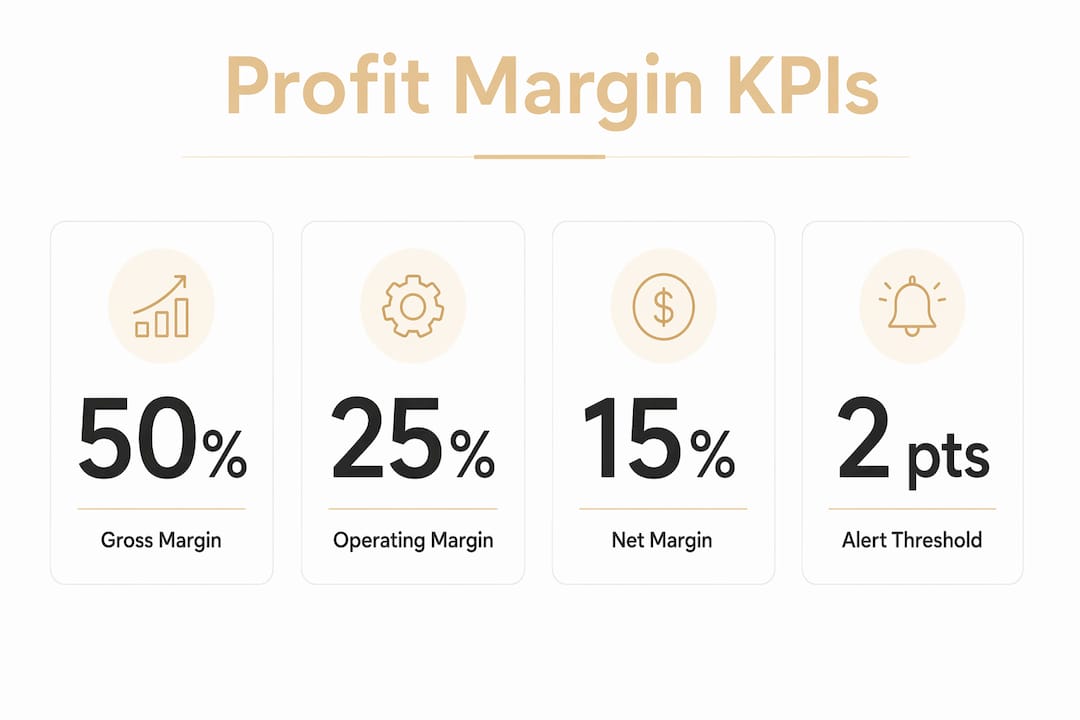
Xero's performance dashboards pull this data automatically, making it easier to run these calculations monthly rather than waiting for year-end accounts.
What are good profit margin benchmarks for Australian trades and SMEs?
Benchmarks vary sharply by industry, so comparing your numbers to the wrong peer group is worse than no comparison at all.

Typical margins vary widely across industry sectors like trades, retail, hospitality, professional services, and building and construction SMEs, with different expected ranges for gross and net margins.
For most service businesses, a net margin of 15%–25% is healthy. Product-based businesses typically run 5%–15%. The more useful question is whether your margins are stable or trending in the right direction, not whether they hit a generic target.
A 50% gross margin is not too high. It simply means you keep 50 cents of every revenue dollar after direct costs, which leaves room to cover overhead and still generate net profit. Whether that's achievable depends on your pricing power and cost structure.
Australian businesses sourcing materials or equipment internationally face an additional variable: currency fluctuations directly affect COGS. When the Australian dollar weakens against the US dollar or euro, import costs rise without any change in your pricing, compressing gross margins. Building a currency buffer into your supplier pricing or locking in forward contracts can protect margins during volatile periods.
A revenue audit can surface exactly where currency exposure and cost creep are hitting your numbers before they become a structural problem.
Practical ways to improve your profit margins in 2026
Cost reduction improves margins more efficiently than equivalent dollar price increases. That's not intuitive, but the math is clear: saving $20,000 in costs on $500,000 revenue moves your margin by 4 percentage points, while earning an extra $20,000 in revenue on the same cost base moves it by only 3 points.
The three main levers:
- Raise prices using value-based pricing. Base your prices on what the outcome is worth to the customer, not just what it costs you to deliver. Customers who perceive high value will pay more without pushback.
- Reduce COGS through supplier negotiation. Review supplier contracts annually. Negotiate bulk pricing as your order volume grows. Even a modest reduction in material costs flows directly to gross margin.
- Audit operating expenses ruthlessly. Software subscriptions, admin time, and vendor costs accumulate during growth phases and rarely get reviewed. Every expense should justify itself against current business needs.
Common margin leaks in trades businesses specifically:
- Labor costs quoted without superannuation, payroll tax, or insurance included
- Overhead costs (vehicle depreciation, tool replacement) not allocated to individual jobs
- Discounts offered to win work without calculating the margin impact
- Low-margin jobs accepted to fill capacity, dragging down the blended rate
Pro Tip: Run a segment margin analysis quarterly. Break your revenue down by job type, customer, or service line and calculate the net margin on each. You'll almost always find that 20% of your work generates 60%–70% of your profit. That's where to focus your pricing and sales effort.
Growth Prop offers tiered margin reporting packages for builders and construction SMEs, covering everything from bookkeeping to internal cost controls. For trades operators wanting coaching on margin improvement, Championbusinesscoaching provides structured programs with clear targets and a 90-day results guarantee.
Tax, compliance, and advisory considerations that affect your margins
Australian tax obligations directly reduce net profit margins, so understanding them is part of margin management, not separate from it.
Key factors for Australian SMEs:
- Company tax rate: The base rate for most small businesses is 25% (for companies with aggregated turnover below $50 million that are base rate entities). This flows directly from pretax to net margin.
- GST: Collected on behalf of the ATO, not a margin cost, but poor GST management creates cash flow pressure that masks true profitability.
- Payroll tax: Thresholds vary by state. In New South Wales, the threshold is $1.2 million in annual wages; in Queensland, it's $1.3 million. Businesses approaching these thresholds need to factor payroll tax into their labor cost calculations before it hits.
- Superannuation: Currently 11.5% of ordinary time earnings. This belongs in your COGS for direct labor, not as a surprise year-end expense.
Advisory services like Growth Prop and Championbusinesscoaching help businesses build these obligations into their margin calculations from the start, rather than discovering the gap at tax time. Regular quarterly reviews with an advisor catch compliance costs before they erode net margins silently.
Hidden overhead costs, including administrative time and unnecessary software subscriptions, silently erode net profits in growing service businesses. An annual zero-based expense review, where every cost must justify its existence, is one of the highest-return activities a business owner can do.
What Australian business coaches know about margin management that most owners miss
The most common strategic mistake is chasing revenue growth while ignoring margin trends. Revenue growth can mask margin dilution until the cash flow problem becomes impossible to ignore. A business that doubles revenue while halving its net margin ends up with the same net profit dollars and twice the operational complexity.
A few patterns Championbusinesscoaching sees repeatedly with Australian SMEs:
- Prioritizing volume over margin: Accepting lower-margin work to stay busy creates a ceiling on net profit. The fix is identifying your highest-margin services and actively directing sales effort toward them.
- Treating margin analysis as an annual exercise: By the time year-end accounts reveal a margin problem, months of cash have already been lost. Real-time margin monitoring turns margin data into a management tool rather than a retrospective report.
- Ignoring the margin-volume trade-off: Chasing maximum margin per unit at the expense of volume can actually reduce total net profit dollars. The goal is maximizing net profit, not the percentage.
Pro Tip: Set a monthly gross margin alert threshold. If your gross margin drops more than 2 percentage points in a single month, treat it as a trigger for an immediate cost and pricing review. Catching a drift early costs far less than correcting a structural problem six months later.
Championbusinesscoaching's profit and margin coaching programs are built around exactly this kind of proactive monitoring, combined with the pricing and cost strategies that move the numbers. The 90-day guarantee means you see results or the session is free.

Ready to stop guessing and start managing your margins with a clear plan? Book a coaching session with Championbusinesscoaching and get a personalized margin improvement strategy built for your business.
Key Takeaways
Net profit margin is the single most reliable indicator of financial health for Australian SMEs, and improving it requires tracking all four margin types consistently, not just revenue.
| Point | Details |
|---|---|
| Use all four margin types | Gross, operating, pretax, and net margins each reveal a different layer of your profitability. |
| Cost cuts beat price rises | Reducing costs improves your margin percentage more efficiently than equivalent revenue increases. |
| Trades must include full labor costs | Superannuation, payroll tax, and insurance belong in COGS, or your gross margin is overstated. |
| Monitor margins monthly | Real-time margin tracking lets you catch and fix problems before they compound into cash flow stress. |
| Benchmark against your own sector | Most service businesses should aim for a net margin of 15%–25%, while product-based businesses typically see 5%–15%. Trades and construction SMEs often fall within this range; however, comparing within your sector is most meaningful. |