
Management coaching is the practice of managers using coaching skills to develop their team members' potential, shifting from directive oversight to empowering leadership. This approach is now recognized as a core management competency, not a soft skill reserved for HR departments. Gallup's 2026 research shows that coach-led managers spend less time problem-solving and more time on employee growth. The result is measurable: teams with coaching managers report stronger engagement, better decision-making, and fewer problems that escalate upward. For Australian business leaders, adopting management coaching is one of the most direct paths to building a team that performs without constant supervision.
What is management coaching and why does it matter?
Management coaching is defined as a structured approach where a manager uses coaching techniques, such as active listening, powerful questioning, and developmental feedback, to help team members grow their own capabilities. The International Authority for Professional Coaching and Mentoring (IAPC&M) and the International Coaching Federation (ICF) both set recognized competency standards for this practice. These bodies exist because coaching done poorly looks like therapy or vague conversation. Done well, it produces measurable shifts in team performance and manager effectiveness.
The shift from traditional management to a coaching approach is not cosmetic. Gallup's research identifies this as a functional change in how managers spend their time. A traditional manager answers questions, assigns tasks, and monitors output. A coaching manager asks questions, builds capability, and monitors growth. That distinction changes the entire dynamic of a team.
Australian workplaces are increasingly recognizing this shift. Leadership development programs across sectors now embed coaching skills as a baseline requirement for mid-level and senior managers. The demand for a qualified management coach in Australia reflects a broader understanding that managing people well requires more than technical expertise.

How does management coaching differ from traditional management and training?
The clearest way to understand management coaching is to contrast it with what it is not. Traditional management is directive. The manager identifies a problem, decides on a solution, and tells the team what to do. This works in a crisis or with a new employee who needs clear instruction. It fails when applied to capable team members who need to develop their own judgment.
Training is different again. Training delivers a fixed body of knowledge or skill, usually in a classroom or workshop format. It is useful for onboarding or compliance. Coaching differs from training by starting from the manager's or team member's real-life issues and helping identify specific blockages to develop tailored solutions. Training gives you a tool. Coaching helps you figure out why you are not using the tool you already have.
The practical distinction matters most in daily leadership. A manager using a coaching approach does not switch off their authority. They choose when to coach, when to manage, and when to advise, and they make that choice transparently.
Here is when each mode works best:
- Coach mode: When a team member has the capability but lacks confidence or clarity. Use open questions to help them find their own answer.
- Manager mode: When a task has a non-negotiable standard or deadline. Be direct and clear about the requirement.
- Advisor mode: When a team member lacks experience and needs your knowledge. Share it directly, then ask what they will do with it.
- Mentor mode: When a team member is developing a long-term career path. Draw on your own experience to guide their thinking.
Pro Tip: Tell your team member which mode you are in before the conversation starts. Say "I want to coach you through this" or "I need to give you direction on this one." That transparency builds trust and removes confusion.
What are the core coaching skills every manager should develop?
Coaching skills are learnable. They are not personality traits. A manager who naturally gives advice can learn to ask questions instead. A manager who avoids difficult conversations can learn to give developmental feedback with clarity and care. The following five competencies form the foundation of effective coaching for management.
-
Active listening. This means listening to understand, not to respond. It requires full attention, minimal interruption, and the ability to reflect back what you heard before moving forward. Most managers listen at about 25% capacity because they are already forming their reply. Active listening closes that gap.
-
Powerful questioning. Effective coaching involves asking precise, open questions rather than providing answers, enabling team members' ownership and self-reliance. Questions like "What do you think is driving this?" or "What would you do if you knew you could not fail?" open thinking rather than close it.
-
Developmental feedback. Feedback in a coaching context is not evaluation. It is information that helps someone grow. The most effective format is specific, behavioral, and forward-looking. "When you did X in the meeting, the impact was Y. What would you do differently next time?" is coaching feedback. "You need to be more confident" is not.
-
Accountability without micromanaging. A coaching manager sets clear expectations, agrees on progress checkpoints, and then steps back. The team member owns the outcome. The manager checks in at agreed intervals, not constantly.
-
Contracting coaching conversations. This means being explicit at the start of a conversation about what kind of conversation it is. Blending coaching with managing and advising as appropriate, and knowing when to shift modes transparently, is what separates effective coaching managers from those who confuse their teams.
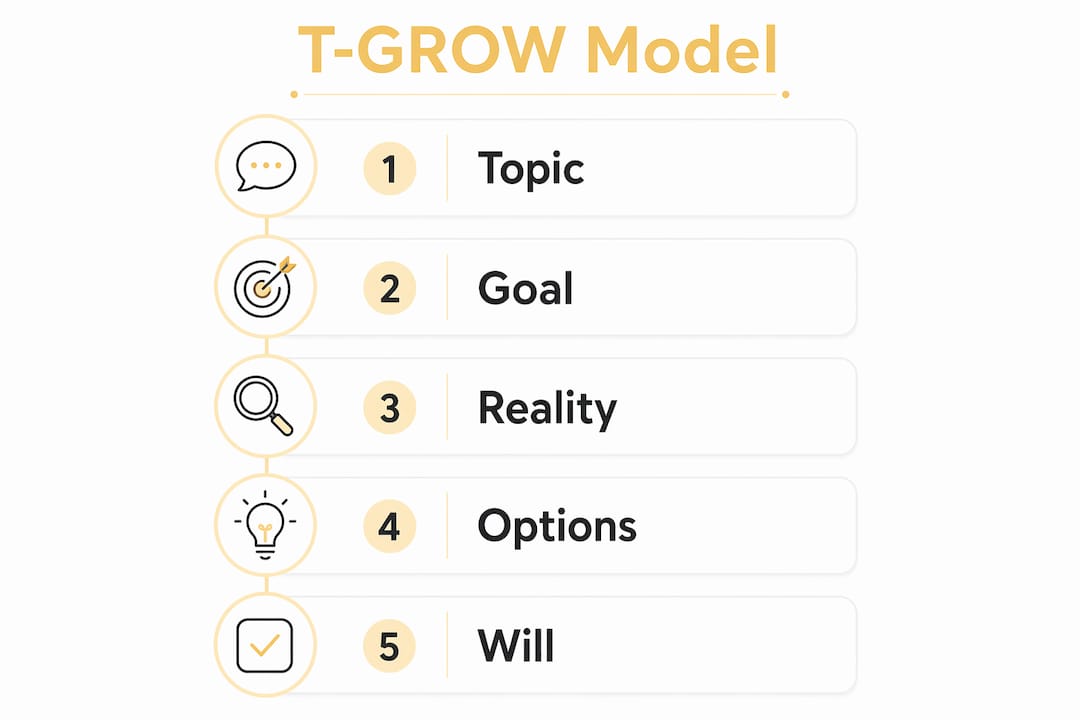
A practical framework many managers use is the T-GROW model: Topic, Goal, Reality, Options, and Will. It gives structure to a coaching conversation without making it feel scripted. The Topic sets the context, the Goal clarifies what success looks like, the Reality grounds the conversation in current facts, the Options generate possibilities, and the Will commits to a next step.
Pro Tip: Practice the T-GROW model in low-stakes conversations first, such as a weekly check-in, before applying it to a performance issue. The structure becomes natural faster than you expect.
What does effective management coaching look like in practice?
Effective coaching does not require a formal session booked in a calendar. It happens in the hallway, at the end of a project debrief, and during a one-on-one meeting. The key is intentionality. Gallup's Five Coaching Conversations framework gives managers a practical structure for frequent, meaningful interactions that focus on strengths, setting expectations, progress reviews, and developmental coaching.
The shift from annual performance reviews to ongoing coaching conversations is one of the most significant changes in modern leadership development. Annual reviews tell people how they performed. Ongoing coaching conversations shape how they perform. The difference in team outcomes is substantial.
Coaching managers also report a specific and counterintuitive benefit. Managers who coach well report deeper relationships with their teams and that many problems get resolved before reaching their desk. That means less firefighting, not more. The manager who fears coaching will slow them down usually discovers the opposite.
The organizational benefits of a coaching approach include:
- Higher employee engagement. Team members who feel heard and developed stay longer and contribute more.
- Better decision-making at team level. When people are coached to think through problems, they make better calls independently.
- Increased psychological safety. Coaching management style increases team psychological safety, empowering employees to take risks and speak openly, which boosts performance and retention.
- Reduced manager workload. Empowered teams bring solutions, not just problems.
Measuring coaching impact requires clear baseline data. Track team engagement scores, staff turnover rates, and the frequency of escalated problems before and after embedding a coaching approach. Progress becomes visible within a 90-day window when coaching is practiced consistently.
How can managers begin and sustain a coaching approach?
Starting a coaching practice does not require a career change. It requires a mindset shift and a commitment to practice. The most common barrier is the belief that coaching takes more time than directing. Gallup's Chief Scientist Jim Harter notes that coaching's tangible efficiency benefits free managers from problem-solving overload by enabling empowered decision-making. The time investment in coaching pays back quickly.
Here is a practical path for managers starting out:
- Enroll in a structured program. Accredited programs such as those recognized by IAPC&M and ICF include live masterclasses, mentoring, and evidence portfolios. These are not theoretical courses. They build real skill through supervised practice.
- Build a reflective practice. After each coaching conversation, spend five minutes noting what worked, what you defaulted to directing, and what you would change. This reflection accelerates skill development faster than any course alone.
- Find a peer or mentor. Practicing coaching with a colleague who gives you honest feedback closes the gap between knowing the theory and applying it under pressure.
- Integrate coaching into existing conversations. You do not need to add new meetings. Apply coaching questions in your current one-on-ones, team meetings, and project debriefs.
- Get executive support. Coaching cultures do not survive without leadership buy-in. If your organization's senior leaders model directive management, coaching at the team level will face resistance. Advocate for coaching as a business tool, not a personal development hobby.
For managers in Australia, leadership skills for managers are increasingly tied to coaching competency in both corporate and small business contexts. The market expectation is shifting. Managers who coach are more promotable, more effective, and more sought after.
Pro Tip: Set one coaching goal per week. For example, "This week I will ask three open questions before offering any advice in every one-on-one." Small, specific targets build the habit faster than broad intentions.
Key Takeaways
Management coaching is the single most effective tool a manager has for building a team that performs, grows, and stays.
| Point | Details |
|---|---|
| Coaching differs from managing | Coaching uses questions to build capability; managing uses direction to complete tasks. |
| Core skills are learnable | Active listening, powerful questioning, and the T-GROW model are practiced skills, not personality traits. |
| Gallup's five conversations | Frequent coaching conversations on strengths, expectations, and progress outperform annual reviews. |
| Psychological safety drives results | Coaching managers create environments where teams take risks, speak openly, and perform at a higher level. |
| Certification builds credibility | IAPC&M and ICF accreditations set the competency standard for coaching programs worth completing. |
Why most managers are coaching wrong without knowing it
The most common mistake I see is managers who think they are coaching because they ask "What do you think?" before telling the person what to do anyway. That is not coaching. That is the illusion of coaching, and it erodes trust faster than pure direction would.
Real coaching requires you to sit with the discomfort of not giving the answer. For most managers, especially those promoted because they were the best at solving problems, that discomfort is significant. Your identity as the expert is at stake. Coaching asks you to put that aside and trust that your team member's thinking, developed through good questions, will get to a better place than your answer would.
I have also seen managers abandon coaching after one or two conversations that felt awkward. Coaching is a skill. The first few conversations will feel unnatural. That is not a sign it is not working. It is a sign you are learning. The managers who push through that initial discomfort and commit to business coaching techniques consistently are the ones who report the biggest shifts in their team's performance and their own satisfaction as a leader.
The other thing worth saying directly: coaching is not appropriate in every situation. A safety issue, a compliance breach, or a new team member on day one all require direction, not questions. The best coaching managers know when to coach and when to manage. That judgment is itself a skill worth developing.
— Duncan
Championbusinesscoaching: built for managers ready to lead differently
Managers who want to build real coaching skills need more than a workshop. They need a structured, practical program that fits around a working week and delivers results they can measure.
Championbusinesscoaching works with managers and business leaders across Australia through tailored coaching plans designed around your real challenges, not a generic curriculum. Programs are available online and in person, with a 90-day coaching guarantee: results or your session is free. Slots are limited to maintain quality. If you are ready to shift from managing to coaching and build a team that performs without constant oversight, explore coaching services and take the first step.
FAQ
What is management coaching?
Management coaching is the practice of managers using coaching skills, such as active listening and open questioning, to develop their team members' capability and confidence rather than directing their every action.
How does coaching differ from training for managers?
Training delivers fixed knowledge in a structured format. Coaching starts from a manager's or team member's real challenges and builds tailored solutions through guided conversation and reflection.
What is the T-GROW model in management coaching?
T-GROW stands for Topic, Goal, Reality, Options, and Will. It is a structured framework that guides a coaching conversation from context-setting through to a committed next step.
How long does it take to develop coaching skills as a manager?
Coaching skills develop through consistent practice over weeks and months, not a single course. Structured programs with supervised practice and evidence portfolios, such as those accredited by IAPC&M, accelerate the process significantly.
Is management coaching relevant for small business owners in Australia?
Management coaching applies directly to any leader responsible for a team, including small business owners. Building a team that solves problems independently is one of the most practical outcomes a small business owner can achieve through a coaching approach.