
Leadership skills for managers are the learnable behaviors that determine whether a team thrives or stagnates. These are not personality traits you either have or lack. They are specific, trainable competencies covering communication, coaching, emotional intelligence, and decision-making under pressure. The research is clear: managers drive 70% of the variance in team engagement. That single figure explains why leadership development is not a nice-to-have for Australian businesses. It is the most direct lever for performance, culture, and retention available to any organization.
What are the key leadership skills for managers in 2026?
The top leadership skills for managers in 2026 go well beyond traditional authority and task delegation. The modern manager must operate across multiple competency domains simultaneously.
AI literacy sits at the top of the emerging skills list. Only 50% of employees report that leadership has communicated a clear AI strategy. That gap creates anxiety and confusion across teams. Managers who understand AI tools well enough to explain their relevance build confidence and reduce resistance to change.

Communication and clarity remain foundational. Clear communication prevents delays, aligns expectations, and keeps teams engaged during complex projects. The manager who speaks plainly and listens actively outperforms the one who relies on status updates and email chains.
Emotional intelligence is the most underrated differentiator. Research shows emotional intelligence accounts for nearly 90% of the difference between star and average performers in leadership roles. That figure dwarfs the contribution of IQ or technical expertise. Managers who read the room, regulate their own reactions, and respond with empathy retain talent that others lose.
The full list of key skills includes:
- AI literacy: Guiding teams through technology change with clarity and confidence
- Communication: Delivering clear direction and creating space for honest dialogue
- Coaching and development: Building capability through ongoing feedback, not annual reviews
- Emotional intelligence: Reading team dynamics and managing your own responses under pressure
- Decision-making: Acting with accountability when information is incomplete
- Change leadership: Maintaining performance and morale during transitions
- Resilience: Modeling composure so teams stay focused when conditions shift
Pro Tip: Track which of these skills you use least often in a given week. The one you avoid most is almost always the one your team needs most from you.
How do leadership styles impact team dynamics and outcomes?
Leadership style is not an identity. It is a tool, and the best managers carry several. High-performing leaders use four or more styles situationally, shifting based on context rather than habit. Rigid reliance on one style is the single most common reason capable managers plateau.
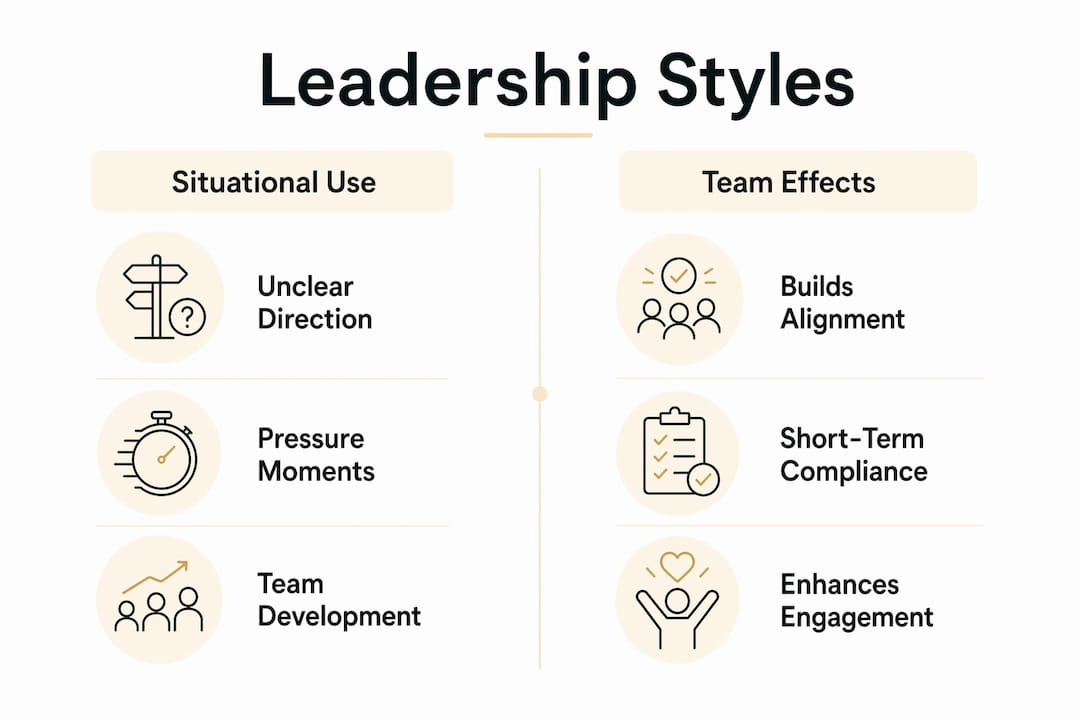
Psychologist Daniel Goleman identified six leadership styles that cover the full range of managerial situations. Each style produces a distinct effect on team climate and performance.
| Style | Best used when | Effect on team |
|---|---|---|
| Visionary | Direction is unclear or shifting | Builds motivation and long-term alignment |
| Coaching | Team member needs skill or confidence growth | Increases capability and engagement |
| Affiliative | Trust is low or conflict is high | Restores relationships and psychological safety |
| Democratic | Team has expertise and buy-in matters | Generates commitment and shared ownership |
| Pacesetting | Team is skilled and self-motivated | Drives high output but risks burnout if overused |
| Commanding | Crisis or urgent compliance required | Delivers fast results but damages morale over time |
The commanding style is the one most managers default to under pressure. It produces short-term compliance but erodes trust quickly. The visionary and democratic styles, used together, create the most durable team performance. High-performing managers combine visionary and democratic approaches to set direction while empowering teams to decide how they execute.
Situational factors that should drive your style choice include task urgency, the experience level of the team member involved, and the current state of your working relationship with that person. A new hire on a high-stakes project needs coaching and clear direction. A senior team member on familiar ground needs democratic space to own the outcome.
Pro Tip: Before your next team meeting, decide which style the situation calls for. Write it down. Managers who name their intended style before entering a conversation adapt far more deliberately than those who react in the moment.
What practical steps can managers take to build leadership capability?
Structured development beats self-directed trial and error. 82% of managers never receive formal leadership training, relying instead on experience and instinct. That approach produces uneven results and leaves significant performance on the table.
Formal programs provide the fastest baseline. Structured programs like the Wharton Management Development Program run approximately 12 weeks with 12 modules covering strategy, finance, and leadership. That structure matters because it forces managers to examine behaviors they would otherwise rationalize or ignore. One-off workshops do not produce the same result.
Ongoing development requires four specific habits:
- Weekly one-on-ones with direct reports. These conversations build trust, surface problems early, and give you real-time data on team engagement. Treat them as non-negotiable, not optional.
- Strengths-based feedback. Identify what each team member does well and build their role around those strengths. Coaching is a learnable behavior involving strengths-based feedback, emotional support, and structured performance conversations. It is not an innate trait.
- Reflection cycles. After significant decisions or team interactions, spend ten minutes reviewing what worked and what you would change. Effective leadership development requires tailored practice, reflection, and feedback cycles within role-specific context.
- External coaching. A skilled business coach provides the outside perspective that internal feedback rarely delivers. Championbusinesscoaching works with mid-to-senior managers across Australia through structured coaching plans designed to produce measurable results within 90 days.
The managers who develop fastest are not the ones who read the most books. They are the ones who practice specific behaviors, get feedback on those behaviors, and adjust. That cycle, repeated consistently, produces the compounding growth that separates good managers from genuinely great leaders.
Pro Tip: Ask one direct report each month: "What's one thing I could do differently that would make your work easier?" The answers will be more useful than any 360-degree review.
How do effective managers shift from boss to coach?
The shift from boss to coach is the most consequential behavioral change a manager can make. Gallup recommends transitioning managers from boss to coach as the primary lever for improving employee engagement and sustaining performance. Command-and-control management produces compliance. Coaching produces commitment.
The difference shows up in outcomes. Managers trained in coaching-based behaviors see a 75% improvement in team quality scores compared to untrained peers. That is not a marginal gain. It represents a fundamental shift in how teams function and how people feel about their work.
Coaching as a management practice involves four specific behaviors:
- Candid, forward-looking conversations. Focus on what the team member will do next, not what they did wrong last time.
- Strengths application. Assign work that plays to individual strengths, then coach around the gaps rather than leading with deficiencies.
- Psychological safety. Create conditions where team members can raise problems, admit mistakes, and ask questions without fear of judgment.
- Consistent presence. Coaching is not a quarterly event. It is an ongoing dialogue embedded in daily and weekly interactions.
"Transitioning from boss to coach requires making coaching an ongoing dialogue focused on strengths over correcting mistakes. Managers who make this shift see sustained gains in engagement that command-and-control approaches simply cannot produce." — Gallup, Manager Development Strategy
Leading through change with a coaching mindset also reduces turnover during transitions. When team members feel heard and supported rather than directed and assessed, they stay. That retention effect compounds over time into a genuine competitive advantage for any Australian business.
Key Takeaways
The most effective leadership approach for managers combines style flexibility, coaching behaviors, and emotional intelligence to drive team engagement and sustained performance.
| Point | Details |
|---|---|
| Managers drive engagement | Managerial behavior accounts for 70% of team engagement variance, making leadership skills the primary performance lever. |
| Style flexibility beats fixed identity | High-performing managers use four or more leadership styles situationally, not one style consistently. |
| Coaching outperforms command | Managers trained in coaching behaviors see a 75% improvement in team quality scores compared to untrained peers. |
| Formal training closes the gap | 82% of managers lack formal leadership training; structured programs produce faster, more consistent development than trial and error. |
| AI literacy is now a core skill | Only 50% of employees say leadership has communicated an AI strategy, making this a critical gap for managers to close. |
What I've learned about leadership that most articles won't tell you
The most common mistake I see mid-to-senior managers make is confusing busyness with leadership. They fill their calendars with meetings, decisions, and approvals, and they call that managing. Real leadership is mostly invisible. It happens in a five-minute conversation where you ask the right question instead of giving the answer. It happens when you choose the affiliative style on a day when your instinct says to push hard.
Style flexibility is the skill that separates genuinely effective managers from technically competent ones. Most managers know what good leadership looks like in theory. Very few practice switching styles deliberately based on what the situation actually requires. The commanding style is the default under pressure, and it is almost always the wrong choice. It feels decisive. It produces resentment.
The other thing I advocate for strongly is making coaching a daily habit rather than a scheduled event. Managers who wait for the annual review cycle to have developmental conversations are operating a year behind their teams' actual needs. Strengths-based feedback delivered in real time, in the flow of normal work, builds capability faster than any workshop.
AI literacy is the new frontier, and the managers who ignore it are already behind. You do not need to be a technical expert. You need to understand enough to guide your team through the uncertainty and communicate a clear direction. That is a leadership skill, not a technical one.
The managers I have seen grow fastest share one trait: they treat their own development with the same seriousness they apply to their team's performance. They seek feedback, they reflect deliberately, and they invest in coaching. That combination produces results that trial and error simply cannot match.
— Duncan
How Championbusinesscoaching supports your leadership growth
Mid-to-senior managers across Australia are working with Championbusinesscoaching to build the specific leadership behaviors that drive team performance and business results.
Championbusinesscoaching delivers tailored coaching and advisory services built around your role, your team, and your specific development gaps. The 90-day coaching guarantee means you see measurable progress or your session is free. Coaching slots are deliberately limited to maintain quality, and the approach is built on structured plans, honest feedback, and real accountability. If you are ready to shift from managing to leading, the next step is a conversation.
FAQ
What are the most important leadership skills for managers?
The most critical skills are emotional intelligence, communication, coaching, and decision-making under uncertainty. Emotional intelligence alone accounts for nearly 90% of the difference between star and average performers in leadership roles.
How do leadership styles affect team performance?
Leadership style directly shapes team climate, engagement, and output. High-performing managers use four or more styles situationally, matching their approach to the urgency, team maturity, and relationship context of each situation.
What is the fastest way to develop leadership skills?
Structured formal training combined with ongoing coaching and weekly reflection cycles produces the fastest results. 82% of managers rely on trial and error alone, which is the slowest and least reliable development path.
How does coaching differ from traditional management?
Coaching focuses on strengths, forward-looking conversations, and psychological safety rather than correction and compliance. Managers who adopt coaching behaviors see a 75% improvement in team quality scores compared to those who use command-and-control approaches.
Why is AI literacy now a leadership skill for managers?
Only 50% of employees report that leadership has communicated a clear AI strategy. Managers who understand AI well enough to guide their teams reduce uncertainty, build confidence, and position their organizations to adapt rather than react.