
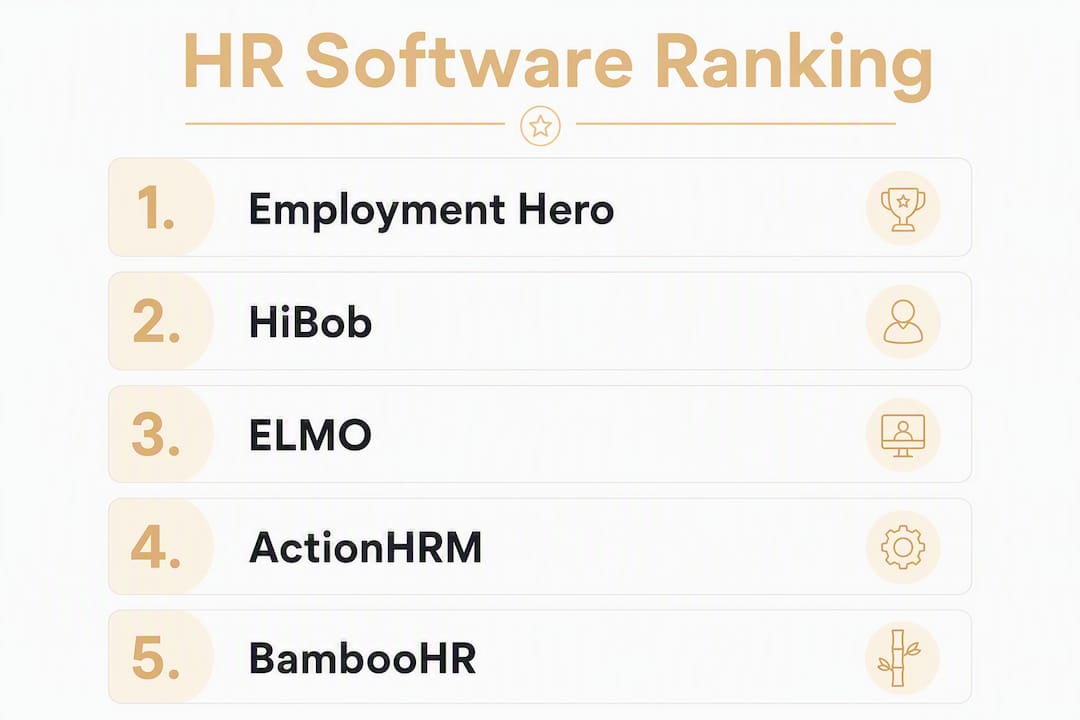
For most Australian small and mid-market businesses, the right HR software combines ATO payroll compliance, Xero or MYOB integration, and enough configurability to handle Modern Awards without a consultant on speed dial. The strongest shortlist right now: Employment Hero for integrated HR and payroll automation, HiBob (Bob) for scaling teams that need AI analytics, ELMO Software for rostering-heavy mid-market operations, Deputy for shift-based businesses, and KeyPay for payroll-first accuracy. BambooHR suits smaller teams prioritizing employee experience, while ActionHRM fits organizations tired of patchwork systems.
One regulatory fact shapes every buying decision in 2026: from 1 July 2026, Australian employers must pay superannuation with every pay cycle, not quarterly. Any platform that cannot calculate super in real time is a compliance liability. Separately, more than 70 percent of Australian companies already use some form of HR technology for payroll and workforce management, so the question is no longer whether to adopt a system but which one fits your structure.
| Platform | Best for | Payroll & ATO | Key integrations | AI features | Data residency |
|---|---|---|---|---|---|
| Employment Hero | SMEs, HR+payroll automation | Yes, STP-ready | Xero, MYOB, KeyPay | Onboarding automation, compliance alerts | AU servers |
| HiBob (Bob) | Mid-market, distributed teams | Via AU payroll integrations | Xero, MYOB, payroll providers | Real-time analytics, predictive attrition | Configurable |
| ELMO Software | Rostering-heavy mid-market | Yes, ANZ-built | Xero, MYOB, rostering | Workforce analytics | AU-based |
| ActionHRM | High configurability, mid-market | Via integrations | Broad integration library | Reporting analytics | AU-owned |
| BambooHR | Small teams, employee experience | Verify AU payroll separately | Xero, MYOB (via connectors) | People analytics | US-hosted |
| KeyPay | Payroll-first, accountants | Yes, ATO-certified | Xero, MYOB, Deputy | Payroll rules engine | AU servers |
| Deputy | Rostering, shift-based SMEs | Via payroll integrations | Xero, MYOB, KeyPay | Scheduling AI | AU servers |
| Xero | Accounting-payroll integration | Yes, STP Phase 2 | HR platforms broadly | Reporting | AU servers |
| MYOB | Existing MYOB users, ANZ payroll | Yes, deep ANZ heritage | HR platforms broadly | Reporting | AU servers |
Table of Contents
- Which HR software platforms work best for Australian businesses?
- What Australian businesses say about these platforms
- How does mobile access compare across these platforms?
- Training resources for Australian HR teams
- Championbusinesscoaching helps you get more from your HR system
- Key Takeaways
Which HR software platforms work best for Australian businesses?
Employment Hero is the most complete option for SMEs that want HR and payroll in one place. Its Employment OS automates onboarding, attendance tracking, and compliance alerts, and it connects directly with payroll to keep STP reporting current. Pricing is per employee per month on tiered plans; setup typically runs 30–60 days for a business under 100 people.
HiBob (Bob) suits scaling organizations with 50–500 employees. Its configurable workflows include a testing environment for award-based rules, which is genuinely useful before going live with Modern Award configurations. AI analytics surface workforce trends in real time, letting managers spot attrition risk before it becomes a resignation. Integration with Australian payroll providers means payroll compliance is handled at the connection layer.

ELMO Software is built in Australia for the ANZ market. It unifies HR, payroll, and rostering on a single data foundation, which removes the reconciliation headache that comes from running separate systems. Modern Awards and enterprise agreement compliance are core to the product, not bolt-ons. Best for mid-market businesses with complex rostering needs, particularly healthcare, aged care, and hospitality.
ActionHRM is Australian-owned and targets organizations from 100 to 5,000-plus employees that need high configurability. Its value is eliminating patchwork HR systems where payroll lives in one tool, rostering in another, and onboarding in a spreadsheet. Strong integration capability means it connects with existing accounting and time-and-attendance tools rather than forcing a rip-and-replace.
BambooHR has excellent UX and strong employee self-service features, but Australian buyers should verify local payroll integrations independently. It does not have native Australian payroll compliance built in, so it works best paired with a dedicated payroll tool like KeyPay.
KeyPay is payroll-first by design. It handles Australian payroll rules, STP Phase 2, and award interpretation with precision, and it integrates with Xero, MYOB, and Deputy. Accountants and bookkeepers managing payroll for clients use it heavily. Not a full HRIS, but the strongest payroll engine on this list.
Deputy handles rostering and time-and-attendance for shift-based businesses better than any full-suite platform. It pairs with KeyPay and Xero for payroll, making it a natural fit for hospitality, retail, and healthcare operators who need scheduling accuracy before payroll accuracy.
Xero and MYOB are accounting platforms, not HR systems, but both anchor the payroll integration layer for most Australian SMEs. If your business already runs on either, prioritize HR platforms with certified integrations to them.
Buying criteria: how to weigh your options
- Per-pay-cycle super readiness. From 1 July 2026, this is non-negotiable. Confirm the vendor calculates and remits super each pay run, not quarterly.
- Modern Award and EBA testing. Effective HR systems let you test award rule configurations in a sandbox before going live. Payout errors from misconfigured awards are expensive and legally exposed.
- Xero or MYOB integration quality. A certified, two-way integration is different from a basic data export. Ask vendors for specifics.
- Company size and rostering complexity. Micro-businesses (under 20 staff) rarely need ELMO or HiBob. Deputy plus KeyPay plus Xero often covers everything at lower cost.
- AI features that actually matter. Workforce analytics and predictive attrition are high-value. Autopilot hiring tools need careful evaluation for accuracy against Australian candidate pools.
- Data residency. Australian server hosting matters for privacy compliance. Confirm it in writing, not just in marketing copy.
- Local support. A vendor with Australian support hours and a local customer success team shortens resolution time when payroll issues arise.
Pro Tip: Run a 30/60/90-day implementation plan: spend the first 30 days in sandbox mode testing award rules and integrations, days 31–60 on a pilot group, and days 61–90 on full rollout with reporting review. Skipping the sandbox phase is the single most common cause of payroll errors at go-live.
What Australian businesses say about these platforms
Australian HR teams consistently flag two things when reviewing these platforms: compliance accuracy and support responsiveness. Employment Hero draws positive feedback from SMEs for its onboarding automation and the speed of getting new hires through paperwork. ELMO users in healthcare and aged care cite the rostering and Modern Award engine as the primary reason they chose it over generic platforms.
HiBob's real-time analytics get strong marks from people and culture managers who previously relied on spreadsheet-based reporting. The shift from monthly HR reports to live workforce dashboards changes how quickly managers can act on turnover signals. ActionHRM users highlight the reduction in integration maintenance once fragmented systems are consolidated.
The consistent criticism across platforms is implementation time. Businesses that underestimate configuration complexity, particularly around award rules and payroll mapping, routinely extend their go-live timelines. Vendors that provide dedicated implementation support and sandbox environments get better adoption outcomes.
How does mobile access compare across these platforms?
Employment Hero, HiBob, Deputy, and ELMO all offer dedicated mobile apps with meaningful functionality: leave requests, shift viewing, payslip access, and manager approvals. Deputy's mobile app is the strongest for shift workers, with real-time schedule updates and clock-in via GPS. BambooHR's mobile experience is clean and well-reviewed for employee self-service.
KeyPay and MYOB have functional mobile access but are primarily desktop-optimized tools. Xero's mobile app covers payroll and accounting basics. For businesses with a high proportion of deskless workers, Deputy's app is the practical benchmark.
Training resources for Australian HR teams
Employment Hero provides an online help center, webinars, and a dedicated customer success team for Australian accounts. ELMO offers structured onboarding training and ANZ-specific compliance webinars. HiBob has a learning hub with product documentation and live training sessions. ActionHRM provides configuration training as part of its implementation package.
Deputy and KeyPay both maintain extensive knowledge bases and video libraries. For teams without a dedicated HR manager, business systemisation resources that cover how to unify HR, payroll, and rostering tools can reduce the learning curve significantly before vendor training begins.
Championbusinesscoaching helps you get more from your HR system
Picking the right platform is step one. The harder part is turning HR data into decisions that actually move your business forward. Championbusinesscoaching works with Australian business owners and managers to do exactly that: translate workforce analytics into hiring plans, use compliance data to tighten operations, and build the people strategy your HR system was supposed to support all along.
During selection, coaching helps you define what you actually need before a vendor demo shapes your thinking. During rollout, a coach keeps the 30/60/90-day plan on track and helps managers interpret early reports. Post-live, the real value of AI-powered analytics only shows up when someone in the business knows what to do with the data. Championbusinesscoaching holds a five-star Google rating and backs every engagement with a 90-day results guarantee. Book a free consultation to see how coaching pairs with your HR software rollout.
Key Takeaways
The best HR software for Australian businesses in 2026 must handle per-pay-cycle superannuation, integrate with Xero or MYOB, and include a sandbox for Modern Award testing before go-live.
| Point | Details |
|---|---|
| Super compliance deadline | From 1 July 2026, super must be paid every pay cycle; confirm your platform supports this before committing. |
| Sandbox testing is critical | Test Modern Award and EBA rules in a sandbox environment to prevent payroll errors at go-live. |
| HR tech adoption rate | More than 70 percent of Australian companies already use HR technology for payroll and workforce management. |
| Match platform to business size | Deputy plus KeyPay suits small shift-based businesses; ELMO or HiBob fits mid-market complexity. |
| Championbusinesscoaching | Pairs coaching with HR software rollout to turn workforce analytics into real business decisions, backed by a 90-day guarantee. |