
The fastest path to your first paying bookkeeping client is this: pick a niche, reach out to 25 warm contacts this week, set up your Google Business Profile, and run one outreach channel consistently for 90 days. That single sequence, done in order, beats every other approach for new and solo bookkeepers.
Here are the six actions to start today:
- Pick a niche and write a one-liner (e.g., "I do bookkeeping for HVAC contractors in [city]"). Expect your first conversation shortly after you can say this clearly.
- Contact 25 people who already know you. Ask for an introduction, not a sale. Warm referrals convert far better than cold outreach and are the highest-quality lead source at any stage. The first client is expected within a few weeks.
- Set up and fully optimize your Google Business Profile. It's free, it drives local search visibility, and it works while you sleep. First inbound inquiry may come several weeks after optimization.
- Run one repeatable outreach system (LinkedIn or CPA partner outreach) for 90 days without switching. Consistency beats variety every time.
- Turn on Google Local Services Ads once you have at least three reviews. Paid leads arrive within days of activation.
- Build a one-page proposal template so you can send a signed scope of work the same day as a discovery call. Speed closes deals.
Pick one of these systems this week and commit to it for 30 days before adding another.
Table of Contents
- What are the most effective strategies to get bookkeeping clients?
- How do you land your first bookkeeping client in 30 days?
- Where do you find bookkeeping clients, ranked by lead quality?
- How should you price bookkeeping services and structure packages?
- How do you convert discovery calls into retained clients?
- Which tools and certifications make you more credible to clients?
- Key Takeaways
- What new bookkeepers get wrong about finding clients
- Championbusinesscoaching can accelerate your first 90 days
- Useful sources for bookkeepers building their practice
What are the most effective strategies to get bookkeeping clients?
Think of client acquisition in five buckets: online presence, warm outreach, partnerships, marketplaces, and paid ads. Each has a different speed-to-results and effort profile. The mistake most new bookkeepers make is dabbling in all five at once. A single acquisition system run consistently beats a toolkit of half-executed channels every time.
Online presence: your 24/7 sales rep
A professional website paired with a fully optimized Google Business Profile is the foundation. Website, local SEO, and Google Business Profile are among the highest-ROI investments for practices serving defined geographies. Your site needs four things to convert: a clear niche statement, a service page with pricing signals, a review section, and a single call to action (book a free call).
Execution steps this week:
- Claim and fully complete your Google Business Profile (every field, real photos, business hours, service area)
- List your practice on at least two industry directories (AIPB's directory, your state CPA society referral list)
Warm outreach: the fastest first client
Niche specialization lets firms charge a premium and win faster. Pair that niche with a warm list and you have the fastest client-acquisition combination available. Write down 25 people who know your work, former colleagues, neighbors, LinkedIn connections, former employers. Message each one personally. Not a mass email. A real note.
Pro Tip: Don't ask for business directly. Ask: "Do you know anyone who might need a bookkeeper who specializes in [niche]?" That framing is far less awkward and produces more referrals.
Partnerships: the highest-quality recurring leads
CPAs, tax preparers, financial advisors, and business attorneys all work with small-business owners who need bookkeeping. A single CPA relationship can send you two to four clients per year, every year. Reach out to five local CPAs this month. Offer to handle the bookkeeping cleanup work their clients bring in before tax season. That's a low-risk introduction for both sides.
Marketplaces: fast but competitive
Software partner directories, such as the QuickBooks ProAdvisor directory and Xero's advisor finder, send pre-qualified leads because the prospect has already chosen their accounting software. Listing there takes under an hour and generates inbound inquiries from people who are actively looking. Freelancer marketplaces are faster to get started on but attract more price-sensitive buyers.
Paid ads: buy speed when you're ready
Google Ads and Local Services Ads (LSA) work well once you have a clear niche and at least a few reviews. LSA's Google Screened badge adds instant credibility. Budget for paid channels only after your profile and website are solid, otherwise you're paying to send traffic to a leaky bucket.
How do you land your first bookkeeping client in 30 days?
This is a week-by-week sprint. Follow it in order.
-
Week 1: Niche, one-liner, and assets. Decide on one niche (industry + geography). Write your one-liner. Set up or update your website, Google Business Profile, and LinkedIn profile to reflect that niche. Download a customer avatar guide to sharpen who you're targeting.
-
Week 2: Warm outreach to 25 contacts. List 25 people who know your work and ask for introductions. Send a personal message to each. Offer a low-risk entry point: a free 30-minute review of their books, or a paid one-time cleanup project. Track responses in a simple spreadsheet.
-
Week 3: Partner outreach and LinkedIn activity. Email five local CPAs with a short, specific offer. Connect with 10–15 LinkedIn prospects per day in your niche. Send a value message on day 3 (a useful tip, not a pitch). Track connection acceptance and reply rates.
-
Week 4: Discovery calls, proposals, and onboarding. Run discovery calls with every interested prospect. Send your proposal the same day. Use an e-signature tool so they can sign immediately. Your goal: one signed client by day 30.
Metrics to track each week:
- Contacts messaged vs. replies received (aim for 20–30% reply rate on warm outreach)
- Discovery calls booked vs. proposals sent (aim to send a proposal after every call)
- Proposals sent vs. signed (a 50% close rate on proposals is achievable when scope is clear)
Where do you find bookkeeping clients, ranked by lead quality?
Not all channels are equal. Here's how the main ones stack up when you're working with limited time:
- LinkedIn outreach: a LinkedIn three-message sequence (connect, day-3 value, day-10 ask) produces consistent call flow when run daily. Moderate effort, scalable.
- Google Business Profile and local search — free, high-intent leads from people actively searching for a bookkeeper near them. Takes 3–6 weeks to build momentum but compounds over time.
- TaxDome's practice management ecosystem: TaxDome offers marketing guidance and a client portal that improves your professional presentation, which indirectly supports conversion.
When time is tight, focus on warm referrals and one digital channel only. Add a second channel after you have two paying clients.
How should you price bookkeeping services and structure packages?
Three pricing models dominate the market: hourly, fixed packages, and monthly retainers. Hourly is the easiest to start with but caps your income and creates uncertainty for clients. Fixed packages and retainers are better for both sides once you know your delivery time.
Here's a sample package structure you can adapt:
| Package | Scope | Typical Deliverables | Pricing Shape |
|---|---|---|---|
| Starter | 1 bank account, up to 50 transactions/month | Monthly reconciliation, basic P&L, email support | Entry-level flat monthly fee |
| Core | Up to 3 accounts, up to 150 transactions/month | Reconciliation, P&L, balance sheet, quarterly review call | Mid-tier flat monthly fee |
| Growth | Multiple entities or accounts, payroll, AP/AR | Full-service bookkeeping, monthly strategy call, tax-ready reports | Premium monthly retainer |
Present pricing on your website with a clear scope for each tier. Anchoring matters: list your highest package first so the middle option looks like the reasonable choice. Add-ons (payroll, sales tax filing, catch-up bookkeeping) should be priced separately and listed on your proposal. State your cancellation or notice terms clearly (30 days written notice is standard) so clients know what they're committing to.
Niche specialists consistently command higher rates than generalists because clients perceive them as lower-risk. If you serve restaurant owners, your packages can reflect their specific needs (daily sales reconciliation, tip reporting) and justify a premium.
How do you convert discovery calls into retained clients?
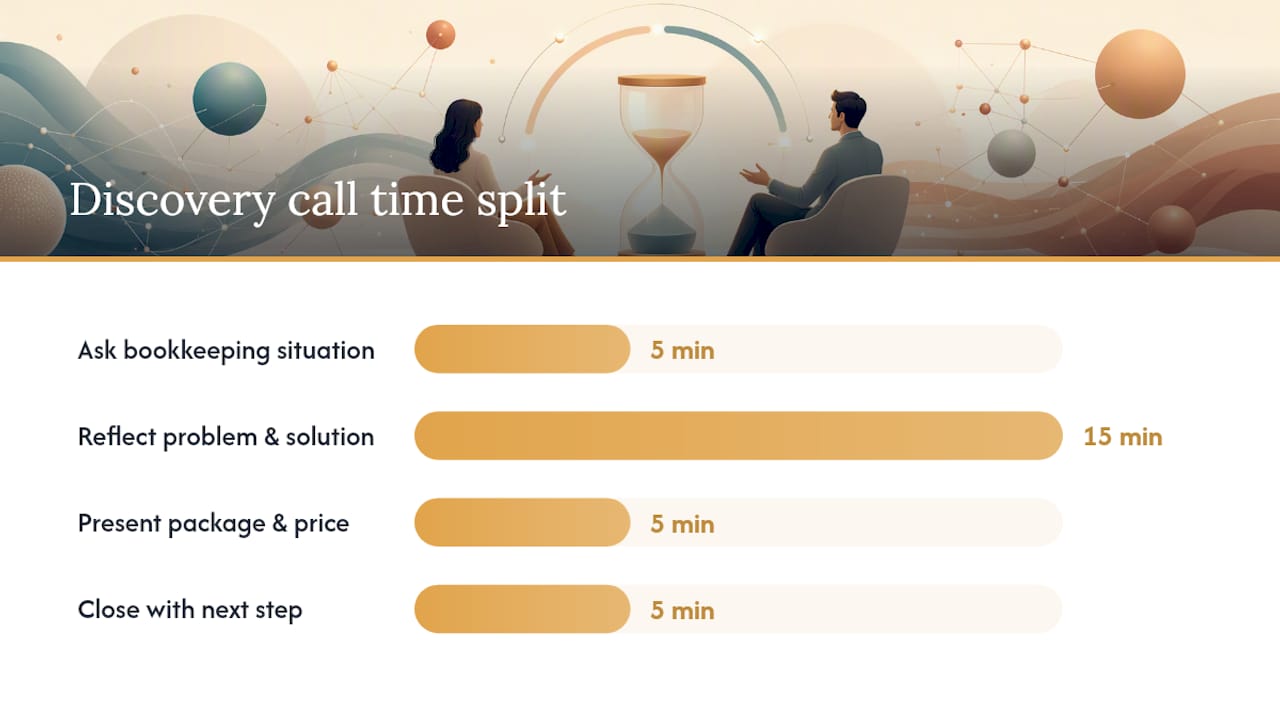
The discovery call has three goals: qualify the prospect, show them you understand their problem, and close a clear next step. Keep it to 30 minutes.
Discovery call structure:
- Minutes 1–5: Ask about their current bookkeeping situation and biggest pain point
- Minutes 5–20: Reflect their problem back, share one specific way you'd solve it, and ask about their volume and software
- Minutes 20–25: Present your relevant package and price range
- Minutes 25–30: Close with a next step ("I'll send you a proposal today. If it looks good, you can sign and we'll schedule your onboarding call.")
Proposal checklist:
- Fixed scope with clear deliverables (no open-ended "as needed" language)
- Timeline for first deliverable (e.g., "First reconciliation delivered by [date]")
- Monthly price and payment terms (auto-pay preferred)
- Engagement letter with e-signature (use DocuSign, PandaDoc, or HelloSign)
- 30-day cancellation clause
Onboarding checklist:
- Collect read-only access to bank and credit card accounts
- Set up recurring billing (Stripe, QuickBooks Payments, or similar)
- Grant and confirm software access (QuickBooks, Xero, or your practice management tool)
- Send a welcome email with 30/60/90-day milestones so the client knows what to expect
Pro Tip: Send your proposal within two hours of the discovery call. Prospects who receive a same-day proposal with an e-signature link close at a significantly higher rate than those who wait 48+ hours. Speed signals professionalism.
Which tools and certifications make you more credible to clients?
Certifications signal that you meet a professional standard, which matters most when a prospect doesn't know you yet.
- AIPB Certified Bookkeeper (CB): the most widely recognized bookkeeping-specific credential in the US; display it on your website, proposals, and LinkedIn profile
- AICPA resources: not a bookkeeper-specific credential, but AICPA's practice standards and ethics frameworks are useful references for professional credibility
Practice management tools worth knowing:
- TaxDome — client portal, document collection, e-signatures, and recurring billing in one platform. Reduces admin time and looks professional to clients.
If you're new, prioritize QuickBooks ProAdvisor certification and a TaxDome or Ignition account. Both are visible to clients and reduce friction in the sales and onboarding process. Add AIPB or NACPB once you're delivering consistently.
Key Takeaways
The fastest path to bookkeeping clients combines a clear niche, warm referrals, and one consistent outreach channel run for at least 90 days.
| Point | Details |
|---|---|
| Start with warm outreach | List 25 people who know your work and ask for introductions before spending on ads. |
| Niche to charge more | Specialists consistently command higher rates and win clients faster than generalists. |
| Google Business Profile first | A fully optimized, free GBP listing drives local inbound leads and compounds over time. |
| Send proposals same day | Same-day proposals with e-signature links close at a higher rate than delayed ones. |
| Championbusinesscoaching | A 90-day coaching program can accelerate your client-acquisition sprint with a structured playbook and accountability. |
What new bookkeepers get wrong about finding clients
The most common mistake is skipping the niche decision and going straight to volume tactics. Bookkeepers who try to serve everyone end up competing on price with every other generalist, and they lose. The highest-leverage decision you'll make in your first 90 days is who you say no to.
The second mistake is treating marketing as something you do after you have clients. It needs to run in parallel with delivery, even if it's just 30 minutes a day. The bookkeepers who build steady practices aren't the ones who found a magic channel. They're the ones who picked one system and ran it without stopping.
Third: slow proposals. A prospect who waits three days for a proposal has already started talking to someone else. The same-day send is not a nice-to-have. It's a competitive advantage that costs you nothing.
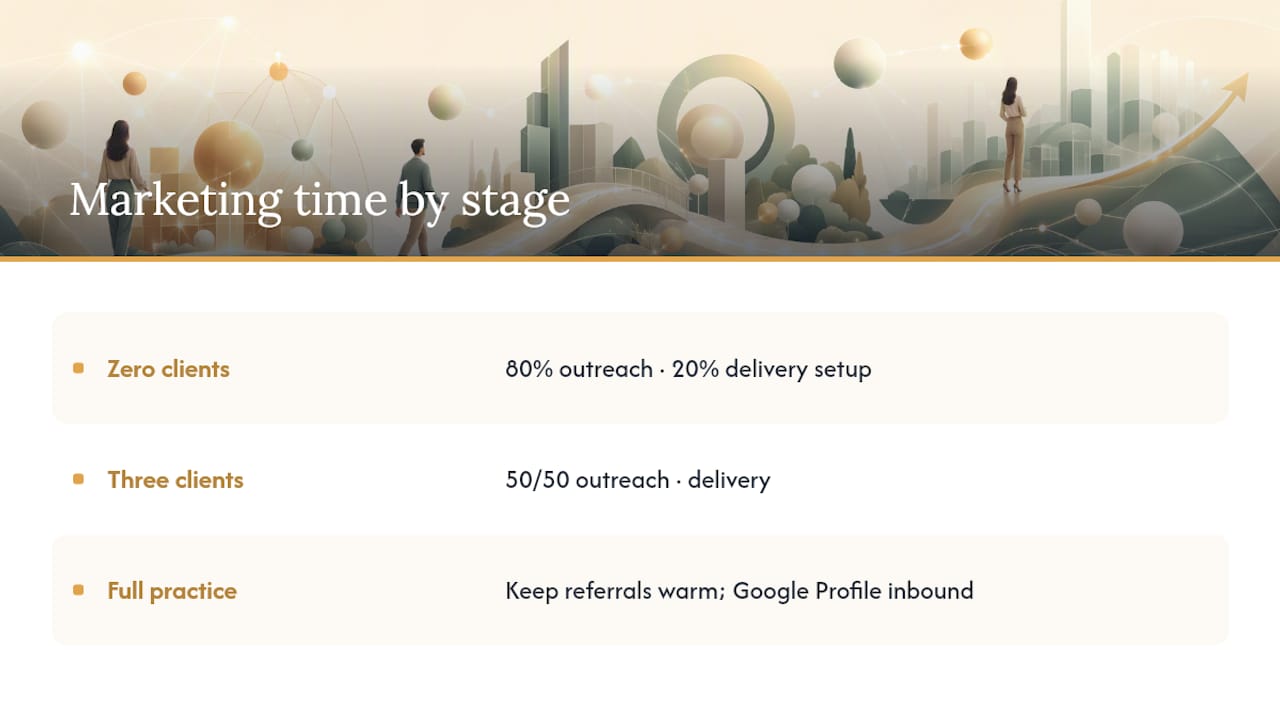
The mental model worth keeping: think of your marketing time as a ratio. When you have zero clients, 80% of your time goes to outreach and 20% to delivery setup. Once you have three clients, flip it to 50/50. Once you're full, your only job is to keep the referral pipeline warm and let your Google Business Profile do the inbound work.
One more thing that rarely gets said: the 90-day sprint works because it forces you to commit to a system long enough to see real data. Most bookkeepers quit a channel after two weeks because they haven't gotten a client yet. Two weeks is not enough time to know if a channel works. Ninety days is.
Championbusinesscoaching can accelerate your first 90 days
Landing your first three bookkeeping clients is a solvable problem. It takes a clear niche, a repeatable outreach system, and someone who can tell you when you're wasting time on the wrong channel. That's exactly what Championbusinesscoaching delivers through its 90-day coaching program: a structured sprint with a proven playbook, weekly accountability, and a guarantee that if you don't see results, your session is free.
Championbusinesscoaching works specifically with service-based businesses including bookkeepers, helping them set pricing, define their niche, and build the outreach systems that produce consistent client flow. The coaching is one-on-one, the slot count is limited, and the focus is on what moves the needle in your first 90 days, not a generic framework. To get started, request a consultation and find out whether there's a current opening.
Useful sources for bookkeepers building their practice
- How to get bookkeeping clients: 20 proven strategies - TaxDome
- How to Get Bookkeeping Clients (Agiled)
- How to Get Bookkeeping Clients: The 90-Day Sprint (DreamFirms)
- [Marketing for Bookkeepers and Accountants [2026] | Searchlab](https://searchlab.nl/en/guides/marketing-for-bookkeepers-accountants)
- How to Get Clients as a Bookkeeper - Bookkeeping Biz Academy
- How to Get Bookkeeping Clients (Uku)
- American Institute of Professional Bookkeepers (AIPB)
- AICPA
- Google Business Profile
- Business Coaching Australia | Online Coaching, Advisory & Mentoring