
A digital transformation roadmap is a sequenced, governed plan that ties technology and process changes to measurable business outcomes, not just a list of software rollouts. It matters because it forces leadership to agree on priorities before money moves. The first action: run a readiness assessment across people, process, technology, and data, then convene an executive alignment workshop to confirm what "done" actually looks like.
TL;DR:
- Prioritization should focus on high-impact, high-feasibility initiatives with quick returns, balanced with foundational work like data cleanup and system integration.
- Roadmaps must be treated as living portfolios with ongoing review and re-sequencing, not static project schedules or tool lists.
- Effective governance involves an executive steering group, a transformation office, and clear KPIs across multiple metrics, with review cadences to ensure accountability.
- Proper sequencing depends on dependency mapping and resource planning to prevent rework, with pilots designed around specific questions and measurable success criteria.
- Address common pitfalls such as over-ambition, poor change management, and weak governance to improve chances of successful digital transformation.
Table of Contents
- What Is a Digital Transformation Roadmap and Why Does It Matter?
- Key Components and a Step-By-Step Roadmap You Can Actually Follow
- How Do You Prioritize and Sequence Transformation Initiatives?
- Governance, KPIs, and Review Cadences That Keep the Roadmap Working
- How Should You Run Pilots and Scale What Works?
- Why Do Digital Transformation Programs Stall?
- How Coaching Helps Turn a Roadmap Into Results
- What Tools Support Roadmap Planning and Tracking?
- Which Change Management Methods Fit Digital Transformation?
- An Editorial Take on Roadmaps That Actually Work
- Sources
What Is a Digital Transformation Roadmap and Why Does It Matter?
A digital transformation roadmap is a visualization of key initiatives, sequenced across a defined time horizon, connected to the metrics a business actually tracks: revenue per employee, customer retention, cycle time, error rates. Australia's own government guidance on digital investment planning, Standard 4: Planning, defines it exactly this way and spells out what a roadmap should show: initiatives, dependencies, and delivery timing across the investment horizon. That standard exists because agencies kept confusing a roadmap with a project schedule, and the confusion is just as common in private business.
Here's the distinction that trips up most leaders: a Gantt chart tracks tasks and dates. A technology wish list tracks tools. A roadmap tracks decisions. It answers questions like "which capability do we build first if the budget only stretches to two of the five things we want," not just "when does the new system go live."
Treat the roadmap as a living portfolio rather than a static plan and you avoid the single biggest reason these efforts stall. Practitioner guidance on digital transformation strategy recommends a portfolio-style governance process where a steering group reallocates funding and re-sequences work as evidence comes in, the same way an investment committee reviews a stock portfolio. A document gets filed away. A living management system gets reviewed monthly and changes shape as the business learns.
That reframing changes who owns it, too. A static plan belongs to IT. A living portfolio belongs to the executive team, because the trade-off decisions it forces (which initiative gets the next funding release, which gets paused) are business calls, not technical ones.
Key Components and a Step-By-Step Roadmap You Can Actually Follow
Building a working roadmap follows a fairly consistent sequence regardless of industry. Skip a step and you tend to pay for it later, usually in the form of rework or a project that technically launched but nobody uses.
- Set a measurable strategic vision. Anchor the roadmap to two or three business metrics leadership already reports on, such as gross margin, customer churn, or average handling time. Vague ambitions like "become more digital" give a steering group nothing to say yes or no to.
- Run a readiness assessment across four dimensions: people (skills and change appetite), process (how work actually flows today, not how the org chart says it does), technology (what's in place and what's end of life), and data (quality, ownership, and access). Harvard Business Review's guidance on mapping digital transformation is blunt about this step: skipping foundational assessment and sequencing raises the risk of failure later, often after the money is already spent.
- Define a target operating model and a handful of technology principles. Decide, for instance, whether you're standardizing on cloud-first infrastructure, which platforms are core versus temporary, and how data will be governed across systems. This doesn't need to be a 40-page architecture document. A one-page set of principles that the leadership team actually agrees on beats an exhaustive framework nobody reads.
- Build a backlog of candidate initiatives. List everything under consideration: a new CRM, an automated invoicing workflow, an AI-assisted scheduling tool, a data warehouse. Don't pre-filter yet.
- Score each initiative on impact, feasibility, and time-to-value. This scorecard approach, recommended in practitioner frameworks for digital transformation strategy, turns a subjective argument into a structured conversation about trade-offs.
- Sequence initiatives in waves. Foundational enablers (a clean customer database, a reliable API layer, single sign-on) go first even though they're invisible to customers, because everything downstream depends on them. Value-generating releases follow, timed to land as quick wins that build momentum.
- Embed change management from day one, not as a training session bolted on before go-live. Prosci's guidance on building a people-first roadmap frames change management as the single biggest risk factor in these programs, and recommends assigning visible executive sponsorship, structured training, and, where the budget allows, an internal digital academy to build capability over time.
- Convert milestones into KPIs and set a review cadence. A milestone like "CRM live" means little on its own. "CRM live, with lead response time under two hours by week six" gives the steering group something to check.
- Keep the roadmap alive. Build in explicit rules for re-sequencing: if an initiative slips two review cycles in a row, it gets re-scored or paused, not quietly carried forward forever.
Pro Tip: Print the backlog and the scorecard on one page and pin it to the wall of every steering group meeting. The moment prioritization decisions live only in someone's slide deck, they stop being decisions anyone can hold the group accountable to.
Foundational work rarely gets applause. A new data platform or a cleaned-up customer record set doesn't excite a board the way a customer-facing app does, but skip it and every wave that follows inherits the mess. Public digital platforms like API NSW exist precisely because governments learned that lesson the expensive way: build the plumbing once, well, and everything built on top of it moves faster.
How Do You Prioritize and Sequence Transformation Initiatives?
Most roadmaps fail not because the ideas were bad, but because the sequencing created rework nobody planned for. A new e-commerce platform launched before the inventory system was fixed means double data entry for six months. Getting the order right matters as much as picking the right initiatives.
The scorecard method solves the "everything feels urgent" problem. Score each candidate initiative from 1 to 5 on three dimensions:
- Impact: how much it moves the business metrics leadership actually reports on.
- Feasibility: whether the skills, budget, and technology exist today or need to be built.
- Time-to-value: how quickly the business sees a return, in weeks rather than years.
Multiply or plot the three scores and a pattern usually appears fast: a handful of initiatives cluster in the high-impact, high-feasibility, fast-payback zone. Those are your lighthouse wins, the visible projects that prove the transformation is real and buy political capital for the less glamorous work. But lighthouse wins alone don't build lasting capability. Balance them against foundational work, the unglamorous data cleanup and system integration that has lower visible impact but unlocks everything after it. Practitioner frameworks recommend running both tracks in parallel rather than sequencing all lighthouse projects first and foundational work "later," because later rarely comes.
Before locking a sequence, run a dependency map. List every initiative and what it needs from another initiative to succeed. This is the sequencing test that catches single points of failure: launching a customer portal before the identity management system is stable, for example, creates a rebuild six months out.
Resource conflicts deserve the same scrutiny. If your one data engineer is required by three separate workstreams in the same quarter, that's not a scheduling detail. It's a roadmap risk that needs a mitigation plan, whether that's contracting external help or deliberately staggering the affected initiatives.
Worked example: A trades business automates its quoting process first (high impact, low feasibility cost, six weeks to value). The margin improvement from faster, more accurate quotes funds the next wave: a proper job-costing system that took longer to justify on its own but now has budget behind it because the quick win paid for it.
Governance, KPIs, and Review Cadences That Keep the Roadmap Working
A roadmap without governance is a wish list with a timeline attached. Three structures do most of the work:
- Executive steering group: the people with budget authority who approve funding releases and resolve trade-offs between competing initiatives.
- Transformation office (this can be one person in a smaller business): coordinates workstreams, tracks dependencies, and prepares the data the steering group needs to make decisions.
- Workstream owners: accountable for one initiative's delivery and its KPIs, reporting up to the transformation office.
KPIs should span four categories so no single measure hides a problem elsewhere. Financial metrics might track cost-to-serve or margin improvement. Customer metrics cover retention, satisfaction scores, or response time. Operational metrics track cycle time, error rates, or throughput. People metrics measure adoption rates and training completion, because a system nobody uses delivers zero return regardless of how well it was built.
Review cadences matter as much as the metrics themselves:
- Monthly operating reviews at the workstream level, catching problems while they're still cheap to fix.
- Quarterly portfolio reviews at the steering group level, where re-sequencing and funding decisions actually happen.
- A strategic refresh trigger, an event (a market shift, a new competitor, a regulatory change) that forces the whole roadmap back onto the table outside the normal cycle.
Set decision rules before you need them: what level of spend requires steering group sign off, what "stop" looks like versus "pause and revisit," and who can escalate a stalled initiative. Ambiguity here is where politics fills the vacuum. Basic benefit tracking, comparing projected metric improvement against actuals at each review, keeps the whole system honest rather than aspirational.
How Should You Run Pilots and Scale What Works?
A pilot exists to answer one question cheaply before you commit real budget to the answer. Design it around that single question and it stays useful. Design it to "test everything" and it becomes an expensive, unfocused mini-project that nobody can draw a clean conclusion from.
- Define the question and the success criteria before you start. "Will staff actually use the new scheduling tool without being forced to?" is answerable. "Will this improve efficiency?" is not, unless you attach a number and a deadline to it.
- Keep the design deliberately small. Limit scope to one team or one location, decide upfront how you'll measure the result, and assign a single owner accountable for reporting back. HBR's mapping guidance stresses keeping a pilot's blast radius small so a failed pilot costs a few weeks, not a quarter's budget.
- Communicate honestly with the pilot group. Tell them it's a pilot, tell them what success looks like, and tell them what happens next either way. Pilots that quietly become permanent without anyone saying so erode trust fast.
- Make the scale, redesign, or stop decision on evidence, not sunk cost. If the metric moved and adoption was voluntary, scale it. If the metric moved but adoption required constant management pressure, redesign before scaling. If neither happened, stop, and treat the lesson as cheap insurance against a much larger failure.
- Set scaling guardrails. Confirm the team has capacity to support a wider rollout before greenlighting it. A successful ten-person pilot can still collapse at two hundred people if support capacity wasn't built in from the start.
Why Do Digital Transformation Programs Stall?
Most failures trace back to a handful of repeat offenders, and none of them are really about the technology.
- Prioritizing tech over adoption. A system goes live and usage stays flat because nobody built sponsorship or trained people properly. Prosci's research on change management as the core risk factor points to this as the most common and most preventable failure mode.
- Over-ambition. Trying to digitize five departments at once instead of proving the model with one. Phased sprints with a lighthouse project first build the internal case for the rest.
- Unmapped dependencies. Sequencing gets approved without anyone stress-testing what depends on what, and it surfaces as a rebuild mid-project.
- Weak governance. No clear decision rights, so stalled initiatives just linger instead of getting stopped or fixed.
Pro Tip: If a roadmap has already stalled, don't try to rescue every workstream at once. Re-baseline: freeze new starts, re-score the existing backlog with current data, and relaunch with one lighthouse win to rebuild credibility before touching the rest.
How Coaching Helps Turn a Roadmap Into Results
A roadmap on paper and a roadmap that changes how a business actually runs are two different things. The gap between them is usually readiness and follow-through, not strategy quality. This is where structured coaching earns its place in the process, particularly for a smaller leadership team without an internal transformation office to lean on.
Champion Business Coaching works with Australian business owners on exactly the readiness and accountability gaps that stall roadmaps: assessing where people, process, and systems actually stand, assigning a clear owner to the first wave of work, and building the training habits that make adoption stick rather than fade after launch.
A few factual points worth knowing if you're weighing outside support:
- A coaching guarantee promising results within a set window.
- AI workflow tools built into coaching programs to speed up the assessment and planning stages.
- A deliberately limited number of client slots at any time to keep coaching attention focused.
- A positive Google rating from past clients.
If a stalled roadmap is really a readiness problem, a short discovery workshop followed by a 90-day coaching sprint aligned to your first wave of initiatives is a reasonable next move, worth exploring through Champion Business Coaching's improvement approach.
What Tools Support Roadmap Planning and Tracking?
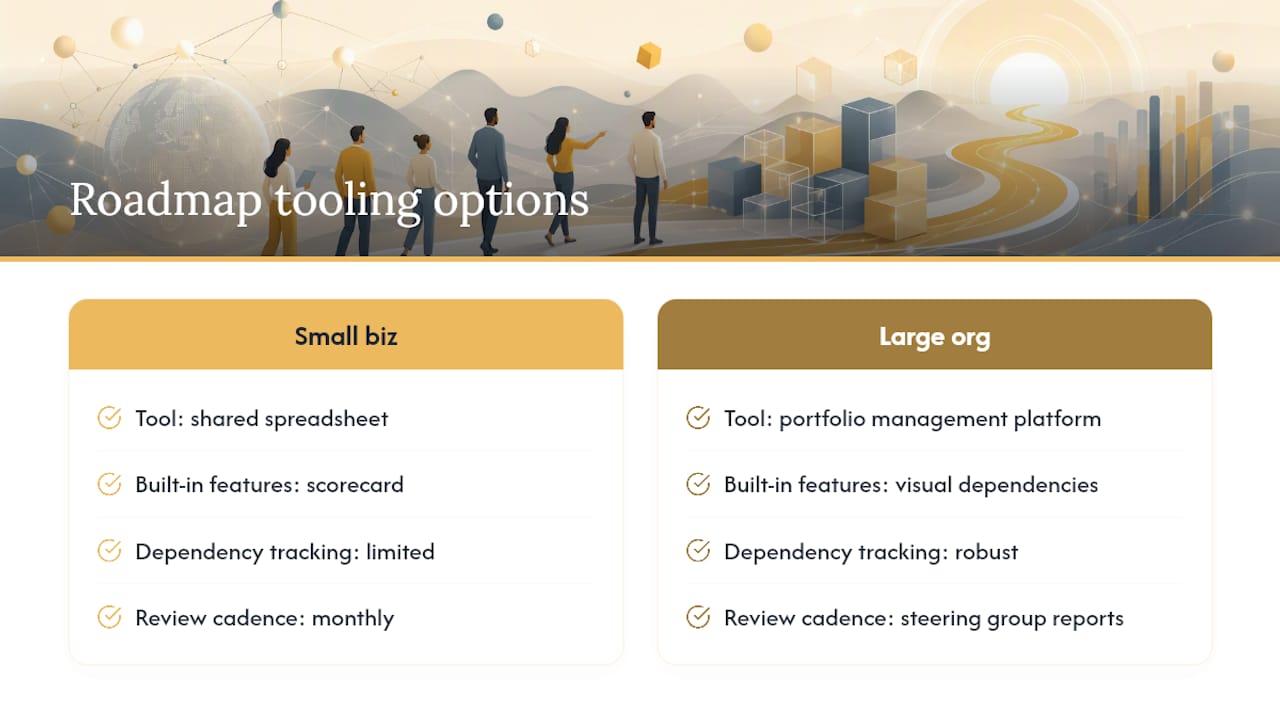
The tooling question matters less than most leadership teams think, but it's not irrelevant. A roadmap needs three things from its supporting technology: a shared view of the backlog and scoring, a way to track dependencies visually, and a reporting layer the steering group can review without someone manually building slides every month.
For smaller businesses, a shared spreadsheet with the scorecard built in, reviewed monthly, often does the job for the first year. It's not sophisticated, but it's transparent, and everyone can see how a decision got made. Larger organizations tend to graduate to dedicated portfolio management platforms once the backlog exceeds what a spreadsheet can track cleanly, particularly when multiple workstream owners need to update status independently.
Where AI genuinely earns a place on the roadmap itself, not just as a planning tool, is in specific operational use cases: automating a quoting workflow, drafting position descriptions, or forecasting cash flow. Research from MIT Sloan on how artificial intelligence reshapes business operations makes the case for treating AI capability as part of the target operating model from the start, rather than bolting it on as a separate initiative later. If you're scoping which AI use cases to pilot first, a resource like Droxy AI's rundown of practical AI agents is useful for narrowing the list before you bring it to your steering group. For process automation specifically, deciding what to fix first before adding new tools on top of a broken process saves a lot of rework later.
Which Change Management Methods Fit Digital Transformation?
Generic change management advice tends to underweight how different digital transformation is from other kinds of organizational change. A new office layout or a merger announcement is a one-time event. A digital transformation is a rolling series of changes, often overlapping, which means the change management approach needs to be continuous rather than a single campaign timed to one go-live date.
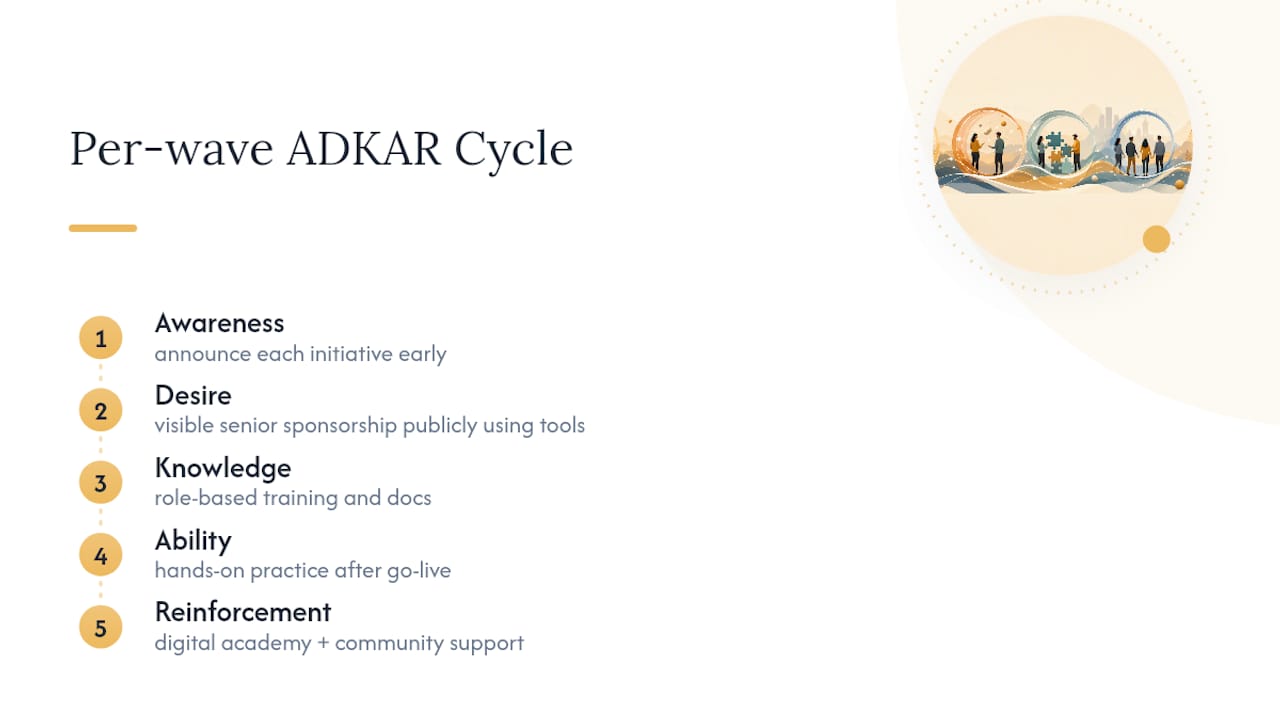
Prosci's structured model, built around individual readiness (awareness, desire, knowledge, ability, reinforcement), works well applied per-wave rather than once for the whole program. Each new initiative gets its own mini change cycle: who needs to know about it, who needs training, and how reinforcement happens after go-live so old habits don't creep back in.
Visible sponsorship matters more than most leaders expect. Prosci's people-first roadmap guidance is explicit that change management works best when integrated into the roadmap from the start, not handled as an afterthought once a system is already built. A senior leader publicly using the new tool, publicly citing the metric it's supposed to move, does more for adoption than a training deck ever will. Digital academies, structured internal training resources, help sustain capability past the initial rollout, particularly for teams that will keep encountering new tools as later waves land. Community-oriented digital capability resources, such as those from Infoxchange, offer a useful model for structuring ongoing training beyond a single launch event.
An Editorial Take on Roadmaps That Actually Work
The conventional advice on transformation roadmaps overweights the plan and underweights the governance that keeps it alive. Most templates spend pages on vision statements and almost none on what happens when initiative twelve slips for the second quarter in a row. That's backwards. A roadmap's real test isn't how good it looks in month one. It's whether the steering group has the discipline to stop a low-value initiative in month seven.
Sequencing gets treated as a scheduling exercise when it's really a resourcing argument in disguise. Most businesses don't fail because they picked the wrong initiatives. They fail because three initiatives needed the same scarce person in the same month, and nobody caught it until the delays started.
If there's one place to spend disproportionate effort, it's the readiness assessment. Rushing it to get to "the exciting part" is the single most common shortcut that comes back to cost more later, exactly what HBR's mapping research warns against. Prioritize that groundwork, build in a genuine review cadence, and treat adoption as seriously as delivery.
— Duncan
Ready to put structure behind your own transformation plan? Champion Business Coaching's business coaching services are built around exactly this kind of readiness-first, accountability-driven planning, with a 90-day guarantee behind the work.
Sources
A few references are worth having open while you build your own roadmap:
- Standard 4: Planning
- How to map out your digital transformation
- Digital transformation strategy (policy repository)
Download or adapt the templates each source offers rather than starting from a blank page. Structure copied from a proven framework beats a homegrown format built under deadline pressure.