
A delegation framework is a structured set of rules, levels, and governance artifacts that assign decision rights and ownership so managers can scale outcomes without becoming the bottleneck. If you want one action you can take in the next 15 minutes: pick one recurring decision you make weekly, write down who could own it instead, and assign it a level from 1 (you decide, then tell them) to 5 (they decide, no check-in needed). That single mapping exercise is where every mature framework starts.
Three elements signal a framework has moved past ad-hoc handoffs:
- A delegations register — a published list of who holds what authority, at what level, and under what limits
- A delegations policy — the written rules governing how authority is granted, exercised, and reviewed
- Banded levels — a defined spectrum (typically five to seven rungs) that removes the ambiguity of "I thought you had sign-off on that"
Key Takeaways
A delegation framework only works when the level assigned matches both the person's readiness and the maturity of the surrounding process.
| Point | Details |
|---|---|
| Start with one decision | Map one recurring decision to a delegation level in the next 15 minutes to build the habit. |
| Name the level out loud | State the delegation level explicitly at every handoff to remove ambiguity and hold yourself accountable. |
| Build governance artifacts | Publish a delegations register, assign a named governance owner, and set a review cycle before scaling. |
| Use the 2x2 matrix | Assess both person readiness and process maturity before choosing a level — mismatches drive most failures. |
| Championbusinesscoaching | Offers structured 90-day coaching to help managers design and implement a working delegation framework. |
Table of Contents
- What is a delegation framework and why does it matter?
- Common delegation models every manager should know
- What each delegation level looks like in practice
- Step-by-step delegation framework you can apply today
- How ready is your team? A trust-in-people vs. trust-in-process matrix
- Governance artifacts and tools: what you need to run delegation at scale
- Common pitfalls and how to avoid them
- Why most managers get delegation backwards
- Delegation coaching that gets your framework off the ground faster
- Sources
What is a delegation framework and why does it matter?
A delegation framework is the formal structure through which an organization allocates decision-making authority from senior leaders to the people closest to the work. It has three core components: roles and authorities (who can decide what), levels or banding (how much autonomy each role carries), and governance artifacts (the register, policy, and training that keep the system honest).
Without an explicit framework, authority gets handed off informally. That creates two problems. First, accountability blurs — when something goes wrong, nobody can point to a documented decision owner. Second, the organization can't scale: every non-trivial decision routes back to the same two or three people, and those people become the ceiling on how fast the team can move.
Two signals that a framework is actually working: a published delegations register that staff can look up without asking HR, and a named governance owner who runs a scheduled review cycle. Both the ANU delegations framework and Griffith University's delegations framework treat these as non-negotiable baseline artifacts — not optional extras. That institutional standard is worth borrowing regardless of your organization's size.
Common delegation models every manager should know
The terminology varies wildly across organizations, which is the first thing that trips managers up. Here are the models you're most likely to encounter, mapped to where each one fits best:
- Banded delegation — authority is grouped into financial or decision-size bands (e.g., expenditure up to $50,000 sits at Band 3). Best for finance approvals, procurement, and contract sign-off where dollar thresholds define risk.
- Specialist or domain delegation — authority is granted by subject-matter expertise rather than seniority (e.g., a chief information security officer holds sole authority on data breach response). Best for technical, legal, or clinical decisions where role knowledge matters more than hierarchy.
- Legislative or statutory delegation — authority flows from a specific law, regulation, or policy instrument and cannot be sub-delegated beyond what the legislation permits. Common in government agencies, universities, and regulated industries.
- RACI and responsibility matrices — Responsible, Accountable, Consulted, Informed. Not a delegation model per se, but widely used to map who does the work versus who owns the outcome. Best for project-level clarity in cross-functional teams.
- Seven-level ladder (Tell → Delegate) — a spectrum from "I decide and tell you" through to "you decide, no check-in needed." The seven-level model is popular in engineering and product management because naming the level out loud removes ambiguity at handoff.
- Five-level variant — a compressed version of the ladder, described by MindTools, that works well for smaller teams or managers who find seven rungs unwieldy.
The naming variance ("banding" vs. "levels" vs. "ladders") is mostly cosmetic. What matters is that your organization picks one vocabulary and uses it consistently.
What each delegation level looks like in practice
The spectrum runs from full centralization to full autonomy. The most useful way to think about it is a seven-rung ladder, though the five-level version covers the same ground with fewer distinctions:
Level 1 — Tell: You make the decision and inform the team. No input sought. Use this for irreversible, high-stakes calls where the delegate lacks the context to contribute.
Level 2 — Sell: You decide, then explain your reasoning. The delegate understands the "why" but doesn't influence the outcome. Useful when buy-in matters but the decision can't wait for consultation.
Level 3 — Consult: You gather input before deciding. The delegate's view is heard and considered, but you retain the final call. Good for decisions where the person doing the work has ground-level data you don't.
Level 4 — Agree: You and the delegate reach a joint decision. Neither party acts without the other's sign-off. Use sparingly — it's slow, but appropriate for decisions with shared accountability.
Level 5 — Advise: The delegate decides; you offer input if asked. Your role shifts from decision-maker to sounding board.
Level 6 — Inquire: The delegate decides and acts, then tells you afterward. You stay informed but don't influence the outcome.
Level 7 — Delegate: Full ownership. The delegate decides, acts, and reports on results at the agreed review interval. No check-in unless they choose to escalate.
Research on supervision and delegation consistently shows that mismatched levels — too close or too distant — reduce performance. The same decision can sit at Level 3 for a new hire and Level 6 for a seasoned team lead. The level should follow the person's readiness, not just the decision's category.
Three quick examples using a budget reallocation decision:
- New manager, first quarter: Level 3 — consult them, hear their reasoning, you decide.
- Experienced manager, proven track record: Level 6 — they reallocate, tell you at the monthly review.
- Senior director, full P&L ownership: Level 7 — they own it, report on outcomes quarterly.
Step-by-step delegation framework you can apply today
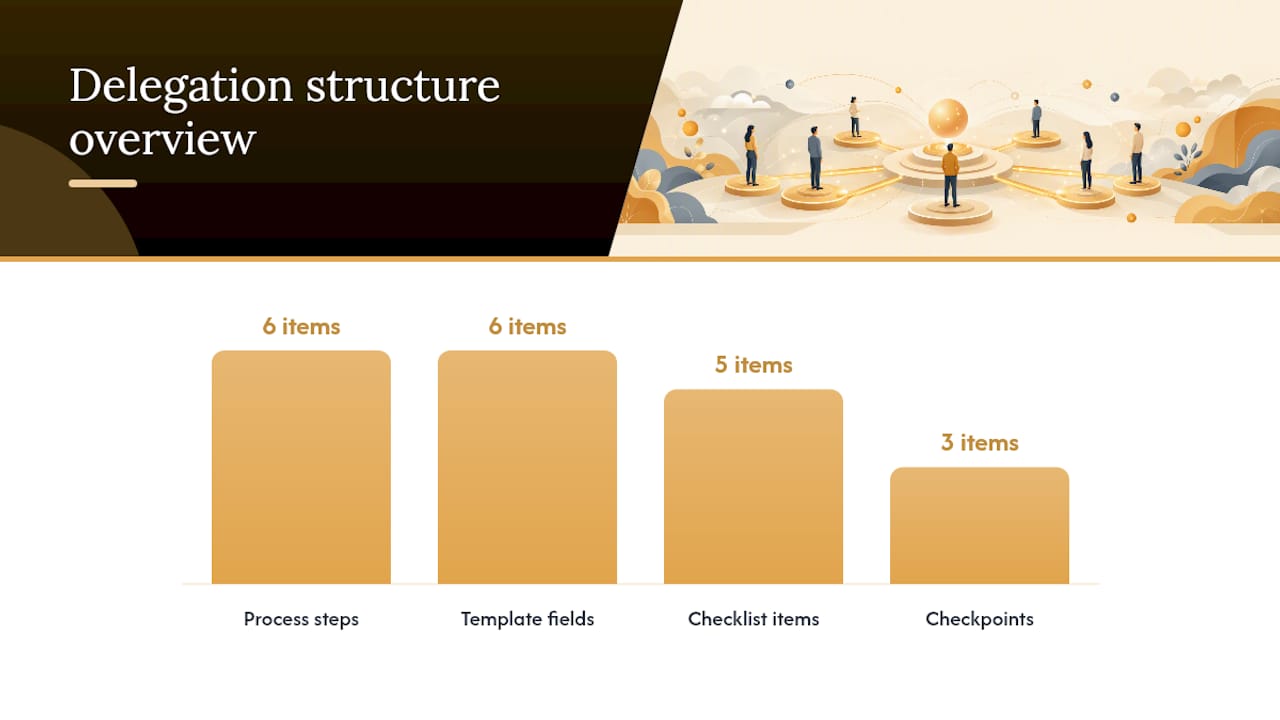
Outcome-based delegation — transferring ownership of results rather than a list of tasks — is what actually scales a manager's capacity. Here is a six-step process you can run for any decision or workstream:
- Select the outcome. Define what "done well" looks like in one sentence. Not the tasks involved — the result you need.
- Pick the level. Use the ladder above. Be explicit: say the level out loud to the delegate, not just in your head.
- Confirm authority and resources. What can they approve, spend, or commit without coming back to you? State the limits clearly. Delegation without authority is just extra work for the delegate.
- Set checkpoints. Frame check-ins as support, not inspection. One brief at the start, one midpoint pulse, one debrief at the end. HBS Online's delegation guidance emphasizes that feedback loops and clear context are what separate successful handoffs from failed ones.
- Document in the register. Log the decision area, level, authority limits, escalation path, owner, and review date. A delegation that isn't documented isn't a delegation — it's a verbal agreement that evaporates when someone leaves.
- Run a debrief. After the first cycle, spend 20 minutes on what worked, what didn't, and whether the level was right. Adjust before the next cycle.
One-page delegation template — fields to fill:
| Field | What to capture |
|---|---|
| Decision area | The specific decision or workstream being delegated |
| Delegation level | Level 1–7 (or 1–5) with a one-line description |
| Authority limits | Dollar thresholds, scope boundaries, or approval ceilings |
| Escalation path | Who the delegate contacts when a decision exceeds their authority |
| Owner | Named individual (not a role title) |
| Review date | Fixed calendar date for the first formal check-in |
Handoff checklist:
- Outcome defined in writing
- Level named and agreed
- Authority limits documented
- Resources confirmed (budget, access, information)
- First checkpoint scheduled
- Register entry created
Pro Tip: Convert every task-based delegation into an outcome statement before the handoff conversation. Instead of "manage the vendor invoices," write "ensure all vendor invoices are approved and paid within 30 days of receipt, with no late-payment penalties." The delegate now owns a result, not a to-do list.
How ready is your team? A trust-in-people vs. trust-in-process matrix
The single most common delegation mistake is treating readiness as a one-dimensional question ("Is this person capable?"). MIT Sloan Management Review research makes the case that effective delegation requires trust in both the person and the process. Even a highly capable delegate will struggle if the surrounding process — clear handoff criteria, documented escalation paths, feedback loops — is underdeveloped.
That gives you a 2x2 diagnostic:
| Process mature | Process immature | |
|---|---|---|
| Person ready | Delegate freely (Level 5–7) | Build process first, then expand authority |
| Person not ready | Supervise closely, use process as scaffold (Level 2–3) | Hold centrally; invest in both before delegating |
How to use it: Before assigning a delegation level, place the decision in one of the four quadrants. The quadrant tells you the next move, not just the level.
- Top-left (ready person, mature process): This is where you should be spending most of your delegation energy. Push authority down as far as the stakes allow.
- Top-right (ready person, weak process): The delegate can handle it, but without documented escalation paths and clear authority limits, they'll improvise — and that creates risk. Fix the process artifacts first, even if it takes a week.
- Bottom-left (unready person, strong process): The process acts as a guardrail. Use it. Keep the level low (2–3), run frequent check-ins, and use the structure to develop the person over 60–90 days.
- Bottom-right (unready person, weak process): Don't delegate here yet. The combination produces the highest failure rate. Invest in training and process documentation before moving authority.
Governance artifacts and tools: what you need to run delegation at scale
A delegation framework without governance is just a conversation. The artifacts below are what turn intent into an auditable, scalable system. Both the ANU and Griffith University frameworks treat these as core infrastructure, not administrative overhead.
Mandatory governance artifacts:
- Delegations policy — the master document defining scope, principles, and constraints
- Delegations register — the live, published list of all active delegations
- Named governance owner — one person responsible for maintaining and reviewing the register
- Escalation rules — documented paths for decisions that exceed delegated authority
- Training plan — onboarding and refresher training for delegates and their managers
- Review cycle — a fixed schedule (typically annual or on role change) for re-validating all entries
Sample register fields:
For publication and tracking, SharePoint and Confluence are the most common homes for the register in mid-size organizations. For smaller teams, a shared Google Sheet with version control works fine — the tool matters far less than the discipline of keeping it current. Whoever owns the register should have a calendar reminder set for every review date, not just an annual sweep.
Staff management training resources are worth building into the governance plan from day one, particularly for delegates who are new to holding formal authority.
Common pitfalls and how to avoid them
Most delegation failures trace back to a handful of recurring patterns. Knowing the red flags early saves a lot of rework.
- Ambiguous authority. The delegate doesn't know what they can approve without checking back. Fix: document authority limits in the register before the handoff, not after the first escalation.
- Reverse delegation. The delegate brings decisions back to you that you've already handed off. Fix: when they bring it back, ask "what would you do?" and let them answer. Redirect, don't absorb.
- Delegation without resources. You've handed over the outcome but not the budget, access, or information needed to achieve it. Fix: run the handoff checklist in Section 5 before every delegation.
- Micromanagement after handoff. You've assigned Level 6 but you're behaving at Level 2. Fix: name the level out loud at the start and hold yourself to it.
- No documentation. The delegation exists only in a conversation. Fix: every delegation gets a register entry within 48 hours of the handoff.
- Missing debrief. The cycle ends but no one reviews whether the level was right. Fix: schedule the debrief at the same time you schedule the first checkpoint.
Red flags to watch for: repeated upward escalations on decisions that should be owned at a lower level; missed deadlines on delegated work; the same rework appearing across multiple cycles. Each of these signals a mismatch between the delegation level and the delegate's readiness or the process maturity.
One note on team size and culture: in small teams (under 10 people), a lightweight register and two or three defined levels are enough. In large, bureaucratic organizations, the governance layer needs to be more formal — legislative delegations in particular require documented sub-delegation chains and audit trails. The framework scales up; the principles stay the same.
Why most managers get delegation backwards
Here's what I've seen consistently when working with leaders on this: they treat delegation as something they do to a task, when the real work is done on the relationship between the level and the person's readiness. A manager who hands off a decision at Level 6 to someone who needs Level 3 isn't delegating — they're abandoning. And a manager who keeps every decision at Level 2 because "it's faster if I just do it" is building a team that never develops the capacity to run without them.
The habit that changes this fastest is simple: name the level out loud before every handoff. Not in your head. Out loud, to the delegate. "I'm giving you this at Level 5 — you decide, I'm available if you want input." That one sentence removes more ambiguity than any policy document. It also forces you to commit to a level rather than leaving it vague enough to reclaim the decision later.
The leadership skills that make delegation stick aren't about letting go — they're about being precise enough that the delegate knows exactly where their authority starts and stops.
Delegation coaching that gets your framework off the ground faster
Building a delegation framework from scratch takes longer than most managers expect, not because the concepts are hard, but because the governance setup, the register, the level calibration, and the team conversations all have to happen in the right sequence.

Championbusinesscoaching works with managers and business owners across Australia to design and implement delegation frameworks that actually hold up under pressure. The coaching covers level calibration, register setup, governance design, and the team communication that makes authority transfers stick. With a 90-day coaching guarantee and limited coaching slots to keep the work focused, the process is structured enough to produce a working framework within a quarter — not a year. Rated 5 stars on Google by clients who've used it to move decisions down the organization and reclaim their own time.
Book a free consultation to map your current delegation gaps and get a clear starting point.
Sources
- How to delegate more effectively — four approaches (MIT Sloan Management Review)
- How to delegate effectively (HBS Online)
- Delegations framework | Australian National University
- Delegations Framework (Griffith University)
- PMC article on supervision and delegation