
A construction business coach is a specialized advisor who helps construction business owners build profitable, well-run companies through industry-specific systems, financial clarity, and leadership development. Most builders are exceptional tradespeople who struggle to transition from doing the work to running the business. That gap costs real money. Championbusinesscoaching works with construction owners across Australia to close that gap through structured coaching, clear action plans, and a 90-day results guarantee. The difference between a stagnant building firm and a growing one is rarely skill on the tools. It is almost always systems, leadership, and financial discipline.
What does a construction business coach actually do?
A construction business coach guides owners through the full business, not just one problem area. Coaching covers financials, estimating accuracy, operations, talent, organizational structure, and long-term owner vision. That breadth matters because construction businesses fail in clusters. A cash flow problem is usually connected to poor job costing, which connects to weak estimating, which connects to an owner who never had time to build proper systems.
The coaching process starts with a thorough business evaluation. This initial assessment benchmarks financials, work in progress, and overhead against industry standards. That benchmark tells both the coach and the owner exactly where the business stands before any changes are made. Without that baseline, coaching is guesswork.
From there, sessions follow a structured rhythm. Coaching sessions typically run 60–90 minutes with ongoing support available through calls and email between sessions. That ongoing access is what creates accountability. A builder who knows they will report back to their coach next week makes better decisions this week.
Core components of a coaching program
- Operational system review. The coach maps current workflows, identifies bottlenecks, and builds repeatable processes for quoting, scheduling, and project delivery.
- Financial transparency. Owners learn to read their numbers weekly, not just at tax time. Job costing, gross margin by project type, and overhead recovery all get tracked.
- Leadership development. The owner learns to delegate, hire well, and hold their team accountable without micromanaging every task.
- Sales and pricing. Estimating accuracy improves, and owners stop underpricing jobs out of fear of losing work.
- Owner vision and exit planning. Coaching aligns daily decisions with long-term goals, whether that means scaling to $10M revenue or working four days a week.
Pro Tip: Before your first coaching session, pull your last three months of job cost reports. If you do not have them, that is the first thing to fix. A coach cannot help you price better if neither of you knows what your jobs actually cost.
What makes construction coaching different from general business coaching?

General business coaching applies broad frameworks that work across industries. Construction businesses need something more specific. Effective coaching addresses unique construction challenges like pricing jobs, project scheduling, subcontractor control, and cash flow management. A generic coach who has never dealt with retention payments, variations, or a subcontractor who goes missing mid-project will struggle to give practical advice.
The language gap is just as significant as the knowledge gap. A construction coach must speak the language of both the foreman on site and the CFO reviewing margins. Coaches with construction industry backgrounds translate technical field knowledge into business strategy, which is what makes their advice stick. When a coach understands what a wet weather delay actually costs, or why a builder quotes low to keep crews busy, the conversations go deeper and the solutions are more practical.
Construction-specific challenges that general coaches routinely miss include:
- Job costing accuracy. Most builders track revenue but not true job profitability. A construction coach builds systems to measure margin at the project level.
- Subcontractor management. Subbies are not employees, but they can make or break a project. Coaching covers contracts, scheduling, and performance accountability.
- Cash flow timing. Progress claims, retention, and delayed payments create cash gaps that can sink a profitable business. Coaches build cash flow forecasting into the owner's weekly routine.
- Estimating discipline. Underquoting is the single biggest profit killer in construction. A coach with field experience knows exactly where builders leave money on the table.
- Owner dependency. When the business cannot function without the owner on site, growth is impossible. Coaching builds the systems and team that change that.
"Profitability in construction is more about systems and leadership than hard work alone. Most owners already work harder than anyone in their business. What they need is a better-built company, not longer hours."
This is the core insight that separates construction coaching from generic advice. Sustainable growth depends on business systemization and leadership, not on the owner grinding harder. That shift in thinking is often the most valuable thing a coach delivers.
What results can construction business owners expect from coaching?
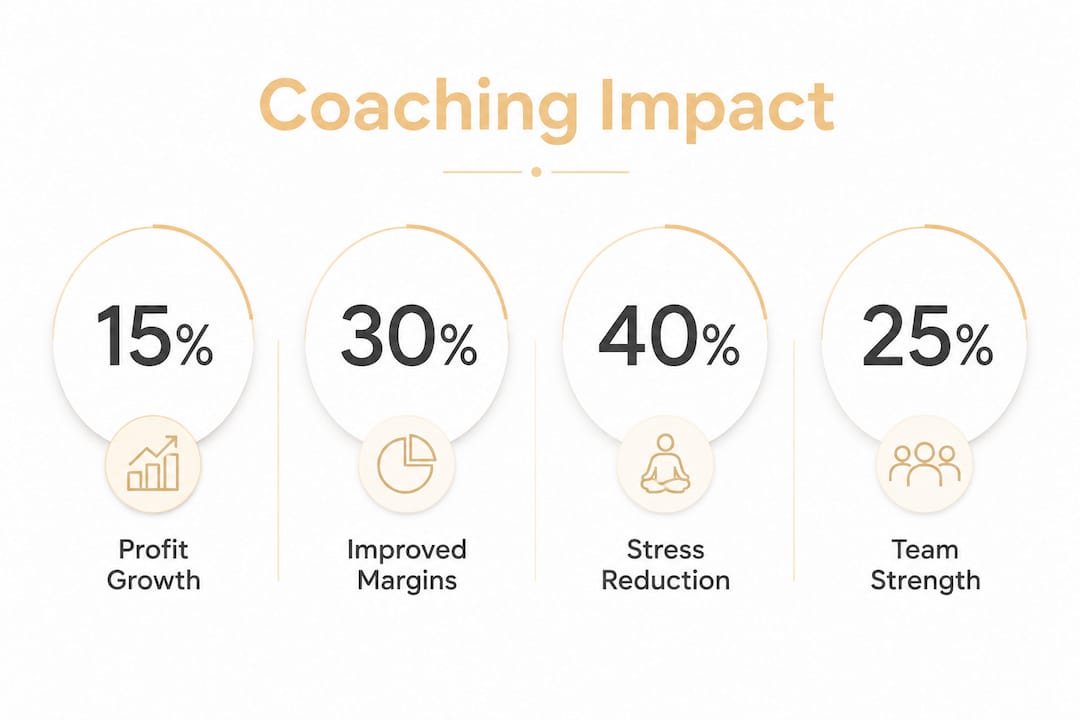
The first results from business coaching for builders usually show up in clarity and decision-making within weeks. Financial and operational improvements follow over months. Long-term transformation requires consistent coaching, accountability, and execution. Owners who commit to the process report measurable gains across multiple areas of their business.
| Result area | What changes |
|---|---|
| Profitability | Job margins improve as estimating tightens and overhead gets tracked properly |
| Cash flow | Forecasting replaces guesswork; payment terms get enforced consistently |
| Owner time | Systems and delegation reduce the owner's hours on daily operations |
| Team performance | Clear expectations and accountability structures reduce staff problems |
| Sales growth | Better pricing confidence leads to higher-value jobs and improved close rates |
Owners working with coaches report improved work-life balance, reduced stress, and stronger teams alongside financial gains. That combination matters. A business that makes more money but destroys the owner's health is not a success. Coaching addresses both the numbers and the person running the business.
The leadership transition is the most significant long-term shift. High-growth building companies become well-run, systematic operations that allow owners to focus on leading rather than daily execution. That transition does not happen by accident. It requires deliberate coaching, new habits, and a willingness to let go of tasks the owner used to do personally.
Pro Tip: Track your gross margin by project type every month, not just your overall revenue. Most builders discover that one or two job categories are quietly losing money while others carry the whole business. Knowing which is which changes every quoting decision you make.
Who benefits most from construction business coaching?
Construction business coaching delivers the greatest value to owners who are ready to grow but feel stuck. The most common trigger is a business that is busy but not profitable. Revenue is up, the phone keeps ringing, but the bank account does not reflect the effort. That pattern points directly to systems and pricing problems that coaching fixes.
Owners who benefit most include:
- Sole traders moving to their first employees. The jump from working alone to managing a team is the hardest transition in construction. Coaching prevents the most expensive mistakes.
- Small firms with 2–15 staff. These businesses are past survival mode but have not built the systems needed to scale. Coaching installs those systems before growth creates chaos.
- Growing companies hitting a ceiling. Revenue stalls, the owner is exhausted, and hiring more people does not seem to help. This is a leadership and structure problem, not a market problem.
- Owners planning an exit. A business that depends entirely on the owner has no sale value. Coaching builds the systems and team that make a business sellable.
The right time to engage a coach is before the crisis, not during it. Many construction companies stagnate because growth outpaces operational structure. Waiting until the business is in trouble means the coach spends the first months on damage control instead of growth. Early investment in coaching prevents the problems that cost far more to fix later.
Signs that coaching is overdue include chronic cash flow stress, an owner who cannot take a week off without the business suffering, staff turnover that never seems to improve, and jobs that consistently come in under the quoted margin. Any one of these signals a structural problem. All four together mean the business is running the owner instead of the other way around.
Key Takeaways
A construction business coach delivers measurable results by combining industry-specific knowledge, financial systems, and leadership development into a structured program built for builders.
| Point | Details |
|---|---|
| Start with a baseline assessment | Benchmark financials, job costs, and operations before making any changes. |
| Construction coaching is industry-specific | Generic business coaching misses job costing, subcontractor control, and cash flow timing. |
| Leadership transition drives growth | Owners must move from daily execution to leading their team for the business to scale. |
| Results build over time | Clarity improves within weeks; financial and operational gains develop over months of consistent coaching. |
| Early coaching prevents costly problems | Engaging a coach before a crisis is far cheaper than fixing structural damage after it occurs. |
Why most builders wait too long to get a coach
I have worked with enough construction business owners to see the same pattern repeat. The owner is talented, driven, and genuinely good at their trade. They built the business from nothing. And that same drive that got them started is exactly what holds them back from growing. They believe that working harder is the answer to every problem. It is not.
The owners who get the most from coaching are not the ones in the worst shape. They are the ones who recognize that their current skills got them to where they are, but a different set of skills is required to get them where they want to go. That recognition takes honesty. It also takes a willingness to be coached, which means accepting that someone else might see your business more clearly than you do.
The biggest mistake I see is owners who hire a coach and then treat sessions like a reporting exercise rather than a working session. Coaching is not a performance review. It is a place to think out loud, challenge assumptions, and build a better version of your business with someone who has seen the same problems solved before. The owners who treat it that way get results. The ones who do not tend to blame the coach.
— Duncan
How Championbusinesscoaching supports construction business owners
Championbusinesscoaching works with construction business owners across Australia who are ready to build a more profitable and better-run company. The coaching programs cover financial management, operational systems, leadership, and sales, all tailored to the realities of running a building or trade business.

Every engagement starts with a full business assessment, and the 90-day coaching guarantee means you see results or the session is free. Coaching slots are limited to keep the quality of each engagement high. If you are ready to stop firefighting and start leading your business, explore the coaching plans available or request a strategy session to get started.
FAQ
What does a construction business coach do?
A construction business coach helps building and trade business owners improve profitability, build operational systems, and develop leadership skills. Coaching covers financials, estimating, team management, and long-term business strategy.
How long does a construction coaching session last?
Coaching sessions typically run 60–90 minutes, with ongoing support available between sessions through calls and email. Most programs run for a minimum of 90 days to allow time for real operational change.
How is construction coaching different from general business coaching?
Construction coaching addresses industry-specific challenges like job costing, subcontractor management, progress claims, and cash flow timing. General business coaching frameworks rarely account for these realities, which limits their effectiveness for builders and tradies.
When is the right time to hire a construction business coach?
The best time to engage a coach is before a crisis, not during one. Owners experiencing growth stagnation, cash flow stress, or burnout are already overdue. Early coaching prevents the structural problems that become expensive to fix later.
What results can I expect from construction business coaching?
Initial improvements in clarity and decision-making often appear within weeks. Financial and operational gains develop over months of consistent coaching and execution. Owners also report better work-life balance and stronger teams alongside improved margins.