
What is business improvement and why does it matter for your bottom line?
Business process improvement is the systematic cycle of mapping, analyzing, redesigning, implementing, and monitoring workflows to reduce costs, improve quality, and increase speed. It is continuous by design: once one process is fixed, the cycle starts again with the next bottleneck. Think of it less as a project and more as a permanent operating discipline.
The payoff goes well beyond cost cutting. Business improvement as a growth strategy lets companies take on work that was previously too expensive to attempt, sharpen competitive positioning, and build the organizational muscle to adapt faster than rivals.
The core elements that drive results:
- Process mapping: Documenting how work actually flows, not how the manual says it should.
- Root cause analysis: Finding the real bottleneck, not just the most visible symptom
- Redesign before automation: Fixing the workflow on paper before adding any technology layer
- Named process ownership: Assigning a specific person to own each improved process long-term
- Continuous monitoring: Revisiting improved processes quarterly during the first year to confirm gains hold
Frameworks like DMAIC (Define, Measure, Analyze, Improve, Control), Lean, Six Sigma, and Kaizen each approach this discipline from a different angle. DMAIC suits projects where you need to reduce defects and variability. Lean targets waste elimination. Kaizen drives culture-level change through small, consistent improvements. The right choice depends on what is actually broken, not what is currently fashionable.
How do you apply proven frameworks to improve business operations?
The five-step improvement cycle runs the same way regardless of which methodology you choose: Map, Analyze, Redesign, Implement, Monitor. Every successful project runs through this loop at least twice.
Step 1: Map. Document the current process as it actually runs, including the informal workarounds your team has built around the official procedure. Hidden workflows are where the real inefficiency lives.
Step 2: Analyze. Identify bottlenecks, redundant handoffs, and waste. Use data, not gut feel.
Step 3: Redesign. Eliminate the problems identified before touching any tool or software. This is the step most teams skip, and it is why so many improvement projects fail.
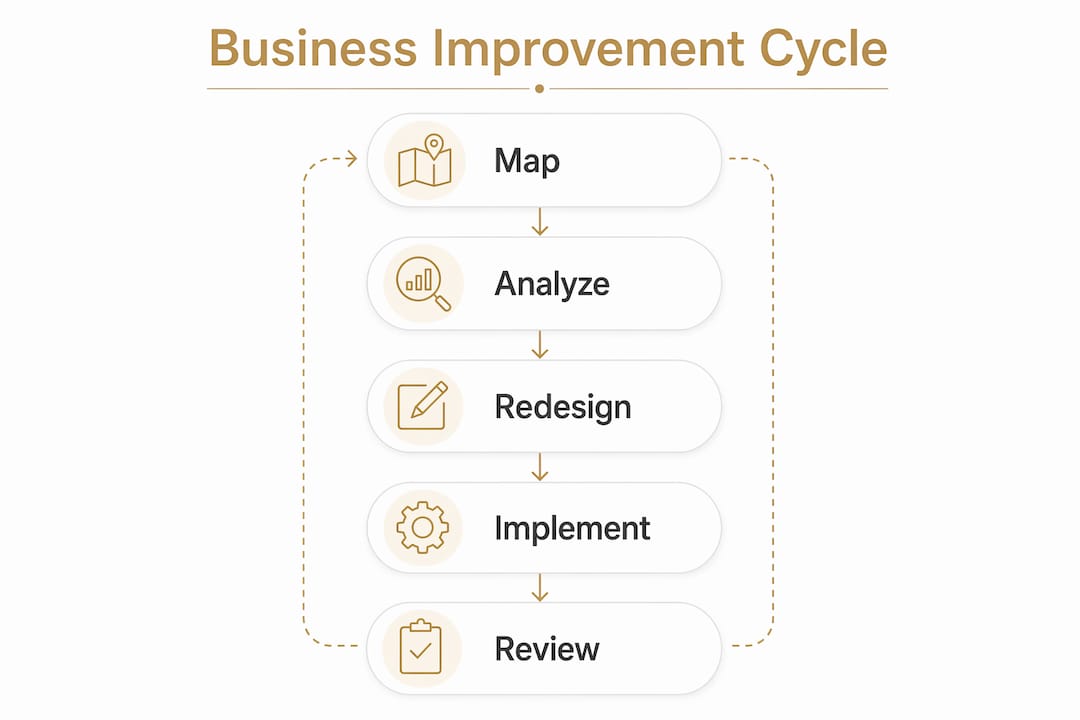
Step 4: Implement. Start with a pilot group. Roll out changes one at a time so you can measure the impact of each.
Step 5: Monitor. Track performance against the baseline you captured in Step 2. If the numbers do not move, the redesign missed the real problem and you loop back.
Practical priorities for your first project:
- Use an Impact vs. Effort matrix to pick which process to fix first: score each broken process by dollars saved or revenue added against the person-weeks required to fix it
- Most mid-market teams have roughly 20 broken processes but can realistically fix two per quarter; pick the highest-value quick win
- Assign a named owner to every improved process and schedule a monthly check-in for at least six months after rollout
- Involve the people who actually do the work in the redesign, not just managers
Pro Tip: AI and hyperautomation can deliver 25–50% efficiency gains but only when the workflow is redesigned from scratch first. Bolting AI onto a broken process makes it break faster, not better.
Sustained improvement requires named ownership and recurring reviews, not a one-time consultant engagement. The teams that compound wins are the ones who finish what they start and treat the first project as a template.
Which Australian business improvement consultants should you consider?
Seven verified Australian providers cover the range from HR compliance software to full-service consultancy and coaching. Each suits a different business size, sector, and budget.
| Provider | Services offered | Specializations | Location | Google rating | Best for |
|---|---|---|---|---|---|
| UBT | Advisory, coaching, consulting, training | Family businesses, SMEs | Global, serves Australia | 4.8★ (46 reviews) | Family businesses and SMEs wanting structured advisory |
| B.I.G. Business Innovations Group | Improvement plans, project management, OHS/WHS audits, supply chain reviews, training | OHS/WHS compliance, innovation projects, business exits | Australia-wide | 4.8★ (5 reviews) | Businesses needing operational reviews and compliance |
| Australia National Institute Of Business | Business advisory and consulting | Localized consulting | Woolloongabba, QLD | 3.7★ (29 reviews) | Queensland businesses wanting local advisory |
| Business Institute of Australia | Consulting services | NSW business improvement | Ultimo, NSW | 2.9★ (18 reviews) | NSW organizations seeking established local support |
| Best Businesses Australia | Business services | Service-oriented improvement | Mayfield East, NSW | 5★ (14 reviews) | Companies needing service-focused local support |
| Australian Business Circle | Business services and networking | Victorian market, local networking | Dandenong South, VIC | 5★ (4 reviews) | Victorian businesses wanting peer networks |
| My Business | HR software, compliance reviews, cybersecurity training | Small business HR and workplace compliance | Australia-wide (online) | 5★ (2 reviews) | Small businesses prioritizing HR compliance affordably |
UBT has operated since 2009 and brings a structured advisory model built specifically around family businesses and SMEs. If your business has complex ownership dynamics or succession considerations layered into the improvement agenda, UBT's depth in that niche is hard to match.

B.I.G. Business Innovations Group stands out for the breadth of its operational scope. Beyond standard consulting, it covers OHS/WHS management audits, supply chain and procurement reviews, joint venture facilitation, and innovation funding projects. For a manufacturing or trade business with compliance exposure, that combination under one roof saves significant coordination time.
My Business takes a different approach entirely. Its HR software and cybersecurity training plans start at $10/month, making it the practical entry point for small businesses that need compliance infrastructure before they can focus on deeper process work.
Australia National Institute Of Business and Business Institute of Australia both offer localized consulting in Queensland and NSW respectively. Neither publishes detailed service breakdowns publicly, so direct contact is the right next step to assess fit.
Best Businesses Australia and Australian Business Circle suit businesses that value local presence and peer connection over specialized methodology depth.
When choosing a consultant, weight these factors: alignment with your business size, whether the firm has worked in your sector, pricing transparency, and whether they assign a named consultant rather than rotating staff through your account.
Championbusinesscoaching offers a coaching-led path to lasting improvement
If the consultants above feel like a formal engagement you are not ready for, business coaching in Australia through Championbusinesscoaching offers a faster, more personal route to the same outcomes.
Championbusinesscoaching works one-on-one and with teams across sectors including trades, NDIS providers, food and beverage, and mortgage brokers. The focus is concrete: clear action plans, AI-integrated tools for cash flow forecasting and staff management, and a 90-day guarantee that promises results or your session is free. That guarantee is the sharpest contrast with traditional consultancy, where engagements often run six to twelve months before any measurable outcome appears. Championbusinesscoaching holds a 5-star Google rating and limits client slots to protect coaching quality. Request a free consultation to see whether the fit is right for your business.
Key Takeaways
Business improvement delivers lasting gains only when processes are redesigned before any tool or automation layer is added, and when a named owner maintains the discipline after implementation.
| Point | Details |
|---|---|
| Redesign before automating | Fix the workflow on paper first; AI applied to a broken process accelerates the problem. |
| Prioritize ruthlessly | Use an Impact vs. Effort matrix and fix one high-value process per quarter, not five at once. |
| Monitor for at least six months | Revisit every improved process quarterly in the first year to confirm gains hold. |
| Match consultant to your context | Choose a provider based on sector fit, business size, and pricing transparency, not star count alone. |
| Championbusinesscoaching | Offers one-on-one coaching with a 90-day results guarantee and AI-integrated tools for Australian businesses. |