
Business coaching services are professional support systems that help business owners improve performance, increase profits, and build leadership capacity through structured, expert guidance. Unlike generic training programs, coaching is outcome-focused and tailored to your specific business stage and goals. The distinction matters: peer mentorship is often free and voluntary, while executive coaching involves a financial investment tied to measurable results and accountability. Frameworks like the "leader-as-coach" model are reshaping how Australian businesses approach professional development coaching in 2026. This guide breaks down what works, what to look for, and how to get the most from any coaching engagement.
What are the main types of business coaching services?
Business coaching services fall into four broad categories, and choosing the wrong one wastes both time and money.
Executive coaching programs sit at the top of the spectrum. They are paid, outcome-focused, and built around organizational alignment. A founder preparing to scale from $2M to $10M in revenue needs a different kind of support than a solo operator trying to fix cash flow. Executive coaching addresses the former. It combines leadership training services, emotional intelligence development, and strategic planning into a single engagement.

Business mentorship services serve a different purpose. Mentors provide knowledge, skills, resources, and accountability to help owners navigate growth and change, particularly in the startup and small business phase. Mentorship is relationship-driven and often informal. It works well when you need experienced perspective, not a structured performance plan.
Professional development coaching targets leaders and teams rather than the business as a whole. It focuses on communication, decision-making, and team management. Leadership training services fall under this umbrella and are often delivered in group formats.
Operational coaching zeroes in on process efficiency, systems, and day-to-day execution. Business owners who feel stuck in the weeds rather than working on the business benefit most from this type.
| Type | Primary focus | Typical cost | Best for |
|---|---|---|---|
| Executive coaching | Leadership and strategy | High | Scaling founders, senior leaders |
| Business mentorship | Growth guidance and knowledge | Low to free | Startups, early-stage businesses |
| Professional development | Team and leader skills | Moderate | Mid-size teams, managers |
| Operational coaching | Systems and efficiency | Moderate | Owners stuck in day-to-day tasks |
Pro Tip: Match the coaching type to your business stage. If you are pre-revenue, mentorship builds your foundation. If you are scaling, executive coaching builds your ceiling.
How do business coaching services improve business performance?
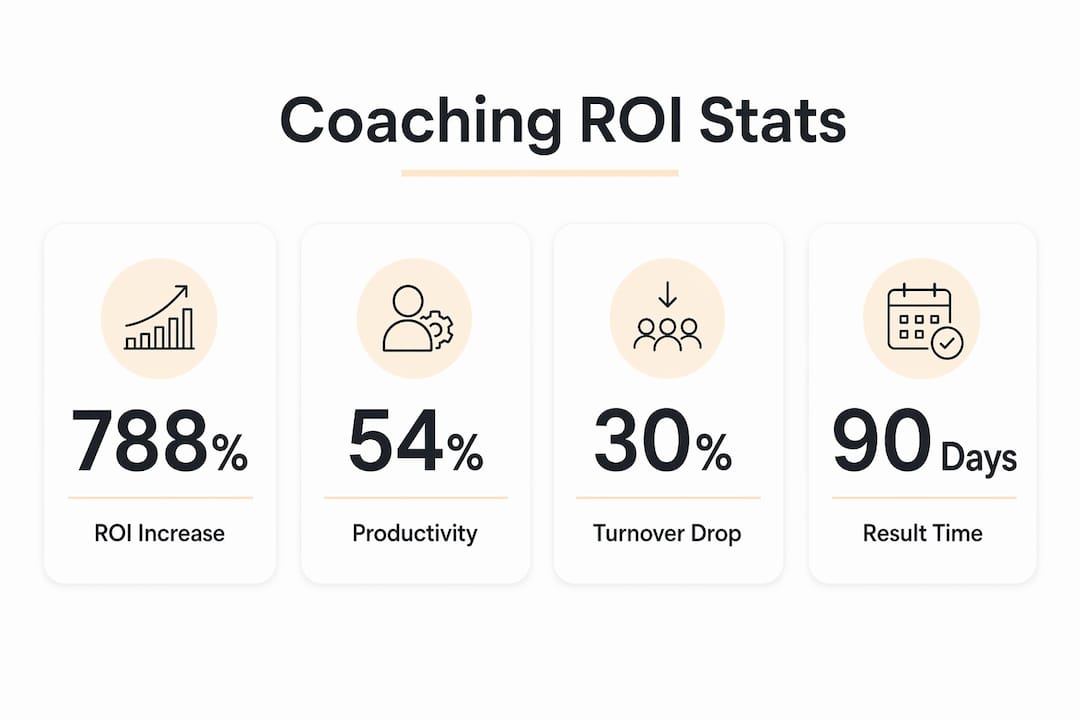
The ROI case for coaching is strong. Executive coaching delivers up to 788% return primarily through increased productivity and employee retention. That figure comes from MetrixGlobal research and reflects what happens when coaching is structured, goal-driven, and sustained over time.
The mechanism is straightforward. Coaching builds accountability. A business owner who sets a quarterly revenue target with a coach is far more likely to hit it than one who sets the same target alone. Regular check-ins create pressure to act, not just plan.
Effective business coaching integrates leadership training, emotional intelligence, and strategic planning to drive comprehensive development. That combination matters because most business problems are not purely operational. They are leadership problems wearing operational clothes. A team that misses deadlines usually has a communication or accountability gap at the top, not a scheduling problem.
Top benefits business owners report from professional coaching engagements:
- Clearer decision-making under pressure
- Faster identification of revenue bottlenecks
- Stronger team performance and reduced staff turnover
- Better financial discipline and profit margin awareness
- Improved confidence in delegating and building systems
Pro Tip: Avoid the most common coaching pitfall: starting without a written goal. Before your first session, write down one specific outcome you want to achieve in 90 days. Vague goals produce vague results.
What should business owners look for when selecting coaching services?
Choosing a coach is one of the highest-leverage decisions a business owner makes. The wrong fit costs money and momentum. The right fit compounds over time.
Coaching formats vary across one-on-one, group, virtual, and in-person options, each with specific benefits. One-on-one coaching delivers the deepest personalization. Group formats reduce cost and add peer accountability. Virtual coaching removes geography as a barrier, which matters for Australian business owners outside major cities. In-person coaching builds rapport faster but limits flexibility.
Beyond format, evaluate these factors before committing:
- Credentials and track record. Ask for case studies or client outcomes, not just testimonials. A coach who has worked with businesses at your revenue stage understands your specific constraints.
- Approach and methodology. Does the coach use a structured framework or work ad hoc? Structured programs with defined milestones produce more consistent results.
- Goal alignment. The coach's specialty must match your priority. A coach who excels at sales growth is not the right fit if your core challenge is team management.
- Accountability structure. How does the coach track your progress between sessions? Weekly check-ins, shared dashboards, or written commitments all signal a serious engagement.
- Cost and value clarity. Platforms now offer flexible coaching at scalable costs, so price alone is not a reliable quality signal. Understand exactly what you get for your investment.
- Guarantee or risk-sharing. Some providers, including Championbusinesscoaching, back their programs with a results guarantee. That structure aligns the coach's incentives with yours.
Ask every prospective coach two questions: "What does success look like at 90 days?" and "What happens if I don't see results?" The answers reveal their confidence and their process.
How to maximize results from business coaching services?
Getting value from coaching requires active participation, not passive attendance. The business owners who see the strongest outcomes treat coaching as a performance system, not a conversation.
Clear goal-setting is the foundation. Regular progress reviews and actionable feedback transform coaching from advice to measurable results. Set a primary goal for each engagement period, break it into monthly milestones, and review progress at every session. If a milestone slips, diagnose why before moving forward.
Open communication accelerates results. Tell your coach what is not working, not just what is. Coaches cannot fix problems they do not know about. The most productive coaching relationships involve honest reporting on failures as much as wins.
Integrate coaching insights into daily operations immediately. A decision-making framework discussed in a session should appear in your next team meeting. A pricing strategy refined with your coach should be tested within the week. Delayed application kills momentum.
The most effective programs in 2026 emphasize a leader-as-coach mindset rather than simply solving problems. That shift matters for long-term results. When you develop the ability to coach your own team, the impact of your coaching investment multiplies across your entire organization.
Pro Tip: Combine your coaching engagement with a short leadership training program for your senior team. When the leader and the team develop together, behavior change sticks. When only the leader changes, the team often resists.
Key Takeaways
Business coaching services produce the strongest results when owners match the coaching type to their business stage, set clear goals, and apply insights immediately rather than waiting for the perfect moment.
| Point | Details |
|---|---|
| Coaching vs. mentorship | Executive coaching is paid and outcome-focused; mentorship is often free and relationship-driven. |
| ROI is measurable | Studies show up to 788% return from executive coaching through productivity and retention gains. |
| Format affects fit | One-on-one, group, virtual, and in-person formats each suit different business needs and budgets. |
| Goal clarity drives results | Written 90-day goals and regular progress reviews convert coaching sessions into measurable outcomes. |
| Leader-as-coach model | Developing your own coaching skills multiplies the impact of any professional coaching investment. |
What I've learned after watching hundreds of Australian business owners go through coaching
Most business owners come to coaching with the wrong expectation. They want answers. What they actually need is a better set of questions.
The owners who get the most from professional coaching are not the ones who arrive with the clearest problems. They are the ones who arrive with the most honesty about what they do not know. I have seen founders with $5M businesses who could not tell you their gross margin off the top of their head. Coaching fixed that, not because the coach gave them a formula, but because the accountability structure forced them to look.
The trend toward the leader-as-coach model is the most significant shift I have observed in business coaching and consulting services over the past few years. Businesses that invest in making their leaders better coaches do not just improve performance at the top. They build cultures where feedback flows naturally and problems surface before they become crises. That is a structural advantage that no single training day can replicate.
The uncomfortable truth is that most business owners wait too long. They seek out coaching when they are already in trouble, not when they are positioned to grow. The owners who use coaching proactively, when things are going reasonably well, are the ones who build businesses that last. If you are reading this and thinking "I'll look into this when things settle down," that is exactly the moment to start.
— Duncan
How Championbusinesscoaching works with Australian business owners
Championbusinesscoaching delivers tailored coaching to business owners across Australia, from solo operators to growing enterprises. Every engagement starts with a clear plan tied to your specific revenue, leadership, and operational goals.
The firm limits client slots to maintain quality, which means every client gets direct attention rather than a generic program. Championbusinesscoaching backs its work with a 90-day guarantee: if you do not see results, your coaching session is free. That structure puts the firm's incentives squarely on your outcomes. Rated 5 stars on Google, Championbusinesscoaching has built its reputation on measurable business change, not motivational sessions. If you are ready to work with a coach who is accountable for your results, explore tailored coaching options and find out whether a slot is available.
FAQ
What is the difference between business coaching and mentorship?
Business coaching is a paid, structured engagement focused on measurable outcomes and accountability. Mentorship is typically free and voluntary, offering experienced guidance without a formal performance framework.
How much ROI can I expect from executive coaching?
Studies show up to 788% ROI from executive coaching, driven primarily by productivity gains and reduced staff turnover. Results vary based on goal clarity and engagement quality.
What coaching format works best for small business owners?
One-on-one coaching delivers the most personalized support for small business owners. Virtual formats add flexibility, which is particularly useful for owners outside major Australian cities.
How long does it take to see results from business coaching?
Most structured coaching programs show measurable progress within 90 days when goals are clearly defined and progress is reviewed regularly. Vague goals extend that timeline significantly.
What questions should I ask before hiring a business coach?
Ask what success looks like at 90 days and what happens if you do not see results. Those two questions reveal the coach's methodology and their confidence in delivering outcomes.