
Yes, but with a condition most sales pitches skip: business coaching produces measurable results when the engagement is built around defined metrics from day one. Skip the measurement, and you'll never know if anything actually changed. Peer-reviewed meta-analyses confirm coaching delivers consistent, moderate benefits, while the huge ROI numbers floating around in marketing material usually come from a much shakier source: self-reported industry surveys.
Before you sign anything, track three numbers:
- Hours reclaimed per week once new systems or delegation kick in
- One leading operational KPI tied to your biggest bottleneck (lead response time, quote turnaround, staff retention)
- A financial baseline (revenue, margin, or cash position) measured over the prior three months
Set a 90-day checkpoint on all three. What follows covers where the research actually comes from, how to build your own measurement plan, realistic timelines, and the red flags that predict a wasted engagement.
Key Takeaways
Business coaching produces measurable, moderate-to-strong results when the engagement sets baselines, tracks defined KPIs, and reviews progress on a 90-day cycle.
| Point | Details |
|---|---|
| Peer-reviewed effects are real | Meta-analyses show consistent, moderate positive effects on individual performance and confidence. |
| Big ROI claims need context | Multiples like 788% or 6 to 7x usually come from single-company or self-reported provider data. |
| Track seven core metrics | Revenue, margin, CAC, hours reclaimed, decision velocity, team performance, and clarity scores. |
| Financial results lag behavioral ones | Expect clarity and time savings in weeks, revenue movement in months four to nine. |
| Champion Business Coaching measures from day one | Runs 90-day cycles with a results guarantee and AI-enabled KPI tracking across a limited client roster. |
Table of Contents
- What Does Business Coaching ROI Research Actually Show?
- Which Metrics Actually Prove Coaching Is Working?
- How Long Does It Take to See Business Coaching Results?
- What Determines Whether Coaching Actually Works?
- What Are the Red Flags of an Unreliable Business Coach?
- What Real Coaching Engagements Get Right About Measuring Success
- How Champion Business Coaching Builds Measurable Engagements
- Sources
What Does Business Coaching ROI Research Actually Show?
The research splits into two very different tiers, and conflating them is how owners end up disappointed.
Tier one is peer-reviewed evidence. A systematic review and meta-analysis of business coaching interventions found consistent, positive effects on individual-level outcomes like goal attainment and self-efficacy, with moderate effect sizes. Effects on performance as judged by others (a boss, a board, a client) were smaller and more variable, and the studies themselves showed high heterogeneity, meaning results depend heavily on coaching quality and context, not just on the fact that coaching happened.
Tier two is industry and provider data, and this is where the eye-catching multiples live. The often-cited 788% ROI figure traces back to a single-company study, not a controlled trial, and should be read as one company's experience rather than a universal benchmark, according to a review of the evidence on executive coaching. Broader industry surveys tend to land in a more moderate range: provider and council data commonly cites median returns around 6 to 7 times the coaching investment, though these figures rely on client self-reporting and selective samples rather than independent audits.
Then there's longitudinal provider data, which sits somewhere in between. A 2025 client impact report from CEO Coaching International found multi-year clients posted revenue and EBITDA compound growth rates well above national averages. That's a real signal, but it reflects clients who stuck around for years, which is a self-selected group of businesses that were already implementing well enough to keep paying for coaching.
Here's what you can trust conservatively:
- Coaching has a real, replicable effect on individual performance and confidence, backed by controlled research
- Large ROI multiples are directionally believable but almost always come from provider-reported, not independently verified, data
- Where outcomes are hard to measure directly, evaluators increasingly use contribution-score methods to attribute business changes to coaching rather than assuming causation outright
Read the peer-reviewed effect sizes as the floor you can count on.
Which Metrics Actually Prove Coaching Is Working?
Vague satisfaction with your coach isn't a metric. Here's what actually gets tracked in a well-run engagement:
- Revenue growth against a trailing three-month baseline, checked monthly.
- Profit margin, because revenue growth that doesn't improve margin often signals busywork, not better decisions.
- Customer acquisition cost (CAC), which shows whether coaching improved your marketing and sales efficiency or just your top line.
- Hours reclaimed, tracked weekly, then converted into a dollar figure using your own hourly value.
- Decision velocity, meaning how long it takes you to make and act on calls that used to sit in your inbox for weeks.
- Team performance and retention, since a coach working only with the owner but ignoring the team rarely produces durable change.
- Clarity and confidence, scored on a simple 1 to 10 self-assessment, repeated monthly.
Set your baseline using a three-month average before coaching starts, not a single good or bad month. Review monthly, and treat quarter one as your formal checkpoint. A simple ROI formula looks like this: (value of hours saved + net profit increase) divided by total coaching fees, expressed as a multiple.
Say you reclaim 6 hours a week at a conservative $75 hourly value. That's $450 a week, or roughly $5,850 across a 13 week quarter, before a single dollar of revenue impact shows up. This is exactly why practical measurement guides recommend tracking hours saved as its own line item rather than folding it into vague "productivity" claims.
Pro Tip: Score clarity and confidence before your first coaching session, not after. Owners consistently underestimate how confused they were at baseline once the fog lifts.
How Long Does It Take to See Business Coaching Results?
Financial results lag behavioral ones, usually by months, and expecting otherwise is the fastest way to quit a working engagement too early.
| Timeframe | What typically shows up | Source type |
|---|---|---|
| Weeks 1 to 4 | Clarity, faster decisions, reduced overwhelm | Peer-reviewed individual outcomes |
| Months 2 to 4 | Time savings, new systems, delegation taking hold | Practitioner and provider guidance |
| Months 4 to 9 | Revenue and margin movement, CAC improvement | Industry surveys and provider case data |
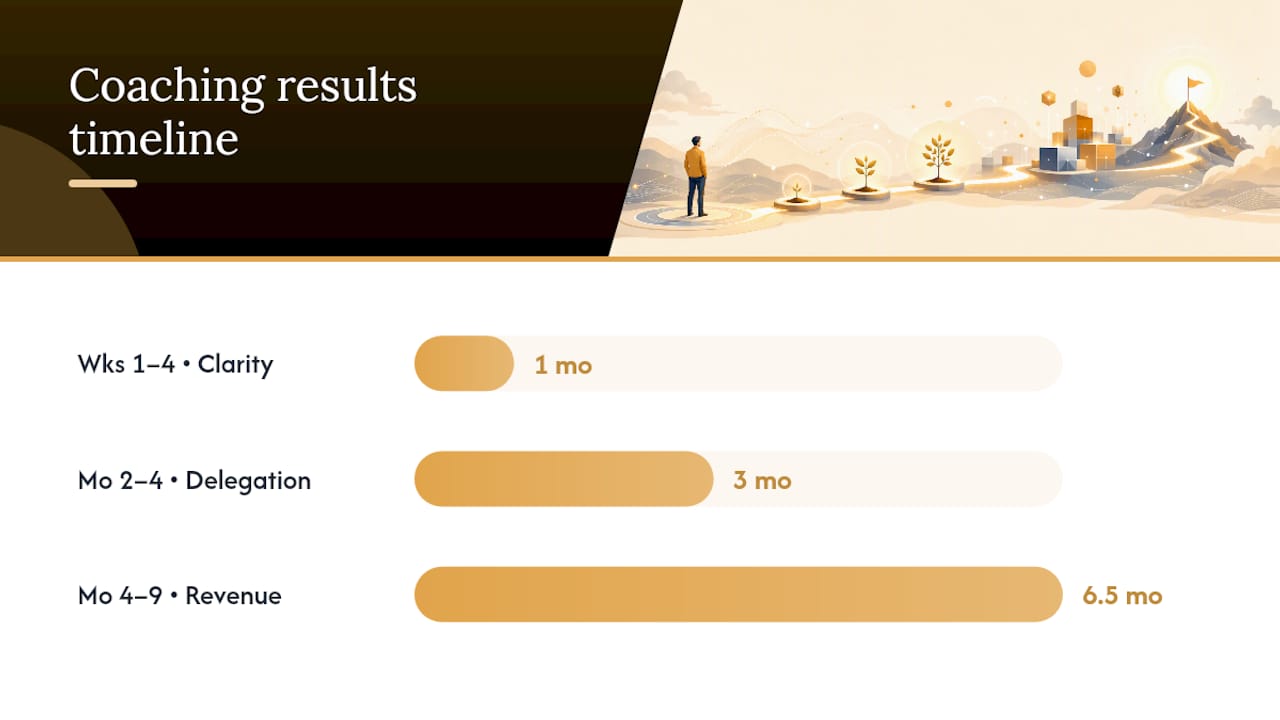
Practitioner sources consistently point to a 90-day cycle as the sensible first checkpoint, since it's long enough for implementation to actually happen but early enough to catch a bad-fit engagement before real money is wasted.
If your 90-day review shows no movement on clarity, hours reclaimed, or your leading operational KPI, that's the signal to change something: the deliverables, the cadence, or the coach.
- Weak week 1 to 4 signals: no change in decision speed, no written action plan
- Weak month 2 to 4 signals: no new systems in place, no delegation attempted
- Weak month 4 to 9 signals: flat revenue and margin despite consistent implementation elsewhere
What Determines Whether Coaching Actually Works?
Three things separate a transformative engagement from an expensive chat: what you bring, who you hire, and how the engagement is structured.
On your end, results track closely with your willingness to execute between sessions, your actual capacity to implement (time, staff, cash), and whether you agreed on KPIs before session one. Implementation-focused coaching, the kind with homework and accountability checks, tends to close the gap between advice given and advice acted on far better than advice-only conversations ever do.
On the coach's end, vet for operating experience at your specific business stage. A coach who has never run a business your size is guessing at what's realistic for you. Ask how they hold you accountable, and ask whether they can extend coaching to your team, not just to you personally.
Engagement design matters just as much:
- 90-day cycles with a defined start and review point
- Written deliverables after each session, not just verbal advice
- A measurement tool or template agreed on upfront
- Team inclusion where the business depends on more than the owner
Pro Tip: Ask a prospective coach to show you a real before-and-after KPI summary from a past client. If they can't produce one, they're not measuring their own results either.
What Are the Red Flags of an Unreliable Business Coach?
Guaranteed revenue promises and 30-day transformation claims are the two biggest tells that a coach is selling hope, not a process. No credible coach can guarantee your revenue, because your results depend on variables outside their control, including your own execution.
Watch for these on top of that:
- No documented KPI list before you sign
- No case studies with actual before-and-after numbers, only testimonials
- Refusal to agree on a review cadence (90 days, minimum)
- Can't describe operating experience at a business stage similar to yours
Ask for a baseline-to-outcome summary from a past client and a reference you can actually call. A coach with real results will hand both over without hesitation.
What Real Coaching Engagements Get Right About Measuring Success
We run every engagement on 90-day cycles because that's how long it takes to separate real implementation from good intentions. Early wins look like faster decisions and reclaimed hours. The financial hit comes later, usually months four through nine, and only if the early indicators were strong. AI-enabled tracking and a deliberately limited client roster are what let us actually catch the gap early instead of finding out at renewal time.

How Champion Business Coaching Builds Measurable Engagements
If you've read this far, you already know the difference between a coach who talks about results and one who measures them. That's the whole premise behind Champion Business Coaching: every engagement runs on a 90-day coaching guarantee, meaning you get real results or your coaching session is free. No vague promises, no guesswork about whether it's working.
The engagement structure itself does the heavy lifting. You get baseline KPIs set in week one, AI-enabled tools for cash flow forecasting and team management built into the coaching, and a client roster kept deliberately small so measurement doesn't get lost in volume. That last point matters more than it sounds. A coach juggling forty clients isn't reviewing your numbers monthly. Ours is.
If you're ready to see what a measurement-first engagement looks like for your business, book a free consultation or compare coaching plans to see which structure fits your stage and goals.
Sources
- A systematic review and meta-analysis of the effectiveness of business coaching interventions
- Is executive coaching worth it? What the evidence says
- Business coaching ROI: essential metrics to measure success