
A six-step business action plan is the fastest way to move from a goal written on a whiteboard to work actually getting done. Here is the checklist you need right now:
- Set a SMART goal
- List granular tasks
- Allocate resources (people, budget, tools)
- Prioritize and sequence tasks
- Assign owners and deadlines
- Monitor, review, and revise
Your next 15 minutes: Write your single most important business goal at the top of a blank page, then list every task you can think of that moves it forward. That rough list is the raw material for everything that follows.
Key Takeaways
A six-step action plan, reviewed on a weekly and monthly cadence, is the most reliable way for Australian small businesses to convert goals into measurable results.
| Point | Details |
|---|---|
| Six steps, in order | Set a SMART goal, list tasks, allocate resources, prioritize, assign owners, then monitor and revise. |
| One owner per task | Named individuals, not teams, drive accountability and execution. |
| Three deadline tiers | Document optimal, acceptable, and unacceptable deadlines to speed decisions when delays hit. |
| Review cadence is non-negotiable | Weekly stand-ups and monthly KPI reviews keep the plan live; without them, it becomes a historical document. |
| Championbusinesscoaching | Provides structured 90-day coaching programs and interactive tools to help Australian businesses build and execute action plans with a results guarantee. |
Table of Contents
- What is a business action plan, and how is it different from a to-do list?
- Why a written action plan actually changes outcomes
- Who should write an action plan, and when?
- The 6 business action plan steps, explained in full
- A copyable template and a worked 30/60/90 example
- Action plan vs. project plan vs. to-do list: which one do you need?
- The top mistakes that kill action plans, and how to fix them
- Why most action plans stay on paper
- Championbusinesscoaching turns your action plan into real results
- Sources
What is a business action plan, and how is it different from a to-do list?
A business action plan is a structured document that connects every task to a measurable objective, assigns a named owner to each task, and sets a deadline and a review cadence. A to-do list does none of that. It is just a collection of things someone intends to do, with no link to a goal and no accountability built in.
Asana's action plan guide puts it well: managers who treat an action plan as a "North Star" for daily execution get fundamentally different results from teams that work off an unorganized checklist. The difference is not cosmetic. When every task traces back to a measurable outcome, the team knows what to skip when time runs short.
A project plan is a different tool again. Where an action plan covers a single goal or initiative (often on one page), a project plan governs a complex, multi-workstream effort with formal scope, budget, risk registers, and change-control processes. Think of the three tools this way:
To-do list: personal, unstructured, no owner beyond yourself, no KPI.
Action plan: goal-specific, one to three pages, named owners, deadlines, KPIs, and a review cadence. Right-sized for most small-business initiatives.
Project plan: multi-phase, multi-team, formal governance. Use it when the initiative spans more than three months, involves external contractors, or carries significant financial or compliance risk.
Common scenarios where an action plan is exactly the right tool: launching a new service line, fixing a recurring operational bottleneck, or hitting a quarterly revenue target.
Why a written action plan actually changes outcomes
The core benefit is accountability. When a task has a named owner and a deadline, it gets done at a measurably higher rate than when it sits on a shared list with no one's name attached. Beyond that, a written plan forces resource reality checks before work starts, not after the budget runs out.
The benefits stack up quickly:
- Clarity: every team member knows what they are responsible for and why it matters.
- Accountability: named ownership removes the "I thought someone else was handling it" problem.
- Resource planning: listing what you need before you start surfaces gaps early.
- Prioritization: sequencing tasks prevents the team from working on low-impact items while high-impact ones stall.
- Measurable progress: KPIs and status fields let you see whether you are on track without calling a meeting.
Atlassian's project planning guide notes that action plans break high-level goals into specific, manageable tasks with owners, deadlines, and progress tracking, and that a clear monitoring cadence (weekly or monthly reviews) is what keeps the plan alive rather than gathering dust.
The alignment angle matters too. Day-to-day work in a small business can drift fast. A written action plan anchors every task to a strategic objective, so when a new opportunity or distraction appears, you have a concrete reference point for deciding whether to pursue it or park it.
Who should write an action plan, and when?
Business owners, operations managers, marketing leads, and small team leaders all benefit from a written action plan. The tool scales down to a solo operator running a trades business and scales up to a management team of ten coordinating a product launch.
Three scenarios where an action plan is the right call:
Launching something new. A new service, product, or market entry has a clear goal, a finite set of tasks, and a deadline. An action plan keeps the launch on track without the overhead of full project governance.
Fixing an operational problem. Cash flow is tight, customer complaints are spiking, or a key process keeps breaking. An action plan assigns specific fixes to specific people with specific deadlines, which is exactly what a vague "we need to improve this" conversation cannot do.
Hitting a growth target. Revenue is flat and you want to add $150,000 in annual turnover within 12 months. An action plan breaks that number into monthly milestones, assigns the marketing and sales tasks that drive it, and gives you a weekly check-in structure.
When not to use a short action plan: if the initiative involves multiple external contractors, spans more than a financial year, carries regulatory compliance obligations (such as a major NDIS service expansion or a construction project with council approvals), or requires formal change control, you need a full project plan, not a one-pager. An action plan used in that context will leave critical dependencies and risks undocumented.
The 6 business action plan steps, explained in full
The Asana framework and MindTools' action planning guide both converge on the same six steps. Here is how to work through each one with practical prompts you can copy.
Step 1: Set a SMART goal
SMART stands for Specific, Measurable, Achievable, Relevant, and Time-bound. Every word in your goal statement should earn its place.
SMART template: [Action verb] + [specific outcome] + [measurable quantity] + [by when].
Sample goal: "Increase monthly recurring revenue from $42,000 to $52,000 by September 30, 2026."
Mini-checklist:
- Does the goal name a specific number or outcome?
- Is there a clear deadline?
- Is it realistic given current resources?
- Does it connect to a broader business objective?
Pro Tip: Write the goal in one sentence. If you need two sentences, the goal is probably two goals. Split them and plan each separately.
Step 2: Identify granular tasks
Break the goal into the smallest tasks that can be assigned to one person and completed in one to five days. Use an action verb to start every task: "Draft," "Call," "Build," "Send," "Review." Vague tasks like "Work on marketing" cannot be tracked or handed off.
Mini-checklist:
- Does each task start with an action verb?
- Can one person complete it without depending on an unresolved upstream task?
- Is it small enough to fit in a one-week sprint?
- Have you captured every task, including the ones that feel obvious?
Pro Tip: Run a five-minute "what could block this?" check on each task before you finalize the list. Hidden dependencies surface here, not mid-sprint.
Step 3: Allocate resources
List what each task needs: the person doing it, the budget required, and the tools or materials involved. Be specific. "Marketing budget" is not a resource allocation. "$2,000 for Google Ads in July" is.
Mini-checklist:
- Is a named person (not just a role) assigned to each task?
- Is the budget estimate based on a real quote or past spend?
- Are the tools or software already available, or does someone need to procure them?
- Have you accounted for time as a resource (hours per week)?
Step 4: Prioritize and sequence tasks
Not all tasks are equal. Two frameworks help here. The Eisenhower matrix sorts tasks by urgency and importance, which helps you decide what to do now, what to schedule, what to delegate, and what to drop.
Dependency mapping is the other half of sequencing. Draw a simple arrow from any task that must finish before another can start. This prevents the team from working on step five while step two is still blocked.
Mini-checklist:
- Have you identified the two or three tasks with the highest impact?
- Are dependencies mapped so no one starts a blocked task?
- Is the sequence logical from the perspective of the person doing the work?
- Have you removed or deferred low-priority tasks that would dilute focus?
Step 5: Assign owners and set deadlines
Every task gets one named owner, not a team or a department. "Sales team" owns nothing. "Priya" owns something. For critical tasks, name a backup owner in case the primary is unavailable.
Project Planning Templates' business action plan template recommends building three deadline tiers into your plan: optimal (the date you want), acceptable (the latest date that keeps the plan on track), and unacceptable (the date at which the goal is at risk). This makes trade-off conversations fast when delays happen, because the threshold is already defined.
Mini-checklist:
- Is there one named person per task?
- Is there a backup owner for high-risk tasks?
- Are the three deadline tiers documented?
- Has the owner confirmed they can meet the deadline given their other commitments?
Pro Tip: Ask each owner to confirm their deadline verbally or in writing. A deadline set without the owner's input is a deadline the owner does not feel responsible for.
Step 6: Monitor, review, and revise
A plan without a review cadence is a document, not a management tool. Atlassian recommends weekly stand-ups for task-level progress, monthly KPI reviews to check whether the goal is on track, and quarterly pivots to adjust the plan to market or business changes.

At each review, ask three questions: What is on track? What is blocked and why? What needs to change in the plan? Update the status column in your template after every review so the document stays current.
Mini-checklist:
- Is a weekly check-in scheduled and recurring?
- Is a monthly KPI review in the calendar?
- Is there a clear process for escalating a blocked task?
- Does the plan get updated after every review, not just at the quarterly pivot?
A copyable template and a worked 30/60/90 example
The template fields
A solid action plan template covers these columns, as recommended by Atlassian's action plan guide and Project Planning Templates:
| Field | What to put here |
|---|---|
| Goal | One SMART goal statement |
| KPI | The metric that proves the goal is achieved |
| Task | Action-verb task description |
| Owner | Named individual (not a team) |
| Backup owner | Named individual for critical tasks |
| Dependencies | Tasks that must finish first |
| Deadline (optimal) | Date you want it done |
| Deadline (acceptable) | Latest date that keeps the plan on track |
| Resources needed | Budget, tools, people-hours |
| Status | Not started / In progress / Complete / Blocked |
| Notes | Blockers, decisions, or context |
Who owns the live document: one person, usually the business owner or operations manager, is responsible for updating the status column after every review. Everyone else reads it; one person maintains it.
Worked 30/60/90 example: Australian service business
Business: A plumbing business in Brisbane with four staff, targeting $30,000 in new residential contract revenue over 90 days.
Goal: Secure 15 new residential maintenance contracts worth a combined $30,000 by the end of the 90-day period.
KPI: Number of signed contracts; total contract value in AUD.
A 30/60/90 structure organizes goals and deliverables across three 30-day periods, each with specific tasks and milestones.
Days 1–30 (Foundation)
First-week checklist (Days 1–7):
- Prospect list started and assigned
- Contract template drafted and sent to lawyer
- Google Business Profile claimed and optimized
Days 31–60 (Build) Focus shifts to converting warm leads. Run two quote appointments per week, refine the pitch based on objections heard in month one, and ask every signed client for a referral. Target: 6 contracts signed by Day 60.
Days 61–90 (Scale) Activate referral network, run a targeted Facebook ad ($500 budget) to the same suburbs, and close the remaining 6 contracts. Review the full plan at Day 90 against the KPI.
Business Victoria's one-page action plan template recommends posting the one-page version in a high-visibility area so the whole team stays aligned without needing a meeting to check in.
Action plan vs. project plan vs. to-do list: which one do you need?
| Dimension | To-do list | Action plan | Project plan |
|---|---|---|---|
| Purpose | Personal task capture | Goal-specific execution | Complex initiative governance |
| Scope | Single person, open-ended | One goal, one to three pages | Multi-team, multi-phase |
| Key fields | Task description | Task, owner, deadline, KPI, resources, dependencies | Scope, budget, risk register, change control |
| Typical cadence | Ad hoc | Weekly stand-up, monthly KPI review | Formal milestone reviews |
| Best for | Daily personal workflow | Business goal, operational fix, launch | Multi-contractor project, compliance-heavy initiative |
Decision rule: if your initiative has one clear goal, a named team of fewer than ten people, and a timeline under six months, an action plan is the right tool. When the initiative grows beyond those boundaries, or when external stakeholders require formal reporting, graduate to a project plan.
The graduation trigger is usually one of three things: a second funding source enters the picture, a regulatory body requires documented milestones, or the number of interdependent workstreams makes a one-page format unworkable.
The top mistakes that kill action plans, and how to fix them
Most action plans fail for the same predictable reasons. Here is what to watch for:
- Vague goals. "Grow the business" is not a goal. Fix: apply the SMART template from Step 1 before anything else gets written.
- No named owner. Tasks assigned to "the team" get done by no one. Fix: one name per task, confirmed by that person.
- Too many simultaneous priorities. Trying to run five initiatives at once means none get the attention they need. Fix: limit active priorities to three at any one time.
- Missing resource estimates. Starting a task without confirming the budget or tool access is available creates mid-sprint blockers. Fix: complete the resources column before the plan goes live.
- No review cadence. A plan reviewed once at the start and never again is a wish list. Fix: put weekly and monthly reviews in the calendar on day one.
- Unclear KPIs. "Improve customer satisfaction" cannot be tracked. Fix: name the specific metric and the target number.
- Ignored dependencies. Starting a task that depends on an unfinished upstream task wastes time and creates rework. Fix: map dependencies in Step 4 and check them at every weekly stand-up.
For tooling: a shared Google Sheet or Notion table handles most small-business action plans well. A kanban board (Trello or a similar tool) works when tasks move through clear stages. Upgrade to a dedicated project management platform when you have more than three concurrent plans, more than ten active tasks per plan, or when you need automated reminders and reporting.
Why most action plans stay on paper
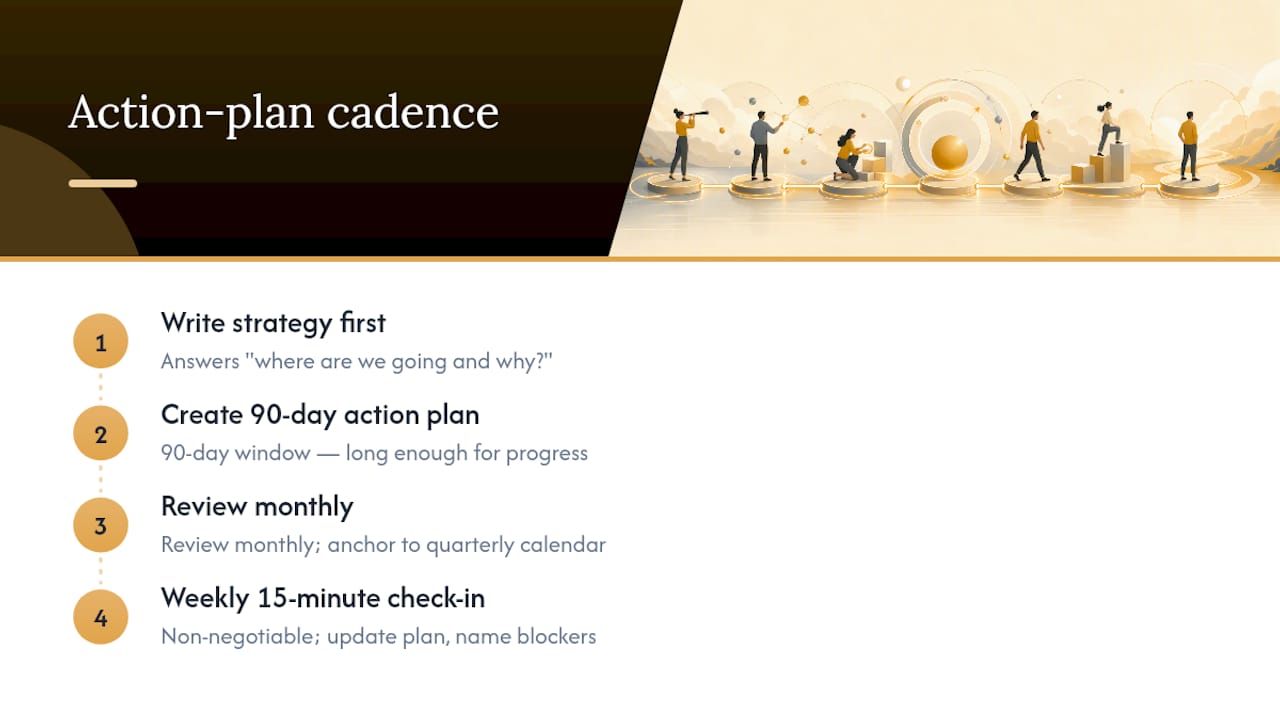
Here is an opinion that most planning guides skip: the six steps are not the hard part. The hard part is the review cadence.
Australian small businesses tend to run on a quarterly rhythm, shaped by BAS lodgement dates, end-of-financial-year reporting, and the natural peaks and troughs of the local market. That rhythm is actually an asset. If you anchor your action plan reviews to the same calendar events your business already tracks, the reviews happen because the calendar forces them, not because someone remembered to schedule them.
What I see consistently in coaching Australian SMBs is that the businesses that execute well are not the ones with the most detailed plans. They are the ones where the owner has made the weekly check-in non-negotiable, even when it is just 15 minutes. The plan gets updated, blockers get named, and the team stays aligned. The businesses that struggle have detailed plans and irregular reviews. The plan becomes a historical document rather than a live tool.
There is also a common mistake in how people think about the action plan versus the strategy. The strategy answers "where are we going and why?" The action plan answers "who does what by when?" Conflating the two produces documents that are too abstract to execute and too operational to inspire. Keep them separate. Write the strategy first, then write the action plan that serves it. The business improvement practices that produce real results in Australian SMEs almost always have this separation clearly in place.
The 90-day window is not arbitrary either. It is long enough to show meaningful progress on a real business goal and short enough that the environment has not changed so much that the plan is obsolete. For most small Australian businesses, a rolling 90-day action plan reviewed monthly is the right cadence.
Championbusinesscoaching turns your action plan into real results
Writing a plan is one thing. Executing it under the pressure of running a business is another. Championbusinesscoaching works with Australian business owners and managers to build clear, realistic action plans and then holds them accountable to the review cadence that makes those plans stick.

The coaching programs include one-on-one sessions, structured 90-day programs, and access to interactive business tools including cash flow forecasting and position description generators. Every engagement comes with a 90-day guarantee: if you do not see results, your coaching session is free. Slots are limited to keep the coaching environment focused and the results consistent.
If you are ready to move from planning to execution, book a free consultation and get a coaching plan built around your specific goal. Or browse the coaching packages to find the format that fits your business.
Sources
The following sources informed this guide and are worth reading directly for templates, deeper frameworks, and worked examples.
- Action plan: learn what it is and how to create one (Asana)
- How to write an action plan in project management (Atlassian)
- Action planning: how to create an action plan (MindTools)
- One-page action plan template (Business Victoria)
- IC-Sample-30-60-90-Day-Action-Plan (Smartsheet PDF)
- Business Action Plan Template | Project Planning Templates