
Branding for small business is the process of defining and expressing your unique value through a consistent visual and messaging system that makes your business memorable and easy to choose. Most small business owners treat branding as a logo purchase. That is the wrong starting point. Consistent brand presentation can increase revenue by up to 33%, and customers typically need to see a brand about seven times before they recall it. Those two facts alone explain why scattered, inconsistent branding costs you money every single week. The industry term for this full system is brand identity, and it covers everything from your color palette to the words you use on a quote form.
What does branding for small business actually mean?
Brand identity is not a logo. It is the complete system of visuals, language, and behavior that tells the market who you are and why you are the right choice. A logo is one element inside that system, the same way a front door is one element of a house.
Small business owners often skip strategy and go straight to design. The result is a logo that looks fine but does nothing commercially. Effective branding is about building mental availability, which means being the first business a customer thinks of when they need what you sell. That is a strategic goal, not a design goal.

The biggest misconception is that branding is about looking bigger than you are. Effective branding is about clarity, trust, and human connection, not scale. A sole trader who communicates a clear promise consistently will outperform a larger competitor with a polished but vague identity.
How do you define your brand story and identity?
Brand strategy starts with three questions: Who do you serve? What do you do differently? And when do customers actually need you?
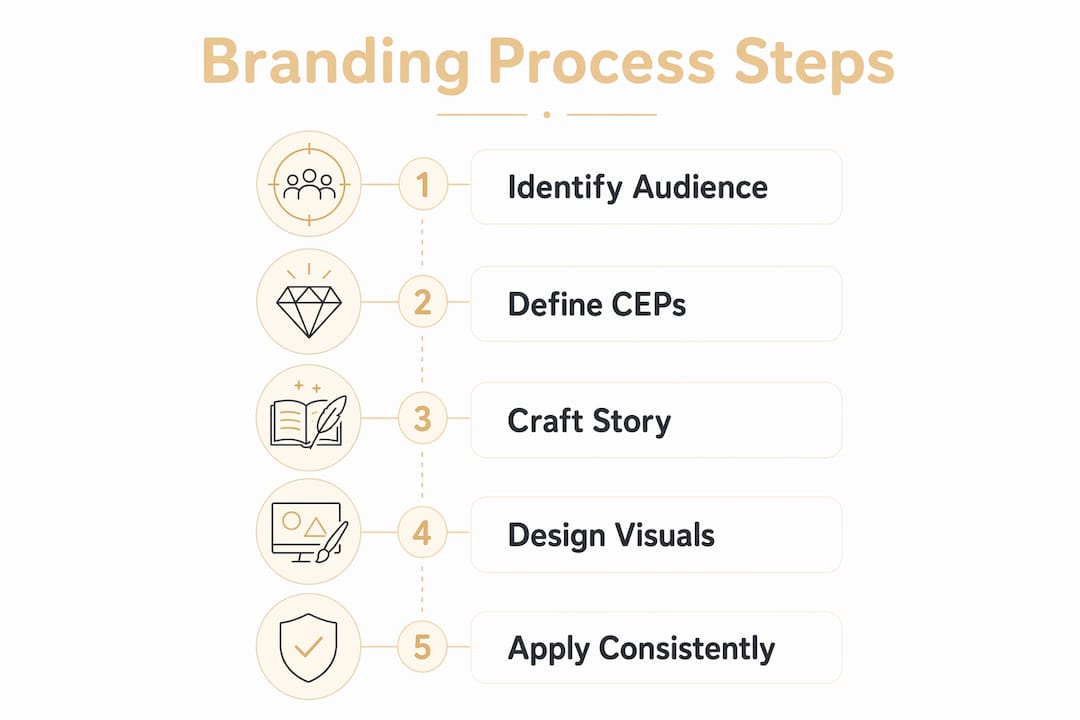
That last question points to a concept called Category Entry Points, or CEPs. CEPs are the specific triggers that prompt a customer to seek your service, such as "my hot water system just failed" or "I need a quote before the weekend." Defining your CEPs before touching any design work is the critical foundation. Without them, your visual identity has no commercial anchor.
Once you know your CEPs, write a single brand story statement. Keep it to two or three sentences. It should name who you serve, what problem you solve, and what makes your approach different. Every design and messaging decision flows from that statement.
Most small businesses struggle by trying to be the best generally, rather than the first thought of in specific buying moments. Narrow your positioning. A plumber who owns "emergency hot water Gold Coast" in the customer's mind wins more calls than one who claims to do everything.
Pro Tip: Write your brand story statement on a sticky note and put it next to your monitor. Every time you create content, a quote, or a social post, check that it matches the statement.
- Identify your three most common customer buying triggers
- Write one sentence describing who you serve and what you solve
- Name one thing you do differently from the next three businesses in your category
- Test your statement on a real customer and ask if it sounds like you
How do you build a visual identity that people remember?
Visual identity is the set of design elements that make your business instantly recognizable. Color, typography, and logo format are the three pillars.
Color does more work than most owners realize. A specific color palette, defined by exact hex codes, creates recognition across every touchpoint. Choosing colors without hex codes means your printer, your web designer, and your social media manager will all use slightly different shades. That inconsistency erodes recognition over time.
Typography follows the same logic. Two fonts are optimal for brand consistency: one display font for headings and one body font for text. More than two fonts create visual noise. Fewer than two limit your ability to create hierarchy on a page.
Your logo needs to work at every size, from a business card to the side of a van. SVG format is the correct file type for logos because it scales without losing quality, unlike JPEG or PNG files. Simple logos outperform complex ones for small businesses because they reproduce cleanly at small sizes and on low-resolution surfaces.
Document all of this in a one-page brand guide. A simple brand guide with your brand story, color codes, font pairings, logo variations, and tone notes is all you need to keep every piece of communication consistent.
| Visual element | What to define | Why it matters |
|---|---|---|
| Color palette | 2–3 colors with exact hex codes | Ensures consistency across print and digital |
| Typography | One display font, one body font | Creates hierarchy without visual noise |
| Logo formats | SVG, PNG on white, PNG on dark | Covers every application without quality loss |
| Tone of voice | 3 words describing how you sound | Keeps written communication on brand |
How do you apply your branding across every customer touchpoint?
Consistency is the mechanism that turns a brand into a memory. Every time a customer sees your colors, your logo, and your message in the same combination, the memory trace gets stronger.
The digital touchpoints are your website, your social media profiles, your email signature, and your Google Business Profile. All four should use identical colors, fonts, and profile images. A customer who finds you on Instagram and then visits your website should feel like they are in the same place.
Physical touchpoints carry equal weight, especially for trade and service businesses. A single wrapped commercial vehicle generates 30,000 to 70,000 impressions per day. That is a moving billboard working for you while you drive to jobs. The return on a vehicle wrap compounds over years, not weeks.
Pro Tip: Create a simple checklist of every place your brand appears, from your invoice template to your voicemail greeting. Audit each one against your brand guide every six months.
Here is a practical sequence for applying your brand across touchpoints:
- Update your Google Business Profile with your correct logo, colors, and brand description.
- Apply your color palette and fonts to your website header, buttons, and footer.
- Align all social media profile images and cover photos to your brand guide.
- Update your email signature with your logo in SVG or high-resolution PNG format.
- Brief any vehicle signage or uniform supplier with your exact hex codes and logo files.
- Review your invoice, quote, and proposal templates and apply your fonts and colors.
Consistent visual identities allow small businesses to charge premium prices and shorten their sales cycles. Customers who recognize your brand before you quote them already trust you more. That trust translates directly into fewer price objections.
What are cheap branding solutions for small business owners?
Budget is the most common reason small business owners delay branding. The good news is that strategy costs far less than execution, and strategy is where most of the commercial value lives.
A full branding package for a small service business, including strategy, visual identity, and vehicle wraps, runs between $14,000 and $17,000 with a professional agency. A brand identity package without wraps costs $10,000 to $11,500. Those figures are realistic for a complete professional job, but they are not the only path.
A hybrid branding approach pairs a professional strategy session with internal execution. You pay a strategist or coach to define your positioning, CEPs, and brand story. Then you use that brief to guide a freelance designer or a DIY tool for the visual execution. This approach cuts cost significantly while preserving the strategic foundation that makes everything else work.
Tools like Canva Pro give you access to brand kit features where you can lock in your hex codes and fonts. That keeps every piece of content on brand without needing a designer for every post. Free resources like Google Fonts cover the typography side for most small businesses.
- Spend your first dollar on strategy, not on a logo
- Use a freelance designer from a platform like 99designs or Dribbble for logo work once your brief is clear
- Lock your brand colors and fonts into Canva Pro's brand kit feature
- Get your logo in SVG format from day one, even if you use a budget designer
- Download free small business resources to build your brief before hiring anyone
What are the most common branding mistakes small businesses make?
The most expensive branding mistake is buying a logo before defining a strategy. A logo without a brand story is decoration. It cannot communicate your positioning or trigger the right buying associations in a customer's mind.
"The biggest misconception is that branding is about looking bigger. Effective branding is about clarity, trust, and human connection. Small businesses that chase the appearance of scale end up with a polished identity that says nothing specific to anyone."
The second most common mistake is inconsistency. Using three different shades of blue, two different fonts, and four different logo versions across your touchpoints tells the customer's brain that these are different businesses. Recognition requires repetition of the same elements.
Ignoring CEPs is the third critical error. If you do not know the specific moments when customers decide to search for your service, you cannot position your brand to be present in those moments. Your brand should answer the customer's question before they finish asking it.
- Buying a logo before writing a brand story statement
- Using inconsistent colors or fonts across print and digital
- Trying to appeal to everyone instead of owning a specific position
- Failing to document your brand assets in a shareable guide
- Not protecting your logo files, which means starting from scratch when a designer leaves
Key Takeaways
Strong branding for small business requires strategy before design, consistency across every touchpoint, and a clear understanding of when and why customers choose you.
| Point | Details |
|---|---|
| Strategy before design | Define your CEPs and brand story before commissioning any visual work. |
| Consistency drives recall | Customers need roughly seven exposures to a brand before they remember it. |
| Visual identity is a system | Color codes, two fonts, and SVG logos form the foundation of a recognizable brand. |
| Budget does not block branding | A hybrid approach, professional strategy plus DIY execution, delivers results at lower cost. |
| Document everything | A one-page brand guide keeps every team member and supplier on the same page. |
Why I think most small businesses are branding in the wrong order
After working with hundreds of small business owners across Australia, the pattern is always the same. The owner spends $500 on a logo, then $2,000 on a website, then wonders why nothing feels cohesive and the phone is not ringing more.
The order is wrong. Design without strategy is just decoration. The businesses I have seen grow fastest are the ones that spent their first hour writing down who they serve, what triggers those customers to buy, and what makes their offer the obvious choice. That clarity costs nothing except time, and it makes every dollar spent on design work harder.
Small businesses have a genuine advantage over large corporations. They can be specific, personal, and human in ways that a national brand cannot. A local tradie who shows up in branded gear, drives a wrapped van, and sends a quote on a professional template is not trying to look like a big company. They are communicating reliability and care. That is what wins jobs.
The risk of skipping brand strategy is not just a weak logo. It is a business that competes on price because it has given customers no other reason to choose it. Building a brand that owns a specific position in the customer's mind is the most durable competitive advantage a small business can build. It compounds over time the same way a reputation does.
— Duncan
How Championbusinesscoaching helps you build a brand that works
Championbusinesscoaching works with small business owners across Australia to clarify their positioning, define their brand story, and build the systems that turn a good idea into a recognized business. The coaching process starts with strategy, not aesthetics, so every dollar you spend on design and marketing lands on a solid foundation.
Championbusinesscoaching's tailored coaching plans cover brand strategy, growth planning, and execution support, all backed by a 90-day results guarantee. If you are ready to build a brand that attracts better customers and commands better prices, book a coaching session and get a clear plan within your first call. Rated 5 stars on Google by business owners who have been through the process.
FAQ
What is the difference between a logo and a brand?
A logo is one visual element inside a brand identity system. A brand includes your positioning, your messaging, your color palette, your typography, and the experience customers have at every touchpoint.
How many times does a customer need to see my brand before they remember it?
Customers need approximately seven exposures to a brand before they recall it. That number makes consistency across every touchpoint a commercial priority, not a design preference.
What should I spend my first branding budget on?
Spend it on strategy first. Defining your Category Entry Points and brand story before any design work means every dollar spent on visuals has a clear commercial purpose behind it.
Can I build a recognizable brand on a tight budget?
A hybrid approach works well for budget-conscious owners. Hire a professional for the strategy session, then use that brief to guide a freelance designer or a tool like Canva Pro for execution.
How do I keep my brand consistent across my team?
Create a one-page brand guide that includes your hex color codes, font names, logo file links, and tone of voice notes. Share it with every designer, printer, and team member who creates anything under your business name.